

Observing the ocean’s color change has a subtle, unsettling quality. It wasn’t a dramatic overnight change, nor was it particularly noticeable. Instruments orbiting hundreds of kilometers above the water record the slow process, which is measured in light wavelengths. Nevertheless, Stephanie Dutkiewicz at MIT did not feel relieved to be proven correct when she examined what the satellites had been telling her for years. She described it as frightening.
Approximately 36% of the world’s open ocean, or an area close to 122 million square kilometers, has seen discernible color changes, according to data collected between 1998 and 2022. What was once a deep, clear blue is now trending toward light blue or green in 25% of cases. An additional 11% has become even more blue, primarily in the vicinity of the equator. You wouldn’t notice these significant visual shifts from a beach. However, satellites take notice. Additionally, what they are detecting is consistent with what scientists have been modeling and fearing for some time.
The ocean’s hue is not random. In essence, it is a mirror of the life that exists close to the surface. Ocean water that is pure, open, and devoid of biological activity appears deep blue; light absorbs cleanly and reflects back very little. The picture changes when you introduce phytoplankton, those microscopic photosynthetic organisms. Their chlorophyll draws the water toward the algae-tinged color you see in coastal areas or colder, nutrient-rich seas by absorbing blue light and reflecting green. The water turns green where phytoplankton is abundant. It blues where they thin out. To put it another way, the color is a census.
A redistribution of that census is what the satellites have captured over the past 25 years. The increasing greenness of the polar regions, especially in the northern hemisphere, indicates the movement or intensification of phytoplankton. Chlorophyll is disappearing from the historically productive subtropical regions. Researchers at Duke University applied the Gini index, an economics concept commonly used to quantify wealth inequality, to the distribution of chlorophyll in the ocean. The analogy is surprisingly accurate: the biological “wealth” of the ocean is draining from some places and concentrating in others, and the pattern is not arbitrary.
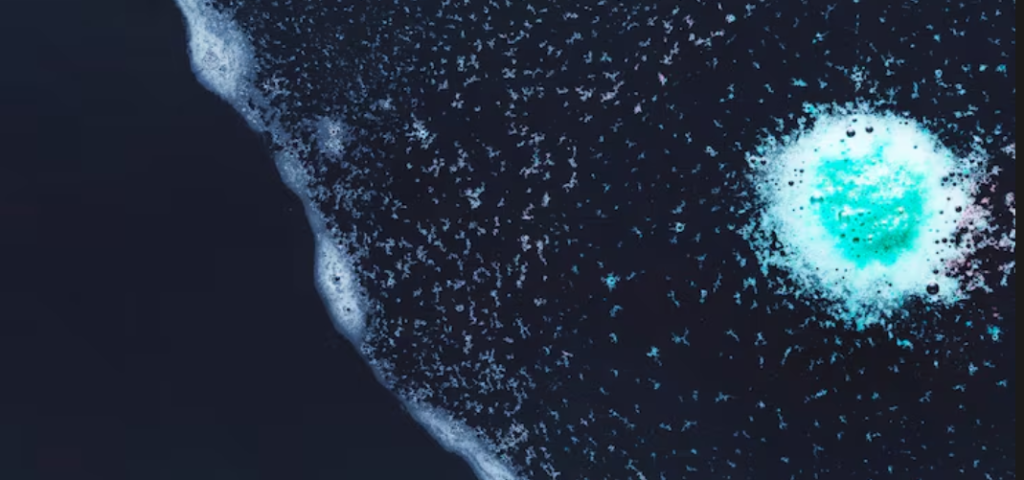
The primary cause seems to be rising sea surface temperatures. Although the mechanics are complicated, the reasoning is straightforward: water stratifies more sharply as oceans warm. The mixing between layers, which typically brings nutrients to the surface, slows down as warmer water sits on top and colder water remains below. Phytoplankton can flourish when fewer nutrients reach the sunlit zone. This indicates that the blue gets deeper in the subtropics. In the meantime, phytoplankton are extending their range in response to the warming of polar waters, which were previously too cold for much biological activity.
The precise effects of this reorganization on the larger food web are still unknown. Nearly every organism in the ocean, including fish, whales, seabirds, and the entire structure of marine life, depends on or passes through phytoplankton. This is not merely an ecological issue because different phytoplankton species absorb and sequester carbon at varying rates. It directly contributes to the amount of carbon dioxide that the ocean extracts from the atmosphere, which has long been one of the planet’s more subdued defenses against global warming. You may alter the effectiveness of that buffer by altering the composition of phytoplankton communities, which could have unpredictable effects.
For years, Dutkiewicz has been using simulations to predict precisely this type of color drift. It is not particularly consoling to see it validated by twenty years of actual satellite data. Reading the research gives one the impression that science is witnessing a slow-motion tipping point—not an abrupt disaster, but a slow, compounding change whose full ramifications are still being worked out. From a shoreline, the ocean appears essentially the same to the human eye. However, the satellites don’t blink, and what they see is an ocean that is changing.
