

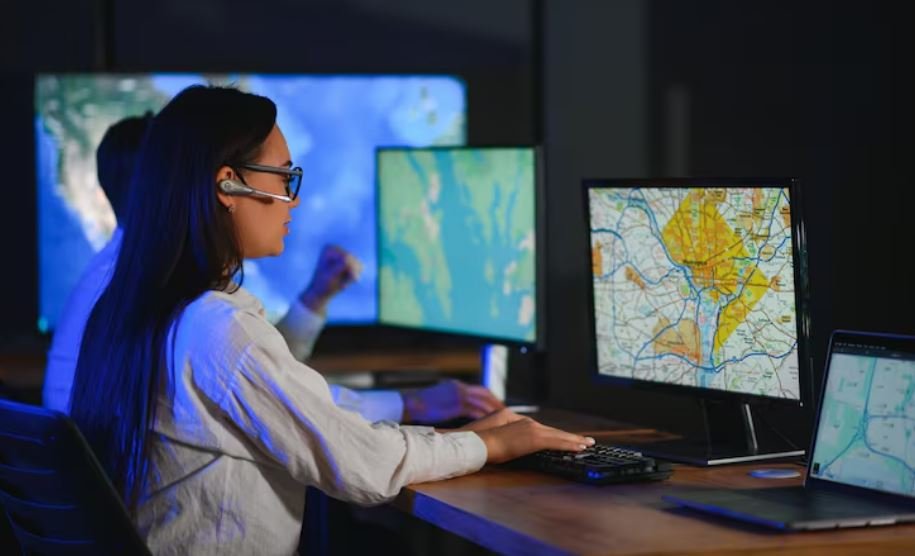
A small group of scientists work around the clock in a building in Boulder, Colorado, keeping an eye on the sun. Through data streams, magnetometers, X-ray flux charts, and satellite feeds that arrive from almost a million miles away—not through telescopes in the romantic sense. The Space Weather Prediction Center is unfamiliar to the majority of Americans. However, on any given day, over 500,000 people surreptitiously visit its website to check numbers that determine whether a GPS-guided tractor operates in a cornfield, whether a satellite operator needs to reposition an asset before a storm arrives, or whether tomorrow’s polar flight is rerouted.
That’s a big deal. That’s just not how it’s discussed. Technically, one of nine National Centers for Environmental Prediction is NOAA’s Space Weather Prediction Center, or SWPC for those interested in solar-terrestrial physics. Beneath layers of federal acronyms, it operates in tandem with the U.S. Air Force. However, its role is more urgent than bureaucratic: it monitors the sun in real time, sends out alerts when coronal mass ejections are approaching Earth, and provides power grid operators, aviation dispatchers, NASA mission controllers, and emergency managers with the few hours of notice necessary to make decisions that could save or cost hundreds of millions of dollars.
Once you start pulling on the thread, the extent of reliance on SWPC is truly shocking. For each polar flight that dispatchers clear, the FAA mandates that they account for SWPC solar radiation alerts. A carrier may have to pay up to $100,000 for a single rerouting caused by high-frequency radio blackouts. This is precisely why 25 different flights were diverted over a 23-day period in 2001. The robotic arm on the International Space Station, a piece of hardware worth about $1 billion, is protected by NASA using SWPC data.
In order to prepare for possible grid disruptions, rural electric cooperatives in states like Minnesota rely on space weather forecasts. The majority of people who use GPS-guided farming equipment during planting season might not be aware that solar activity can completely disrupt their signal. Farmers were left without working equipment during planting season due to GPS disruptions during the Gannon Storm in May 2024, the strongest geomagnetic event since 2003. The full extent of the financial harm caused by the postponed planting that spring is still unknown.
The lack of public recognition for this work is both remarkable and a little unsettling. Weather forecasting and climate research received a lot of media attention when the Trump administration implemented widespread layoffs at NOAA in early 2025, eliminating over 800 jobs from a workforce of roughly 13,000. They had good reason to be concerned. However, SWPC also suffered losses in the form of scientists, institutional expertise, and individuals whose careers were centered on comprehending solar wind and geomagnetic disturbance. As that happened, some solar physicists openly expressed concern about pipeline issues that had been developing for years as well as immediate capacity. Graduate students are entering the field at a lower rate than specialists retiring. It takes time for that gap to close.
Then, just this past week, a truly noteworthy event occurred with very little publicity. SOLAR-1, a satellite that launched in September 2025 and traveled for four months to the Sun-Earth Lagrange point 1, about a million miles from Earth, was declared to be in official operational service by NOAA. It is the first satellite that the US has ever put into orbit specifically for ongoing, functional space weather monitoring. Within 30 minutes of capture, its coronagraph can provide SWPC forecasters with imagery of coronal mass ejections. In contrast, transmitting similar data from the outdated SOHO observatory can take up to eight hours. These hours are the whole window between preparation and emergency in space weather forecasting, not just a convenience.
The satellite will give power grid operators more time to prepare, satellite operators more time to safeguard their assets, and aviation and national security partners more time to comprehend what’s coming, according to Clinton Wallace, director of SWPC. The story’s measured, operational, and almost modest framing most likely explains why it didn’t break through the news cycle. It lacks the drama of a moonshot or rocket launch. Infrastructure is what it is. The kind that only becomes apparent when it isn’t functioning.
The larger picture that emerges from Boulder is one of a center that, while largely invisible to the public it serves, has subtly grown indispensable to modern civilization’s reliance on technology, electricity, and space-based navigation. It’s still unclear if the staffing constraints of the previous year have permanently decreased that capacity. The fact that the sun doesn’t stop for budget cycles seems more difficult to refute.
