

Despite being the basis for almost everything in our environment, physicists hardly ever bring up this peculiar little fact at dinner parties. The two protons and two neutrons that make up a helium nucleus weigh less than the components required to construct it. Not significantly. However, it is lighter. And that missing bit of mass, when multiplied by the square of the speed of light, is what powers the reactors close to Lyon, lights the stars, and, in August 1945, flattened two cities. It’s known as nuclear binding energy, and it’s the kind of concept that, after careful consideration, begins to seem a little surreal.
The definition in the textbook is sufficiently dry. It is the amount of energy required to completely disassemble a nucleus, separating each proton and neutron until they are no longer able to sense one another. The number is positive in experimental physics because disassembling things requires effort. Since the bound nucleus has a lower energy than its scattered pieces, it is expressed as a negative in theoretical physics. Just from different sides of the doorway, the two perspectives depict the same reality.
The mass defect, or the difference between the weight of a nucleus and the weight of its constituent parts, is what makes the whole thing peculiar. That tiny difference is transformed into an astounding amount of energy by Einstein’s equation, E = mc². In a way, the mass has vanished. It is now legally binding. And because of that squared speed of light, the conversion ratio is incredibly generous. When a gram of matter is completely transformed, it releases about the same amount of energy as a mid-sized nuclear bomb. The principle holds true even though most reactions fall well short of that ceiling.
It took decades for physicists to fully explain the force that holds the nucleus together. A clump of protons should instantly fly apart because they repel one another, so the electric force is unable to accomplish this. At that scale, gravity is far too weak to be significant. The strong nuclear force, or more accurately its residual strong force, which is a sort of echo of the deeper interaction that binds quarks inside each nucleon, is what actually keeps a nucleus intact.
A few millimeters apart, two tiny magnets are nearly indifferent to one another and nearly impossible to separate while in contact. This is the analogy that physicists prefer. That is the behavior of the nuclear force, but it is more intense and unfamiliar, and its reach is so limited that it hardly reaches beyond the nucleus.
The hydrogen in a balloon does not spontaneously fuse into helium because of this limited reach. Protons never approach closely enough. Before nuclei can overcome their mutual repulsion and move into the range where the strong force takes over, you need the engineered violence of a thermonuclear device or the crushing pressure inside a star. For about 4.6 billion years, the Sun has been silently changing hydrogen into helium and releasing the binding-energy difference as heat and light. The idea that the warmth on a windowsill in the afternoon can be traced back to a mathematical trick carried out at the center of a star is difficult to ignore.
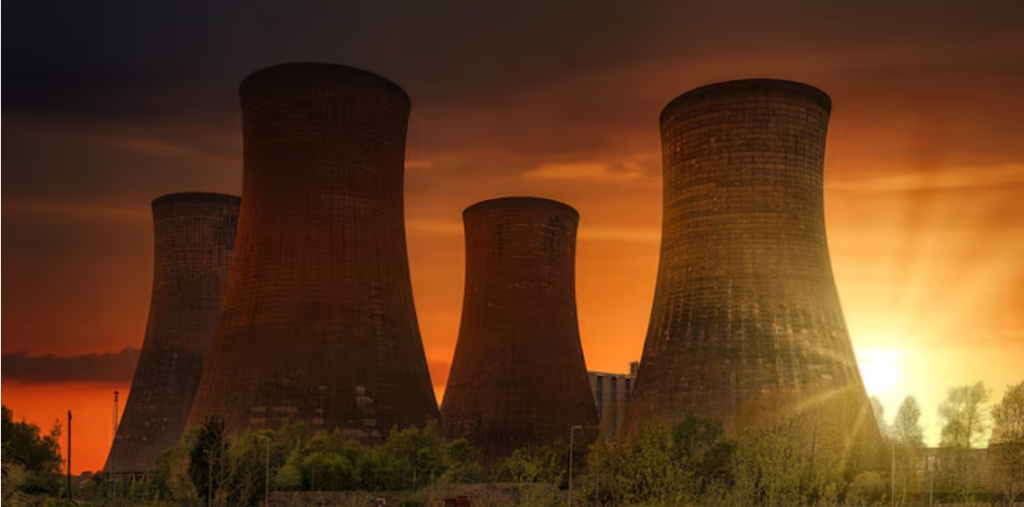
Humans have learned to chase the same numbers from the opposite direction on Earth. When heavy nuclei, such as uranium-235, split, binding energy is released as gamma rays and fission products. This is essential for hundreds of reactors around the world. Experiments at facilities like ITER and the National Ignition Facility have slowly advanced, raising hopes and questions in roughly equal measure. Fusion, the star’s method, is still the harder prize. It’s still unclear whether commercial fusion will occur in 20 or 60 years, and those who make such claims are typically trying to sell something.
The energies that hold electrons to atoms are about a million times smaller than nuclear binding energies. In a nutshell, that ratio explains why nuclear physics powers our cities and our nightmares while chemistry powers our kitchens. In reality, the atom is not a tiny solar system. Tightly knotted, it contains more energy than would be expected for something so tiny. And the reason any of this exists at all is somewhere in that knot.
