

A new hydrographic survey project to map and characterize over 30,000 square nautical miles of seafloor off U.S. waters was announced by NOAA in January 2026. A few hundred words made up the press release. It made very little sound as it landed. No public discussion, no cable news segment, and no congressional hearing. The silence was startling for an initiative linked to what might be one of the most important resource decisions of the upcoming ten years, and it’s difficult not to believe that it was at least partially deliberate.
Only 54% of the United States’ own waters have been mapped. According to data presented in a recent congressional hearing, 64% of the world’s ocean is still uncharted and unexplored. That is not a small knowledge gap. That covers the majority of the earth. However, there are trillions of dollars’ worth of polymetallic nodules—potato-shaped rocks rich in cobalt, nickel, copper, and manganese—somewhere in those dark, uncharted depths, especially in the Clarion-Clipperton Zone, a 1.7 million square mile area of the Pacific between Hawaii and Mexico. Geopolitical competition is now defined by the same materials used in EV batteries, power grids, weapons guidance systems, and supply chains.
For years, China has made its intentions very clear. After investing hundreds of millions in deep-sea research and equipment, it has more exploration contracts in the CCZ than any other nation. Claims have been made by South Korea, Japan, France, Germany, Russia, Cuba, and Tonga. The United States, which never ratified the UN Convention on the Law of the Sea and thus has no official seat at the International Seabed Authority, which oversees commercial mining in international waters, is the only significant economy noticeably missing from that list. In a 2019 interview, retired rear admiral Jonathan White, who has spent years advocating for American involvement in ocean governance, put it bluntly: without a seat at that table, the United States is, in his words, something like an outlaw of the sea.
When President Trump signed an executive order in April 2025 directing federal agencies to expedite permitting for deep-sea mining in both U.S. and international waters, that calculation was altered. The order cited the Deep Seabed Hard Mineral Resources Act, an obscure 1980 statute, as the legal justification for completely avoiding the ISA. In a matter of days, the Canadian mining company The Metals Company submitted an application to start commercial-scale extraction in the CCZ through TMC USA, its U.S. subsidiary. It was presented as a global first. It was deemed a breach of international law by the ISA. Over 40 nations denounced the action. The price of TMC’s stock more than doubled.
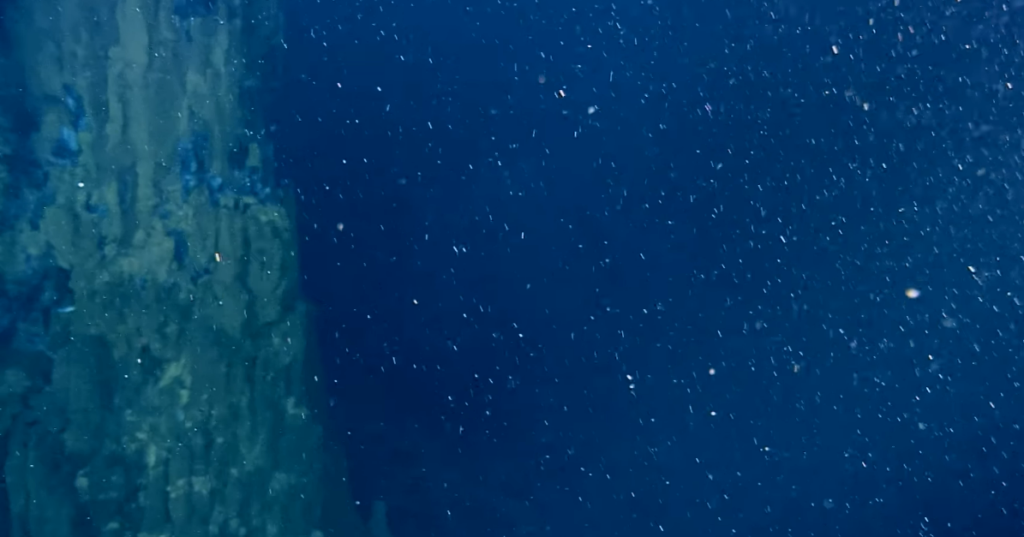
Gerard Barron, the CEO of The Metals Company, has been making this argument for years with a persistent enthusiasm that, depending on your personality, either reads as visionary or slightly untethered. He characterizes the nodules as resting on the seafloor “like golf balls on a driving range,” portraying the entire process as more moral and environmentally friendly than mining on land in locations like the Democratic Republic of the Congo. There is some truth to that framing: deep-sea extraction would not entail the child labor scandals that have plagued cobalt supply chains for years, the clearing of forests, or the uprooting of communities. On a limited environmental comparison, the calculus might not be entirely incorrect.
However, the scientists operating in that region of the Pacific are not comforted. For years, scientists at the University of Hawaii and other institutions have been attempting to determine the true contents of the mid-water column above the CCZ, including where species feed, where larvae drift, and where sediment plumes from mining operations would end up. The issue is straightforward, according to oceanographer Sheryl Murdock: on land, people can witness the devastation caused by mining. No one can see anything on the seafloor. That being invisible does not equate to being harmless.
The national security narrative also obscures a legal aspect. A significant distinction was recently made by Coalter Lathrop, a senior lecturing fellow in international law at Duke University who has researched the Law of the Sea since it came into effect in 1994: the minerals found in U.S. exclusive economic zones are American. According to international law, the minerals found in the CCZ’s international waters are part of humanity’s common heritage. Early in 2026, NOAA Administrator Neil Jacobs referred to those foreign nodules as a “domestic source of critical minerals.” To put it mildly, that description is legally disputed.
Observing all of this, it appears that the United States is attempting to address a real strategic issue—reducing reliance on China for essential minerals—through a mechanism that might shatter the international ocean governance framework that the country itself spent decades establishing. Whether NOAA’s mapping efforts result in responsible extraction or an ungoverned scramble will likely depend on decisions that have not yet been made, on regulations that are still being drafted, and on legal frameworks that 171 nations interpret very differently from Washington. How that is resolved is still unknown. However, the mapping ships have already set sail.
