

Every summer, a common sight can be seen in city parks, backyards, and beaches: people sprawling across the grass as if they’ve been knocked flat by an invisible force. By late afternoon, your eyelids feel heavy even though you spent a few hours outside doing nothing more demanding than reading a paperback or chatting over lemonade. The couch is what the body wants. It’s a strange kind of tiredness, the kind that doesn’t quite fit the day you’ve had.
The answer is surprisingly multi-layered for something so prevalent. In this case, the sun itself isn’t the antagonist. It’s heat. The brain’s hypothalamus silently switches on when the temperature rises, operating what is essentially a tiny power plant inside your body to keep your internal temperature close to the sacred 98.6 degree mark. The process is known as thermoregulation, and most people are unaware of how costly it is in terms of metabolism.
The headline act is sweating. Heat is removed from the skin by droplets that form and evaporate. Simple enough, but in order to do so, the body must actually burn calories, increasing the metabolic rate in a manner similar to that of a light jog. Vasodilation is a silent second mechanism that allows the skin to release heat by widening blood vessels and moving warm blood toward the skin’s surface. At a picnic, this is what happens when someone’s face gets pink. It functions, but it also lowers blood pressure and makes the heart beat more quickly. As a result of this resource reallocation, the brain and stomach have a little less to work with. It feels like a fog to you.
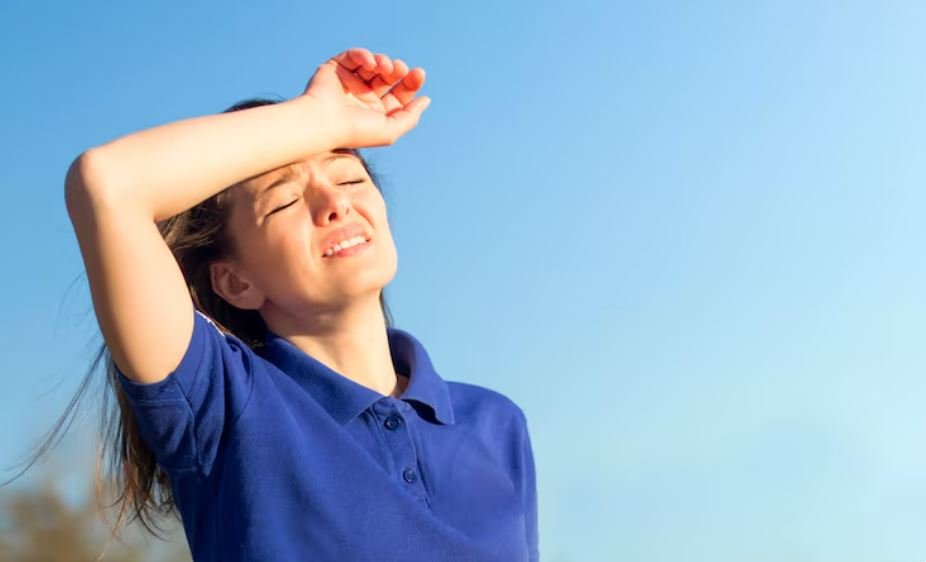
Everything is made worse by humidity. In a sort of frustrated loop, the body continues to produce more sweat while it sits there, refusing to evaporate. The feeling is familiar to anyone who has spent a July afternoon in a city like Houston or Karachi. Nothing moves in the air. The body continues to try.
Next comes dehydration, and it’s possible that most people don’t realize how fast it can happen. Even mild perspiration for a few hours drains fluid and removes electrolytes (sodium, potassium, and magnesium) that are essential to muscles and nerves. Blood volume decreases. The heart has to work harder once more. For years, medical professionals have observed that many patients who complain of inexplicable fatigue are actually, unglamorously, dehydrated. Water seems to be disregarded because it seems too easy to be important.
The skin itself comes next. The immune system has already started a silent healing process beneath the sunburn, even if it doesn’t blister or peel and is just a light pink across the shoulders. Healing is not free, and UV radiation causes an inflammatory reaction. The body expends energy repairing invisible damage, reroutes fluids, and slightly raises core temperature. Although the evidence is still limited, earlier studies have suggested that repeated UV exposure may be a factor in mental exhaustion.
Additionally, the body clock operates on its own. A bright day feels so good in the morning because sunlight suppresses melatonin and increases serotonin. However, the circadian rhythm has a built-in slump between 1 and 3 p.m., which also happens to be the hottest and brightest part of the day. There is a purpose behind the Mediterranean siesta. It’s difficult to ignore the fact that some cultures built their afternoons around this hours-long dip after giving up on it centuries ago.
The distinction between mild sun fatigue and more serious conditions is important to remember. Dizziness, nausea, clammy paleness, and confusion are symptoms of heat exhaustion. Even more dangerous, heatstroke can completely stop sweating. Both are worthy of prompt action. But the typical fatigue, the kind that just makes you want to turn off the lights and lie under a fan? That’s the body working loudly. Find shade, drink water, and have a light meal. In the same way that summer slowness always seems to pass, the grogginess usually goes away by evening.
