

At some point in late summer, the North Atlantic just won’t cool down. Sea surface temperatures breaking records, fishermen returning with smaller catches, and coral systems bleaching in areas that had previously appeared to be safe ground have all been occurring with startling regularity. The natural tendency has always been to measure what we can see with buoys and take pictures of the surface using satellites. However, it appears that we have been focusing on the wrong area of the ocean, according to a recent study published in Nature Climate Change.
In collaboration with scientists from Portugal and Australia, researchers at Nord University in Norway have spent years studying the movement of marine heatwaves as well as where they start, at the top. In a subtle way, what they discovered is quite concerning. Since 2000, ocean heatwaves have increased in duration, depth, and formation in previously unheard-of locations. It doesn’t just sit at the surface and fade away. It sinks. Furthermore, conditions may not return to anything approaching normal for up to two years after it reaches the deep.
“Marine heatwaves occur increasingly often due to climate change, much like we see extreme weather phenomena more often on land.”— Nord University Professor Mark Costello
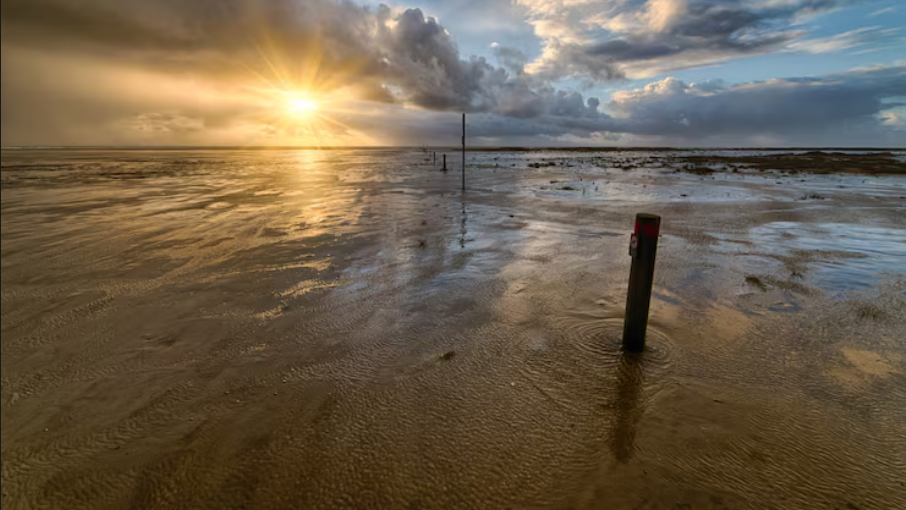
Two years is a significant amount of time to reflect on. A heatwave breaks out on land. It’s raining. The earth cools. No matter how catastrophic, the crisis is over. However, the water lacks such a mechanism for rapid release at depths of 50 to 200 meters. The organisms that have evolved over millennia to live in cold, stable environments are left with nowhere to go because the heat is trapped. The research’s principal investigator, Professor Mark Costello, put it simply: warming can boost biological activity at such depths, but it can also push species beyond their tolerance limits, decreasing growth and productivity in ways that are still hard to quantify.
In order to track temperature anomalies up to 2,000 meters, the study combined real ocean measurements with modeling to analyze global marine heatwave data from 1993 to 2019. Researchers discovered that in some places, heatwaves were 19% more intense at depth than at the surface. This means that, contrary to what one might anticipate from a body of water that doesn’t receive direct sunlight at those depths, heatwaves were hotter rather than colder. Although the precise cause of the heat amplification in some deep zones is still unknown, ocean circulation patterns are probably a contributing factor. It is evident that deep water is no longer a stable, unaltered barrier against global warming.
There is a feeling that up until now, the discussion surrounding marine heatwaves has been essentially surface-level. The majority of earlier studies concentrated on coral bleaching events, sea surface temperature spikes that are visible from space, and other ecological catastrophes that are captured on camera. The threat below was mostly imperceptible, and imperceptible things don’t usually create a sense of urgency. In 22% of the world’s oceans, deep-water heatwaves coincide with areas where marine species are already living at the very edge of their thermal tolerance, according to research. These are the most vulnerable areas, and they are primarily found at depths of 1,000 to 2,000 meters, where very little systematic monitoring has ever been carried out.
The fact that not all deep-water warming is obviously catastrophic adds complexity and, in some ways, interest to the picture. Costello took care to point out that a slight rise in temperature can actually speed up biological activity in polar and sub-polar areas, where baseline temperatures are close to zero degrees Celsius. For example, if temperatures rise from 0 to 2 degrees, Greenland halibut may grow more quickly. In those situations, growth is limited by the cold rather than the warmth. However, that subtlety is limited. The math completely changes if you push much further.
It’s difficult to ignore the similarities with what has been shown for years on land: that not all areas are equally impacted by climate change and that some areas benefit before the full effects of warming materialize. It turns out that the ocean is conducting the same intricate experiment, but with species we hardly know and at depths we hardly ever consider. In particular, in the deep zones that are currently virtually unobserved, the researchers are advocating for much more subsurface monitoring. Costello acknowledges that it’s hard to predict with certainty which scenario will occur without knowing what temperatures the species are actually experiencing. It is unsettling to be uncertain.
This past summer, record temperatures in the North Atlantic made headlines. They were observable, quantifiable from the coast, and hard to ignore. Perhaps because it is more difficult to see, the deeper story—ocean heatwaves that run deeper, last longer, and form in places they had no business forming—has gotten far less attention than it merits. That might be evolving.
