

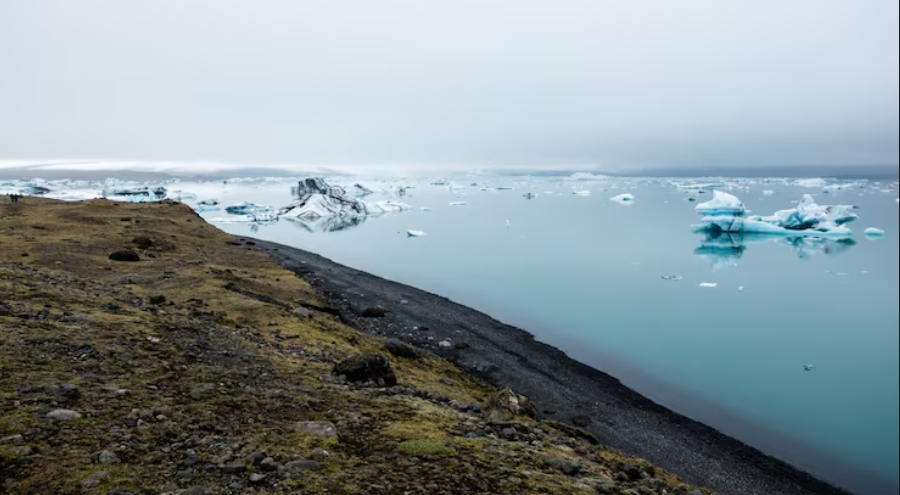
It’s easy to overlook the crisis when standing on the edge of Kachemak Bay in the early morning and observing the fog hovering low over the water. The bay appears old and unconcerned. The water flows in the same manner as before. However, the people whose lives depend on what exists beneath that surface are beginning to sense that something has changed—quietly, chemically, and imperceptibly.
America’s coastal oceans are changing chemically. The pH of surface ocean waters has decreased by 0.1 units since the industrial revolution. When you realize that the pH scale is logarithmic, that seemingly innocuous number actually indicates a 30% increase in acidity. About thirty percent of the carbon dioxide that people release into the atmosphere is absorbed by the ocean. The ocean contributes to the cost of every cleared forest, every coal plant that burns through the night, and every car that sits at a red light.
Carbonic acid is created when CO2 dissolves in seawater. That acid breaks down into hydrogen ions and bicarbonate, and those hydrogen ions do a particular, harmful thing: they form a bond with the carbonate ions required by pteropods, corals, and shellfish to form their skeletons and shells. Shells are thinner when there are fewer carbonate ions. Animals with thinner shells are weaker. Additionally, shells continue to form in sufficiently acidic waters, which some Pacific regions are already getting close to. They begin to fall apart. Pteropod shells, which are tiny sea snails sometimes referred to as “sea butterflies,” were added by researchers to seawater whose pH levels were predicted for the year 2100. The shells had started to clearly dissolve after 45 days. That experiment does not serve as a warning for the future. It’s a current illustration of the direction things are going.
The worst of it is being absorbed by coastal Alaska. The northern Pacific’s chemistry is already more advanced than that of the majority of the world’s oceans because cold water retains more CO2 than warm water. Deep, nutrient-rich, low-pH waters that were naturally acidic long before industrial emissions started to tip the scales are upwelling at the coast of the Gulf of Alaska. The early life stages of crabs, the shells of clams and mussels, and the tiny plankton that make up almost half the diet of some salmon species are all in danger when you add decades of atmospheric CO2. This is not an abstract ecological issue for a state where fishing supports tens of thousands of jobs and brings in $5.8 billion. Although it hasn’t been officially declared, there is an economic emergency.
It’s difficult to ignore the conflict between the scope of the issue and the lack of public discourse surrounding it. There are no striking visuals associated with ocean acidification, such as burning forests or floodwaters rushing through urban areas. In water, it occurs at the chemical level while no one is around to witness it. When the environment becomes more acidic, a clownfish’s ability to recognize predators decreases. Clownfish larvae have difficulty locating suitable habitat. These are real, compounding events that don’t make headlines. The food web that individual species are a part of begins to buckle under the strain when those species start to struggle. Before scientists can completely map those effects, it’s still unclear how far they will cascade.
The goal of NOAA’s Kachemak Bay pilot monitoring project is to create that map. In addition to monitoring how freshwater from glacier melt and precipitation mixes with upwelling ocean water and sending water samples to the University of Alaska Fairbanks for carbonate chemistry analysis, researchers are taking seasonal measurements of temperature, salinity, carbon content, and pH. It’s meticulous, unglamorous work—exactly the kind of science that typically goes unfunded and unreported until it becomes critically important.
Ocean surface pH could drop to about 7.8 by the end of this century, according to estimates based on current emission trajectories. The last time Earth’s oceans were at that level was between 14 and 17 million years ago, during the middle Miocene, when the planet was several degrees warmer and a major extinction event was already underway. It seems to depend on one’s point of view as to whether that historical parallel should reassure or frighten anyone. Some researchers believe that the window for a different result is still open, but it is getting smaller in ways that don’t make headlines.
The difficult aspect of ocean acidification, and maybe the most truthful thing to say about it, is that there isn’t a perfect solution on the shelf. This is also slowed by anything that slows climate change. However, the ocean has already undergone change. Already, the chemistry has changed. The decisions made today, primarily by those who will never stand at the edge of Kachemak Bay and watch the fog settle over water that appears to be exactly the same on the surface, will determine what happens next.
