

The ability of the same cable carrying a video call from London to New York to sense an earthquake occurring thousands of miles away under the correct circumstances is subtly astounding. Not in a symbolic sense. You can actually feel the slight mechanical tremor of a seafloor fault by observing how light behaves. The ocean floor was essentially a blind spot in seismology for many years. Since two thirds of the Earth’s surface is underwater, the equipment required to properly monitor it has always been costly, challenging to use, and prone to loss. There have been repercussions from that observational gap. There hasn’t been enough warning when tsunamis have struck. Errors have not been mapped. For all intents and purposes, the deep ocean has been observing us instead of the other way around.
Beneath millions of tons of seawater, carrying stock trades and Instagram posts, is the technology that is causing this dynamic to start changing.
The backbone of international phone and internet traffic is made up of more than 1.48 million kilometers of fiber-optic cable that crosses the ocean floor. Over the past few years, scientists have been working on ways to transform this current infrastructure into a distributed sensing network that can track underwater currents, detect seismic activity, and track temperature changes that indicate more significant changes in the climate. In hindsight, the solution appears clear, but it took years of meticulous, costly science to make it a reality.
It is based on precise yet elegant physics. A tiny portion of laser light scatters backward off tiny flaws in the glass as it passes through an optical fiber. Researchers can identify changes in the fiber brought on by mechanical stress or temperature fluctuations by analyzing that backscattered light, especially a feature known as the Brillouin peak. The fiber stretches or compresses when the seafloor moves, even by a centimeter or two, and the light signal reflects these changes. The method is known as Brillouin Optical Time Domain Reflectometry, and although its name is anything but poetic, its capabilities are astounding.
For seven years, Marc-André Gutscher, a marine geoscientist at the Geo-Ocean research center in Brest, France, has been in charge of the EU-funded FOCUS project, which tested this theory in real-world settings. Near a known fault zone off the coast of Catania, Sicily—a region with a significant seismic history—his team installed a prototype cable across the seafloor. The 7.1-magnitude Messina earthquake of 1908 caused a tsunami that killed over 80,000 people. Gutscher’s group wasn’t operating in a vacuum. They were attempting to construct something that might eventually assist coastal communities in anticipating danger before it materializes.
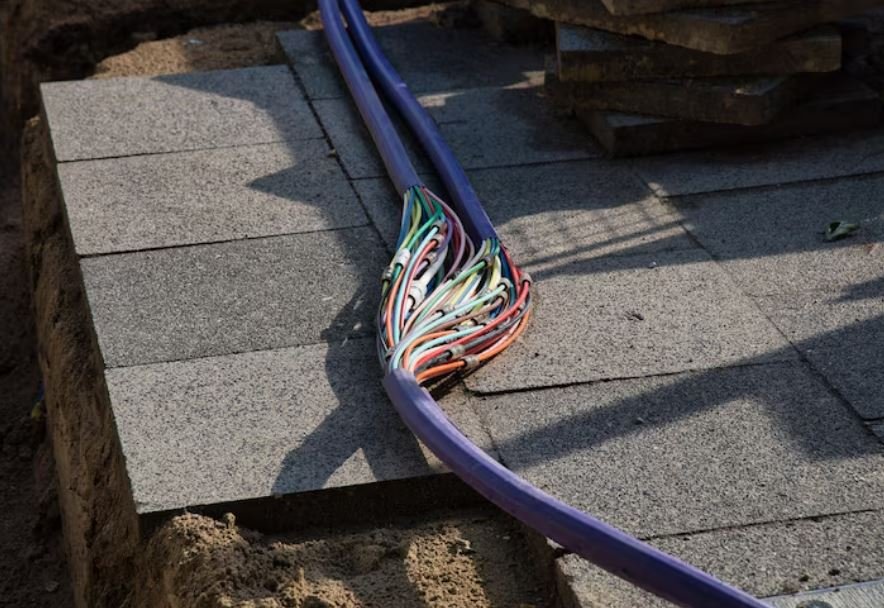
The cable itself, which is only nine millimeters thick, was made of two different kinds of optical fiber: tightly buffered fibers that are more strain-sensitive and loosely buffered fibers that resemble regular telecom cables. Since October 2020, laser measurements have been taken approximately every two hours after a remotely operated vehicle placed it across the fault in four locations. According to Gutscher, the fact that no notable fault movement has been observed is instructive in and of itself. Tectonic stress appears to be building up on the locked fault. He has stated, “We’ll be watching when that stress is released.”
However, what the cable has already found is startling. It detected the signature of a massive submarine current in late 2020, which was probably caused by an underwater landslide. This type of event is rarely seen in great detail. Monitoring secondary hazards that endanger both coastal populations and the cables themselves was a broader capability that was revealed by that data, which captured something that scientists hardly ever see in real time.
A different team in the United States used a transatlantic cable that connected Canada and the United Kingdom to demonstrate something equally compelling. Researchers converted twelve cable segments into separate sensors by taking advantage of fiber loops that link signal repeaters, which are typically only used for maintenance checks. These twelve spans tracked signals from Hurricane Larry and recorded a magnitude 7.5 earthquake in Peru. The implication is important: without changing a single piece of hardware, hundreds or thousands of such sensors could be installed throughout the current underwater infrastructure.
The speed at which this technology will transition from research to practical application is still unknown. The telecom companies that own the cables have legitimate concerns: retrofitting monitoring systems into operational infrastructure presents significant coordination challenges, and commercial traffic cannot be interfered with. However, it is becoming more difficult to reject the scientific argument. There has always been trembling on the ocean floor. Finally, the wires are listening.
