

From the surface, the western Pacific, located about 80 kilometers from the Mussau Trench at the border of the Caroline Plate, appears no different from any other area of open ocean. Water, horizon, the specific shade of blue that the deep ocean adopts when the sky is the only thing to reflect. The seafloor here is located at a distance from the surface that would need hours of descent for any vehicle capable of reaching it, indicating the depth below this specific piece of it. What the crewed Chinese submersible Fendouzhe discovered on the seafloor during that trip was different from what hydrothermal vent investigations usually find.
The Kunlun Hydrothermal Field, which is approximately 11 square kilometers in size, was named after the mountain range by the researchers from the Institute of Oceanology of the Chinese Academy of Sciences. Twenty sizable seafloor craters can be found there, along with a structure known as a pipe swarm—columns of conduit through the seafloor rock that allow gasses and liquids to rise from depth. The structure’s scale is peculiar. The majority of hydrothermal systems are much smaller. Geochemists find Kunlun particularly fascinating not only because of its vastness but also because of the hydrogen it produces. The research team calculates that 4.8 × 10¹¹ moles of abiotic hydrogen are produced annually via a chemical reaction between seawater and the ultramafic rocks of the oceanic mantle below, rather than by biological creatures.
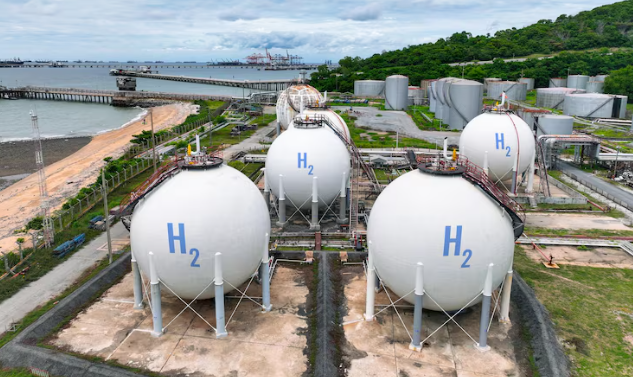
For the number to land correctly, context is necessary. Through a process known as serpentinization, which occurs at hydrothermal systems all over the world, seawater seeping into the seafloor reacts with olivine and other mantle minerals to produce hydrogen as a byproduct of the chemical transformation. Since the 1970s, the process has been identified and investigated in numerous hydrothermal systems throughout the network of mid-ocean ridges. Oceanographers have spent decades improving the projected worldwide undersea abiotic hydrogen output, which is the overall contribution of all these systems combined. The research team calculated that the Kunlun field makes up at least 5% of that worldwide total. One in twenty units of the abiotic hydrogen that is thought to be originating from the entire ocean floor is produced by a single area that is 11 square kilometers in size.
The physical structure of the field reflects the geology that enables this. The breccia deposits, which are broken rock cemented into irregular formations, and steep-walled craters are indicators of past explosive events, periods in the field’s history when gas pressure accumulated in the conduit system and was released strongly enough to modify the seafloor surrounding the vents. These are not soft seeps. In the past, the system has had enough energy to blow craters into the seafloor. The contemporary manifestation of that system was what the Fendouzhe saw throughout its survey: plumes rising from crater floors, active vents pouring hydrogen-rich fluids into the water column, and biological communities that have arranged themselves around the chemical energy the vents offer.
These communities are what give hydrothermal systems their enduring fascination for both geochemists and biologists. Shrimp, anemones, squat lobsters, and tubeworms—organisms supported by chemosynthesis rather than photosynthesis, metabolizing the hydrogen and sulfur compounds produced by the vents rather than relying on organic matter raining down from the sunlit zone above—were observed by researchers near Kunlun’s vents. Since the discovery of the first hydrothermal vent communities on the Galapagos Rift in the late 1970s, chemosynthetic ecosystems have been recognized. Kunlun provides more information about the potential richness and diversity of these communities as well as the widespread use of hydrogen-driven chemosynthesis as a deep ocean energy pathway.
The part of the Kunlun discovery that draws the most speculative and really fascinating scientific attention is the origins-of-life factor. The fluid chemistry that results from alkaline, hydrogen-rich hydrothermal systems is very similar to the chemical environment that some origin-of-life theories suggest was the setting for the emergence of early biochemistry. These environments include mineral surfaces that could catalyze the formation of organic molecules, steep chemical gradients, and an abundance of chemical energy from hydrogen.
This does not imply that life originated at any particular hydrothermal vent or at Kunlun. This means that situations that would have been common in the early Earth’s ocean can be studied using the physical chemistry of these systems as a natural analog. Researchers have an especially rich natural laboratory to study those variables in ways that controlled laboratory trials are unable to fully reproduce in a field that generates hydrogen at Kunlun’s scale.
