

A yellow torpedo-shaped robot, roughly eight and a half feet long, is currently drifting silently through the darkness somewhere in the Atlantic Ocean. Not a crew. The propeller is not spinning. The majority of the work is done by the slow, patient physics of buoyancy, which propels it through the water at around one knot, which is slower than a human walking, while it gathers ocean data that scientists on land are evaluating in almost real time.
I’m Redwing. Constructed in the United States by Teledyne Marine, it was launched off the shore of Martha’s Vineyard in October 2025 and is seeking to do something no underwater vehicle has ever done: round the world. From the Gulf Stream toward Europe, the route travels about 73,000 kilometers south to Gran Canaria, across to Cape Town, through the Indian Ocean to Australia and New Zealand, around through the Antarctic Circumpolar Current, and finally back up through the South Atlantic via the Falkland Islands and Brazil. It is anticipated that the mission will take roughly five years. Additionally, it uses 23 kilowatt-hours of electricity from a single load of batteries, which is about the amount of energy used in a normal American home in a single day.
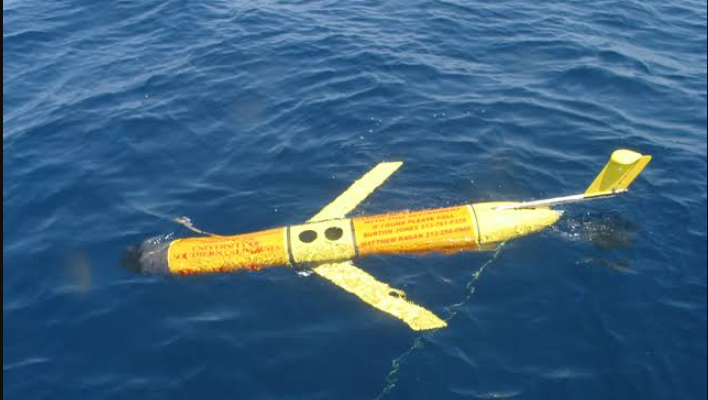
These machines move in a way that initially seems nearly nonsensical. The major lifting is not being done by a propeller. Rather, the vehicle is made heavier or lighter than the surrounding water by a buoyancy engine that moves oil between internal bladders. It sinks as it becomes heavier. It rises when it is lighter. That vertical motion is transformed into forward glide by a pair of swept-back wings, creating a sawtooth path through the water column that repeatedly descends and ascends, gradually covering horizontal space with nearly little energy expenditure. Redwing comes to the surface every few hours, updates its GPS position by pinging a satellite, and then transmits the oceanographic data it has gathered, including temperature, salinity, and current readings, before sinking back under.
It’s difficult to ignore the almost meditative quality of these cars’ operation. They travel in the same methodical, patient manner as ocean currents, obeying rather than opposing the rhythms of the water. The name Redwing is actually an acronym for Research & Education Doug Webb Inter-National Glider, which honors Doug Webb, the 94-year-old creator of the original Slocum glider concept who passed away in 2024. One of the most ambitious autonomous ocean missions ever attempted is driven by Webb’s fundamental realization that a robot could go across the ocean using its own energy.
A team from Rutgers University established the standard for long-distance glider missions in 2009 when their glider, The Scarlet Knight, became the first robot to cross the Atlantic in 221 days. Along with more than fifty students who contributed to the development of Redwing’s flight gear and navigation software, oceanographers Oscar Schofield and Scott Glenn are directing Rutgers’ scientific partnership on the Sentinel Mission. Teledyne and Rutgers have a long-standing partnership that rarely makes headlines but frequently results in truly beneficial outcomes.
Beyond just science, Redwing’s data has practical uses. Hurricane intensity forecasting is improved by better observations of ocean temperature and current behavior. This issue has long plagued meteorologists, in part because the ocean’s heat content directly influences storm strength in ways that surface data alone are unable to fully capture. Additionally, navies are becoming more interested. As it retires its specialized ocean survey ships, the Royal Navy recently placed an order for a number of Slocum gliders, including a Sentinel model. The economics are simple: the cost of a robot that can stay in the ocean for two years on a single battery is much lower than that of a crewed vessel that runs continually. Although it’s still unclear if this capability trade-off will be worthwhile in the long run, defense customers’ interest indicates that confidence is growing.
Redwing is still in its early phases of travel, following the Gulf Stream in the direction of Europe. Numerous factors, including storms, fishing line entanglement, equipment wear, and the unpredictability of the ocean itself, will determine whether or not it completes the whole circumnavigation during the following five years. All of those challenges were encountered by the Scarlet Knight on a single transatlantic voyage. A five-year international journey adds uncertainty on a magnitude that is truly hard to predict ahead of time. Even still, there’s a sense that the folks behind this effort know exactly what they’re doing, and even a partial success would significantly increase our understanding of the world through ocean science.
