

When the first transatlantic telegraph cable was installed in 1858, the speed at which data is carried by a cable approximately the diameter of a garden hose at the bottom of the Atlantic Ocean, somewhere between the coast of Ireland and the eastern shore of the United States, would have been unthinkable. Every second, it handles billions of online requests, financial transactions, encrypted messages, video calls, and everything else that makes up the typical flow of digital life between two continents. The cable is located on the seafloor, mostly unattended, unmonitored, and unprotected by any teeth-like enforcement device. It shares that floor with ship anchors, fishing trawl weights, and occasionally submarines.
It seems as though the internet is located in the cloud. It doesn’t. It is mostly found in fiber-optic cables that run down the bottom of the world’s oceans, and these cables are more vulnerable to destruction, both purposeful and unintentional, than any infrastructure of similar global significance. These cables handle more than 99 percent of international internet traffic. The rest is carried via satellites, although their latency and capacity make them unsuitable as fiber replacements for much more than basic connectivity. The network of underwater cables is not a backup system. It’s the infrastructure.
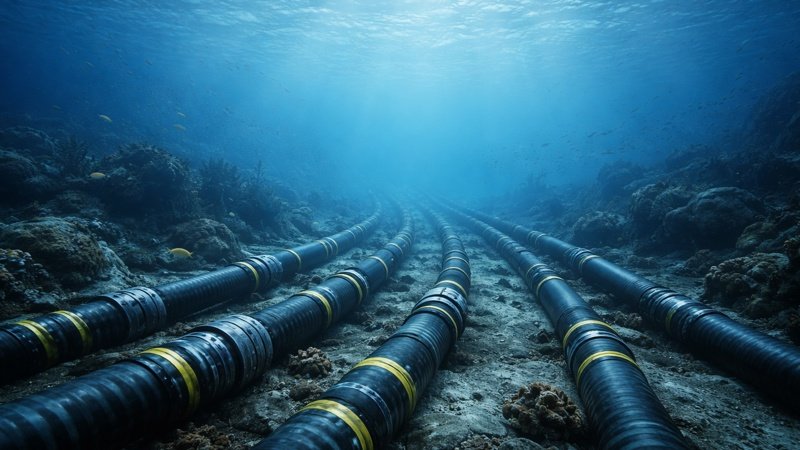
Geopolitical threats are not the most frequent hazard to such infrastructure. The boat is used for fishing. Cables are regularly cut by trawl gear that is dragged across shallow continental shelves; this is an operating expense recognized by the industry. Similar damage is caused by ship anchors dropped in the incorrect location, especially close to port approaches where wires run in crowded corridors. Due to their frequency, prompt identification, and the skilled efficiency of the repair fleets that are available to splice and restore cables, these occurrences do not garner international attention. However, they highlight the basic vulnerability: a network that carries the majority of global internet traffic passes through an area where a farmer’s fishing gear dragging across the incorrect seafloor patch can cut it off.
The most catastrophic failures are caused by natural disasters. The most frequently mentioned example is the 2006 earthquake near Taiwan, which caused underwater landslides that simultaneously destroyed nine different cables, causing weeks of internet service disruption throughout the Asia-Pacific area. Cables that had been built with some tolerance for seabed movement were severed by the landslides’ rapid and substantial movement. Due to the extensive damage and the limited number of specialized vessels required to carry out the repairs—there are only about sixty in the worldwide fleet, owned by a small number of companies—repair required weeks of coordinated work by numerous cable ships, and their deployment had to be prioritized across simultaneous repair needs.
After developing gradually, the geopolitical dimension is currently expanding quickly. Over the past ten years, tech behemoths like Google, Meta, Microsoft, and Amazon have made significant investments in private cable networks, departing from the conventional approach in which telecom consortia built and ran international connections. The strategic reasoning is based in part on geopolitical placement and in part on bandwidth capacity, as the hyperscalers require more than the shared carrier market can effectively supply. In a world where cable landing permissions are increasingly being utilized as policy tools, owning the cable entails controlling who uses it and where it lands. Citing national security concerns, the US has prohibited Chinese companies from installing cables on US soil. In response, China has made investments in alternate routes that evade American authority. The wider technological separation between Chinese and American digital infrastructure is becoming reflected in the cable map.
When many cables in the Baltic Sea sustained damage in conditions that investigators deemed suspicious in 2024—damage patterns at odds with the incidental causes that often account for cable breaks in those waters—the sabotage question went from theoretical to urgent. The events sped up talks on what a protective response framework would actually include and forced NATO member states to monitor vital underwater infrastructure more closely. The issue is that underwater cables pass through international waters where no one state has jurisdiction. While it is theoretically simple to replace a broken cable, it is frequently practically impossible to identify intentional damage. The physical proof is unclear after the event, and a ship may drag an anchor over a cable without having noticed any unusual activity up to that point.
