

Nobody discusses how slow the response had to be when the Titan submersible went silent on June 18, 2023, somewhere in the darkness above the Titanic wreck. The closest port was 420 nautical miles away from the ship. The search area was about twice as large as Connecticut. The equipment had to be transported by ship and then dragged in lawnmower lines across the water. Four days later, a remotely operated vehicle discovered a debris field. Four days is considered short for a search area by scientists.
A team at MIT Lincoln Laboratory and the MIT Ocean Science and Engineering lab has been quietly working to close that gap between how quickly we want to look and how quickly the ocean allows us. The Autonomous Sparse-Aperture Multibeam Echo Sounder is the name of their system, which only an engineer could adore. Its underlying concept is more straightforward. They distribute a wide array of sonar across a small fleet of autonomous surface vessels—robot boats that can be dropped into the water from an aircraft and locked together into a single large listening surface—instead of mounting sonar on the hull of a single ship.
It’s the kind of numbers that make you read twice. mapping at 100 times the resolution of a surface ship and 50 times the coverage rate of an underwater vehicle. One of the project’s leads, Andrew March, says, “Our array provides the best of both worlds,” referring to the sharpness of something crawling along the bottom and the reach of a ship. The issue has always been the combination. Usually, you either get one or the other.
Here’s a simple explanation of why that matters. By firing low-frequency sound at the seabed and timing the echo, ships are able to map the deep ocean. Water absorbs high-frequency sound, especially as you descend, so low frequency is required. Low frequency, however, is hazy. A football field’s worth of information can be represented by each pixel in those maps. That fact has an odd humility to it. The average depth of the ocean floor is approximately 3,700 meters, well beyond the reach of cameras, lidar, or traditional sonar attempting to peer down from the surface, and more than 80% of it is still unmapped at any useful resolution.
The field is simultaneously straining in multiple directions toward better eyes. In collaboration with 3D at Depth, MBARI has advanced subsea lidar to a resolution of one centimeter, which is sharp enough to detect the soft tissue of animals on the bottom. Using laser scanners that create 3D images of jellyfish without ever touching them, a Schmidt Ocean Institute crew confirmed 31 new species off the coast of Brazil this June in just two weeks. The same hunger, different tools.
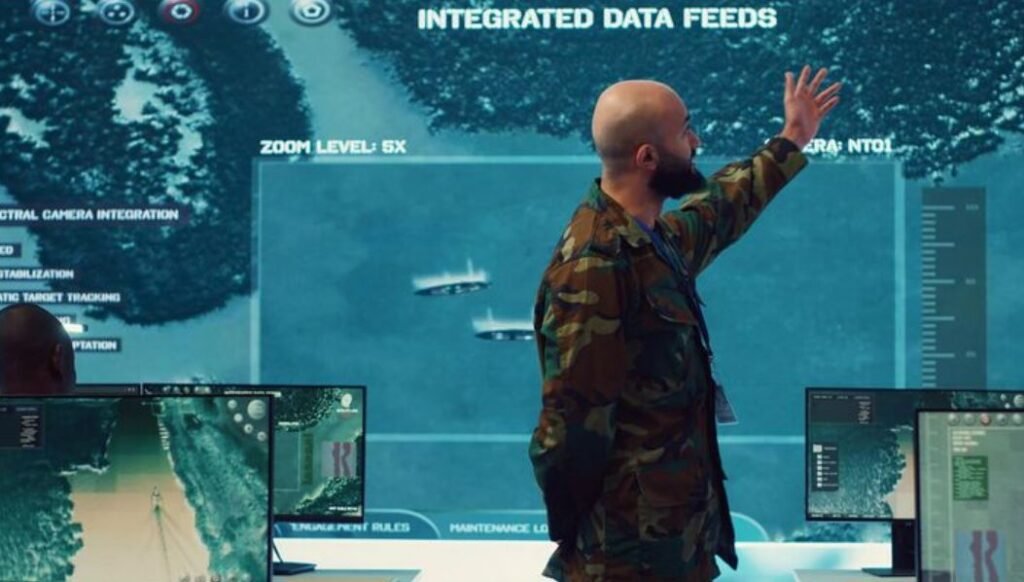
The Lincoln Lab approach is intriguing because it claims meter-scale detail at depth while remaining on the surface, something that no other technology has been able to accomplish. It remains to be seen if it survives beyond the test tank and Boston Harbor trials. Anything that requires numerous platforms to act as a single entity is cruelly treated by sea states.
Additionally, the background is uncomfortable. News of the removal of over 900 deep-sea sensors from the Pacific and Atlantic, as well as the dismantling of an ocean monitoring program, surfaced the same week these developments were being reported. As a result, while the tools are improving, some people are hesitant to use them. The contradiction is difficult to ignore.
Nevertheless, it seems like the seafloor’s long privacy is coming to an end as this develops. It sounds like a technical achievement to cover a square mile in a single pass. It could turn out to be more akin to a door opening.
