

When a group of astronomers began closely examining a red dot, the James Webb Space Telescope was already experiencing an incredible run of discoveries. It was an abnormally red spot in deep space photography that didn’t easily fit into any established type of cosmic entity; it wasn’t the biggest or most dramatic item in the frame. That proved to be important. The group, headed by Dr. Rohan Naidu of MIT’s Kavli Institute for Astrophysics and Space Research, has released research in Nature that describes what they think is a completely new class of astronomical entity, which they are referring to as a black hole star.
The object, known as MoM-BH-1, is located billions of light years away in the Cetus constellation. Because some of the most unexpected structures appear to be emerging at this time in the early cosmos, astronomers have been closely examining it since Webb came online. Its light indicates that we are looking at something that existed about 660 million years after the Big Bang. The team had recently discovered Mom-z14, one of the earliest known galaxies, which pushed the formation barrier back to only 280 million years after the Big Bang. After that, they shifted their focus and discovered MoM-BH-1.
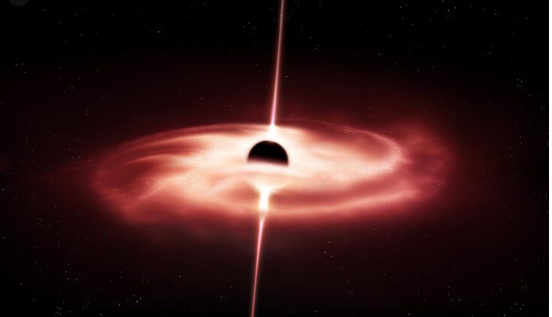
The content of the light emanating from this thing is what makes it very perplexing. It has the spectral fingerprints that astronomers identify with stellar emission, thus on one reading, it appears to be a star. According to a different interpretation, it generates far too much energy for a star. Approximately 100 billion times as much as any known star can produce. That energy output is exactly in the black hole range. The scientists came up with a particular scenario based on computer simulations of what would result from that combination: a black hole so completely incased in layers of dense gas that it radiates outward in a manner similar to that of a star. Not a star. Not a typical black hole. Something in the middle.
It’s important to note that the term “black hole star” is relatively new in scientific literature. When identifying objects that have not been reliably verified by numerous observations, astronomers are typically cautious. The team acknowledges that MoM-BH*-1 is unlike anything previously classified, therefore the theoretical framework for comprehending it is still being developed, even tho they think the model fits the facts. According to Naidu, the object’s spectral signature, which is light that is nearly totally red and abruptly stops at a specific wavelength, cannot be compared to any known class of objects. When researchers believe they have discovered a little uncommon variation of something known, they do not utilize that terminology.
What this might signify for the Little Red Dots is the suggestion that is attracting the greatest attention from scientists. Since the telescope’s inception, Webb’s deep space photos have been replete with enigmatic brilliant red objects. These tiny, vividly red specks have appeared in almost every deep field image, perplexing scientists because they didn’t easily fall into any preexisting category. If the black hole star hypothesis for MoM-BH*-1 is accurate, it would imply that many of these Little Red Dots belong to the same class of objects, dispersed throughout the early cosmos in quantities that would have a big impact on models of the formation and evolution of galaxies.
Naidu’s team is working on an ambitious evolutionary theory based on this. The early swaddled phase that supermassive black holes go thru before becoming the gigantic gravitational anchors that are currently found at the centers of almost every large galaxy, including our own Milky Way, may be represented by black hole stars if they are real and abundant. It is believed that the supermassive black hole at the Milky Way’s center affects the timing and location of star formation throughout the galaxy, which shapes planets and everything that comes after them. The beginning of the cosmic structure story is altered by determining the origin state of such items.
