

A crew from Kraken Robotics has been testing equipment that most people would never see and wouldn’t immediately identify if they did, at a harbor in Newfoundland where the water is consistently chilly enough to make you consider how long you’d endure if something went wrong. The KATFISH sonar system creates images of the seafloor that resemble aerial photography rather than sonar data. It is towed behind an unmanned surface vessel that moves across the surface while the sensor body runs below on a cable. A traditional sonar system would return a blurry smear, but the KATFISH system produces clear, detailed, and resolving objects at centimeter scale in water. There is no driver on the platform that is transporting it. It is lowered and recovered by an autonomous deployment system. The boat is empty.
The submarines and fully autonomous underwater vehicles that typically dominate the public discourse regarding naval robotics are not produced by Kraken Robotics. The launch and recovery infrastructure that enables risky tow operations to be carried out without placing human operators on a small vessel in choppy water next to moving cables under tension, as well as the sonar technology that informs an autonomous platform of what it’s looking at, are closer to the sensory nervous system of those systems. The distinction is important because having a robot hull that can drive itself from point A to point B is not the main reason the Navy is interested in autonomous systems. It’s about having sensors that are good enough to use the data those hulls collect for real-world decision-making.
The technology that makes Kraken’s position in the market truly defendable rather than merely incremental is Synthetic Aperture Sonar. The physical size of the sonar array limits the resolution of conventional multibeam sonar, which yields valuable seafloor mapping data. While larger arrays yield superior angular resolution, there is a practical limit to the size of an array that can be mounted on an underwater platform. By employing the platform’s forward motion to create an effective aperture that is significantly longer than the physical array, SAS overcomes this limitation and produces resolution that increases with range in ways that traditional sonar cannot match. The resulting imagery is sufficiently detailed to map seafloor geology at resolutions important for cable routing and offshore infrastructure development, identify individual marine mines, and differentiate between different types of munitions.
A difficulty that naval mine countermeasures have faced for decades is specifically addressed by the KATFISH system and the autonomous launch and recovery platform that deploys it. Conventional towed sonar operations necessitate the management of cables by a vessel, a crew, and a tow crew in situations ranging from uncomfortable to actually hazardous. Accidents occur during cable handling during deployment and recovery, which involves lowering and raising a large sensor body on a cable from a moving vessel. Using an unmanned surface vessel as the tow platform removes the crew from the vessel itself, and automating that process eliminates the human from the most dangerous aspect of the operation. Whether or not someone is on the boat, the sensor data is returned in the same manner.
Kraken’s technology is extended into missions where the sensor moves underwater instead of being towed from the surface through integration with REMUS AUVs and other U.S. Navy underwater vehicles. The foundation of the U.S. Navy’s tactical autonomous underwater vehicle program is made up of REMUS vehicles, which were created by Hydroid and are currently manufactured under Kongsberg ownership. These vehicles are utilized for tasks like mine hunting, port security, hydrographic survey, and others where a small, deployable autonomous platform is more practical than a crewed submarine or surface vessel. By incorporating Kraken’s sonar processing into those platforms, they are able to obtain imaging quality that was previously unattainable in that vehicle class.
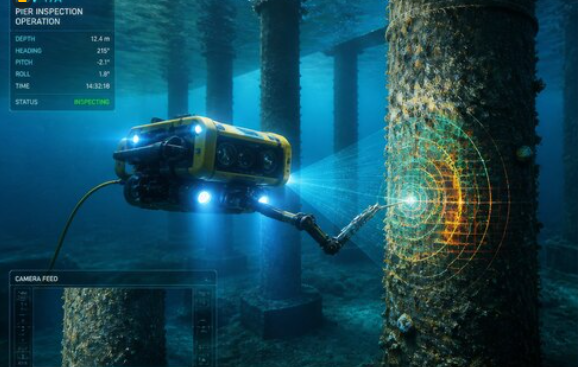
Alongside the Navy contracts, the commercial offshoot from this defense work has been quietly growing. Before installing cable and foundation infrastructure, offshore wind farm companies must conduct accurate seafloor surveys. Operators of subsea pipelines require routine inspection data at resolutions that detect structural irregularities, corrosion, and sediment movement. Authorities in charge of port security must be able to quickly search harbor bottoms for mines or prohibited items. The same autonomous deployment infrastructure and SAS technology that Kraken created for naval mine countermeasures are used in all of these applications. The technology was sponsored by the defense development cycle to a degree of performance and dependability that the commercial market can now take advantage of without having to pay for the development.
