

Tanks big enough to test underwater vehicles under controlled conditions that mimic the physical demands of the ocean are located within a facility on the Johns Hopkins Homewood campus in Baltimore. In order to simulate real operating environments, engineers lower instrumented robots into these indoor pools, run navigation algorithms through scenarios, and observe what happens when the software encounters the kinds of disturbances that real ocean deployments produce, such as shifting currents, unexpected physical contact, and sensor noise. The difference between a promising algorithm and a deployable system is measured in real data at this unglamorous activity, which involves repeating experiments and fine-tuning parameters in a room that smells somewhat of electronics and chlorine.
Researchers at Johns Hopkins‘ Whiting School of Engineering and Applied Physics Laboratory are tackling an unsolved problem: how to create underwater robots that can carry out significant subsea infrastructure repairs without constant human supervision. There are real and significant stakes in solving it. Oil and gas pipelines, power cables, scientific sensor networks, and telecommunications cables are just a few examples of the subsea infrastructure that needs to be regularly inspected and occasionally repaired. These tasks are carried out in environments where human divers can only operate for brief periods of time and at considerable personal risk, and where remotely operated vehicles require skilled human operators to maintain constant supervision through tethered connections.
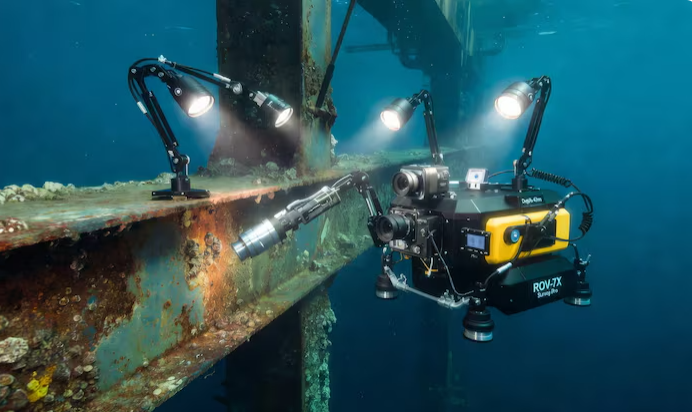
Repair capacity is based on the navigation and control work being done at Whiting. A robot must locate the object, approach it, stable itself against the surrounding current, and position itself precisely enough for its manipulators to come into contact with a certain area of a structure before it can fix it underwater. Compared to its surface counterparts, each of these processes involves control difficulties that are far more difficult.
Drag forces produced by water change depending on the direction and speed of the river. The flow surrounding the robot is altered by its own movement through the water. Incomplete and noisy information about the environment is provided by sensors. When you witness the actual vehicle in the tank attempting to maintain position against a current pattern that it did not experience during training, navigation systems that perform flawlessly in simulation fail in ways that are only apparent.
Research on wire-arc additive manufacturing and robotic arms at the Applied Physics Laboratory focuses on what occurs once a vehicle has stabilized and arrived at its destination. In order to repair structural metal components on underwater infrastructure without the need for pre-machined replacement parts that traditional repair methods rely on, wire-arc additive manufacturing—a process that deposits metal by melting a wire electrode with an electric arc and building material up layer by layer—is being researched. In theory, a robot with this skill may approach a damaged or corroded pipeline or structural member and rebuild the material instead of repairing the damaged part. In reality, handling the heat and chemical consequences of arc welding in a marine environment while doing this underwater presents a number of engineering issues that APL researchers are methodically addressing.
All of it is based on the sensor integration dimension. In order to recognize the damaged area, measure its geometry, track its own tool location in real time, and determine if the repair is going well or not, a repair robot must be able to comprehend what it is working on. The manipulator arm’s force-torque sensors give feedback regarding contact forces. A picture of the surrounding structure is created by sonar and video devices. The combination must function well enough for the robot to decide what to do next without a human having to go over every sensor reading and give every command. That’s where “autonomous” truly implies something different from “remotely controlled,” and it’s the part that’s still really challenging.
In all honesty, the state of this research in 2026 is development rather than completion. There is neither a commercially available device nor a consistently proven field capacity for fully autonomous underwater repair—a robot that finds damage, characterizes it, performs the repair, and verifies the outcome without human intervention at any stage. The component technologies that are currently being developed and tested in order to achieve that goal include manufacturing processes that function on land and are being modified for the underwater environment, navigation systems that can handle real physical environments with meaningful robustness, and manipulation concepts that show promise in controlled testing. Technically speaking, the Johns Hopkins work is genuine. Additionally, it will take several years to develop the kind of functional system that would do away with the necessity for commercial underwater maintenance under human supervision.
