

A SpaceX Falcon 9 rocket took off from Vandenberg Space Force Base in California on a calm Monday morning in November 2025, carrying something unrelated to Silicon Valley aspirations or billionaire space dreams. Around 1,300 kilometers above the surface of a planet whose oceans are slowly and ceremoniously rising, the Copernicus Sentinel-6B satellite broke away from the rocket at 06:21 Central European Time and started its slow arc into orbit.
The first signal was received by the European Space Operations Center in Darmstadt, Germany, at 07:54. It was weak and technical, but it seemed to be sufficient to bring relief to the control room. It was a living satellite. The mission was underway.
If you think about it, the entire situation has a subtly dramatic quality. This unmanned radar satellite was launched for the unglamorous but possibly more pressing task of measuring the height of the ocean surface, centimeter by precise centimeter, while much of the news cycle focuses on crewed missions and Mars ambitions. Children are not motivated to become astronauts by this type of mission. However, it might be the type that prevents flooding in their future coastal residences.
The European Commission, ESA, NASA, NOAA, EUMETSAT, and the French space agency CNES collaborated to build Sentinel-6B, the second satellite in a joint European-American program valued at about $1 billion. Since November 2020, its predecessor, Sentinel-6 Michael Freilich, has been circling the planet, providing ocean data to weather forecasting and climate models that are utilized by governments, shipping firms, and emergency planners worldwide. Sentinel-6B is intended to take over those responsibilities, but first it will fly in close formation with its twin for several months to enable precise cross-calibration. This procedure may sound technical, but it basically guarantees the transfer of three decades of uninterrupted measurement.
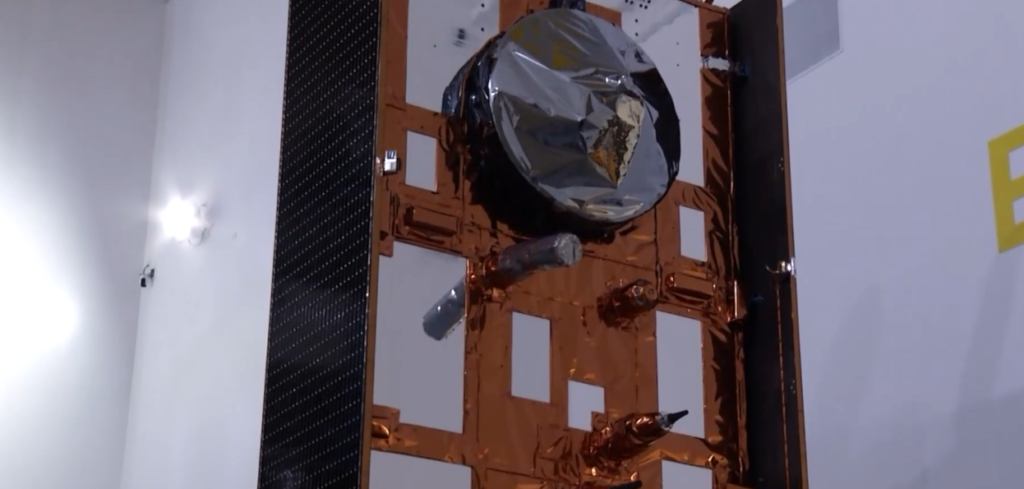
Thirty years. Sitting with that part is worthwhile. This location has been keeping a sea-level record since the early 1990s, starting with the French-American Topex-Poseidon satellite. What began as a scientific experiment has evolved into something more akin to infrastructure—a measurement system that coastal countries now covertly rely on to predict future developments. The global mean sea level has already increased by 228 millimeters since the turn of the century, with an annual rate of about 3.7 millimeters, according to data from the Copernicus Marine Service. That speed is quickening.
The Poseidon-4 radar altimeter, a device that fires microwave pulses at the ocean’s surface and gauges how long it takes for them to return, is carried by the satellite itself. This results in sea-surface height measurements that are accurate to within a centimeter when combined with precise orbital positioning data. Additionally, it has a NASA-provided microwave radiometer that adjusts for the distortion of radar readings caused by atmospheric water vapor. In a way, the entire system functions as an extremely costly ruler, calibrated to identify changes that occur too slowly for human observation.
It’s still unclear how much of the data Sentinel-6B will collect during its operational life will be used to inform the kinds of important policy decisions. From satellite to legislation, data travels a long and convoluted path. However, the applications are already operational. Sentinel-6 data is being used by projects such as STORMPACT to create flood forecasting maps for urban coastal regions surrounding the Bay of Biscay. Sea-level measurements and land subsidence data are combined in Svalbard by a tool called CIRIS to evaluate flood risk to Arctic heritage sites. This is a detail that feels strangely poignant: satellites are monitoring the gradual erosion of places that humans built long before anyone thought to look from space.
After Sentinel-4A, Sentinel-5A, and Sentinel-1D, this launch marked the fourth successful Copernicus Sentinel mission of 2025. This trend indicates that Europe’s Earth observation program is currently functioning with exceptional consistency. It remains to be seen if this momentum will result in consistent funding and political support over the decades that this type of monitoring necessitates. Long timescales are involved in climate science. Notoriously, governments don’t. Sentinel-6B won’t end the tension that has always plagued missions like this one. However, it does at least purchase an additional ten years of viewing.
