

There are rocks sitting in the dark somewhere on the Pacific Ocean floor, about five kilometers below the surface—deeper than most people can even imagine. They appear unremarkable. Brown and lumpy, about the size of a potato. Some of them are so much older than the human species that it is nearly meaningless. In complete silence, complete darkness, and complete cold, a single nodule can take ten million years to grow to the size of your fist, building itself one dissolved metal atom at a time.
Millions of them are now being sought after by mining companies.
On the surface, the argument is convincing. Cobalt, nickel, copper, and manganese are abundant in these polymetallic nodules, which are dispersed throughout the deep ocean’s abyssal plains. the precise metals used in solar infrastructure, wind turbines, and batteries for electric vehicles. More nickel, cobalt, and manganese are thought to be found in the Clarion-Clipperton Zone alone—a seafloor area between Hawaii and Mexico that is about the size of the continental United States—than in all known land-based reserves put together. In business circles, that figure is used so frequently that it has begun to sound like a mantra.
The appeal can be comprehended. There is a genuine, urgent, and mineral-hungry shift away from fossil fuels. Businesses like The Metals Company have spent years convincing investors that the seafloor, where no communities exist and no forests are cleared, is a more environmentally friendly source of these materials than the Democratic Republic of the Congo’s cobalt mines, where child labor and environmental degradation are still grave concerns. It has a certain logic to it, the kind that makes a presentation sound flawless in a boardroom.
However, that story is not supported by the science. Over 5,000 species that were completely unknown to science prior to their search have been discovered in the CCZ by researchers. The scientific community was genuinely taken aback by a discovery made in 2024: these nodules seem to carry out a form of natural water electrolysis, producing oxygen without the need for any sunlight. It’s called “dark oxygen.” Although the exact implications for deep-sea ecosystems are still being determined, the notion that these rocks are passive, inert mineral deposits on the seafloor has already been debunked.
The sediment plume issue is another issue that is often overlooked in the technical details. Nodules and the uppermost layers of seabed sediment are drawn up by the mining process, which functions essentially like a huge underwater vacuum. Unwanted materials are pumped back into the water column. According to studies, fish feed, migrate, and reproduce in the mid-water zone, where these plumes may spread for kilometers. According to a 2025 study, mining discharge may have an impact on 60% of micronekton types and 53% of zooplankton varieties in the impacted areas. These organisms anchor the food chains that supply the tuna stocks that small island nations rely on for both food and economic survival.
The economic framing, according to Solomon Kaho’ohalahala, a Native Hawaiian elder from the island of Lana’i who has been bringing Indigenous voices into international regulatory discussions, ignores everything that is important. “For them, it’s just a money deal,” he remarked about the proponents of mining. “It’s not about the resources, it’s not about people, and it’s not about a vision for the long-term needs of our children yet unborn.” When you think about what the deep sea means to Pacific Island communities—not a mineral deposit, but a living system that has fed families and shaped cultures for generations—it’s difficult not to feel the weight of that statement.
The state of international regulation is, at best, unclear. As of July 2025, the UN’s International Seabed Authority was still unable to come to a consensus despite years of efforts to finalize commercial mining regulations. In the meantime, the Trump administration issued an executive order that essentially circumvented the ISA process by expediting permits for American businesses to investigate foreign waters under a decades-old domestic mining code. A moratorium has been demanded by more than 40 nations. For the following 25 years, Portugal outlawed the practice in its territorial waters. There are bans in four states in the United States. Additionally, businesses like Volkswagen, Google, BMW, and Samsung have promised to completely avoid using deep-sea minerals.
The fact that both sides are fighting for the future of the planet is what makes this dispute so challenging. The goal, according to supporters, is to drive the shift to clean energy while avoiding the human rights catastrophes associated with terrestrial mining. Critics claim that recycling essential minerals from electronics could cut the need for newly mined materials by up to 40% by the middle of the century and that battery technology is developing quickly enough—LFP batteries in China have already completely moved away from cobalt and nickel. It’s still unclear if that shift will occur quickly enough to eliminate the need for deep-sea mining, or if the industry will have started operations before regulations have been decided upon.
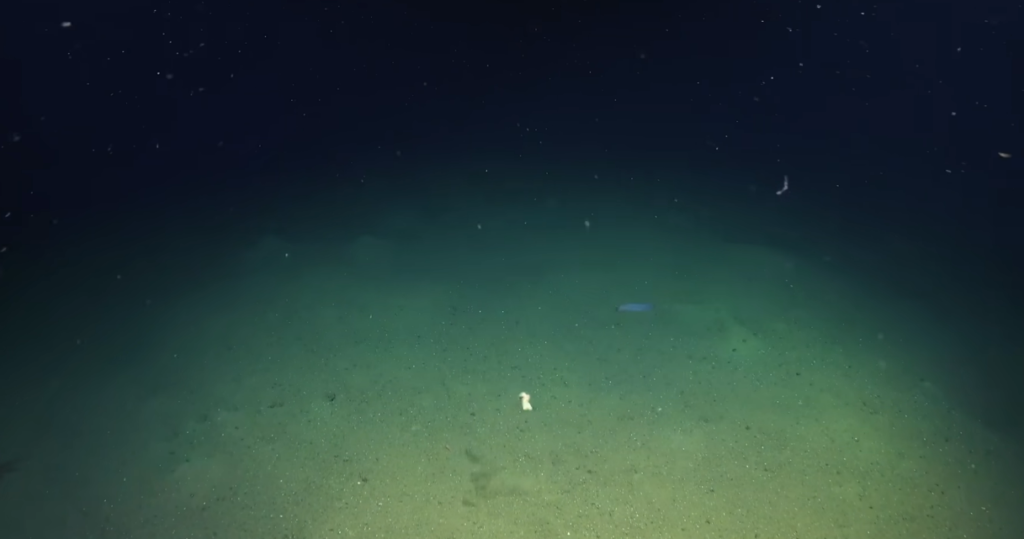
What is more obvious is that the traces of experimental experiments carried out in the 1980s are still discernible on the seafloor. The ecosystems that were disrupted during those small-scale experiments have not recovered. That is an observation made by researchers who went back and looked; it is neither a model nor a projection. A nodule takes ten million years to form. The damage has persisted for forty years.
Who gets to make the decision will determine whether or not that trade-off is acceptable, and as of right now, that is still a hotly debated topic.
