

The peculiarity of sun poisoning is its delayed onset. You tell yourself that a cool shower will take care of the sting as you leave the beach feeling fine, though perhaps a little pink across your shoulders. Your body then begins to send different signals at around hour six. An inexplicable headache. The room is warm, but there’s an odd chill. The skin constricts until it no longer feels like a typical burn.
Physicians will tell you that the name is deceptive. There isn’t any real poison. A severe sunburn combined with a sort of systemic revolt—a reaction so strong that the body begins drawing fluid toward the skin and away from other parts of the body—is what is commonly referred to as sun poisoning. That’s where the problems start. It’s only the surface that is red. It’s the dehydration that knocks you down.
Part of the reason people miss it is that the early hours frequently feel like a typical burn. A serious case keeps getting worse, but mild symptoms may go away in a few days. Blisters begin to appear in areas that people neglect to protect, such as the tops of their feet or shoulders, sometimes in tiny clusters. Lips enlarge. Even after a lengthy shower, eyes feel grainy, as if there is sand beneath the lids. There’s a feeling that the skin is now too small to accommodate the body.
The parts that startle people then follow. chills and fever. nausea, sometimes with vomiting. a dull throb in the joints that sounds like the onset of the flu. Some people experience vertigo when they stand up too quickly. A few pass out. It’s difficult to ignore how frequently these symptoms are initially attributed to something else, such as a poor meal, a demanding day, or a low-grade virus contracted at the pool, when the true cause is the sunny afternoon they hardly remembered to monitor.
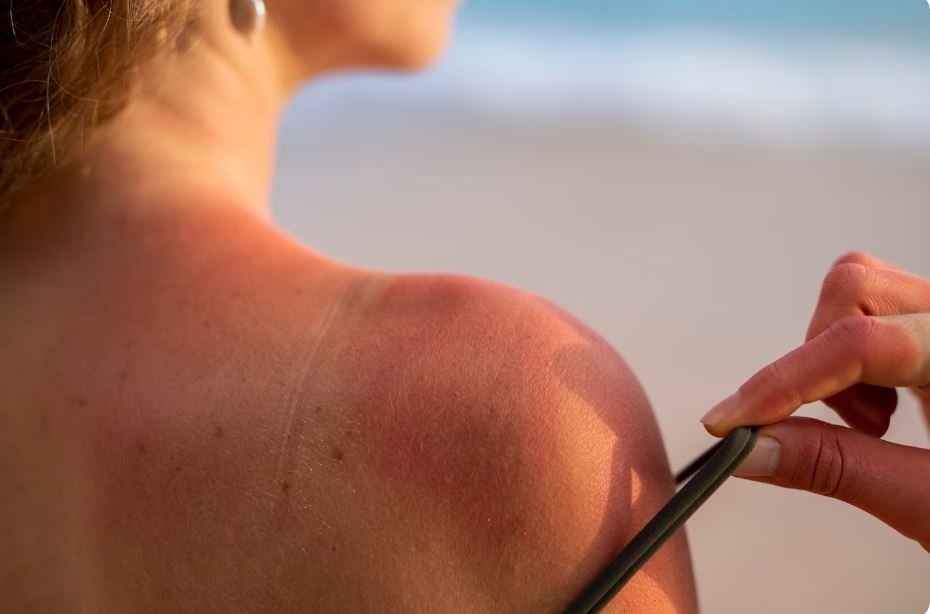
The distribution of risk is not uniform. The odds are increased by fair skin, blue eyes, and red or blond hair, but anyone can get burned severely enough to become susceptible to sun poisoning. Some antibiotics, acne remedies, oral contraceptives, antidepressants, and even St. John’s wort are among the drugs that subtly stack the deck. Dermatologists frequently witness beach reactions, but most people don’t associate a bottle of pills with them. A typical afternoon becomes a chemistry problem when you include sand, water, or snow, all of which reflect UV light back at the skin.
The majority of cases resolve themselves at home. showers that are cool rather than cold. Aloe or a thick moisturizer with no scent. Ibuprofen to reduce inflammation. Water, water, and more water, along with an electrolyte drink if you’re having trouble. The urge to pop a blister is powerful and completely incorrect; once the skin breaks, infection becomes a real possibility and the healing process slows to a crawl.
But there’s a more subdued point to be made. The most dramatic-looking cases are not always those that require medical attention. When you experience symptoms like facial swelling, disorientation, fainting, persistent vomiting, or blisters that ooze or streak red, you should go to urgent care instead of using home remedies. IV fluids act quickly. Seldom does waiting work.
It’s easy to believe that prevention is the dull solution that no one wants when you see how carelessly people handle intense sun. minimum broad-spectrum SPF of 30. Every few hours, reapply. a hat that shades one’s face. The midday hours, roughly from 10 to 4, were given a little more consideration. Maybe boring. The alternative, however, is the protracted, peculiar recuperation that most people only become aware of after their first significant fight; by then, it is typically too late to take any action other than to endure it.
