

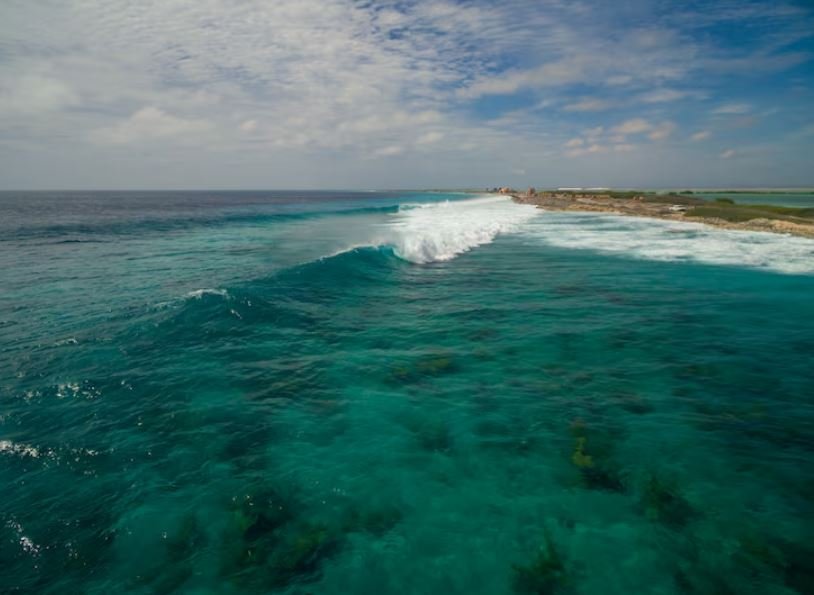
It’s easy to assume that the ocean is acting exactly as it always has when you stand on the edge of Waikiki on a calm morning and watch the waves roll in off the Pacific. The water is heated. The swells show up on time. Some surfers have already left. Nothing seems off. However, something is changing several hundred meters below that serene surface—quietly, steadily, and in ways that won’t remain undetectable for very long.
Over the past 20 years, ocean scientists researching the deep current systems surrounding the Hawaiian archipelago have observed a gradual but discernible decrease in circulation strength. More than just water is moved by the North Pacific Gyre, a vast, spiraling system of currents that stretches between Hawaii and California. Heat is moved by it. It transports nutrients. It transports the massive amounts of marine debris that eventually wash up on the shores of Papahānaumokuākea, the isolated Hawaiian islands in the Northwest that are burdened by fishing gear and plastic produced thousands of miles away. Almost everything carried by that circulatory system changes direction when it becomes weaker.
The Pacific is not the only region where this problem exists. The Atlantic Meridional Overturning Circulation, the ocean’s massive conveyor belt of warm and cold water, is predicted to weaken by about 51% by the end of this century, according to new research published in Science Advances this spring. Compared to earlier mainstream estimates, that number is about 60% higher, and it has significantly less uncertainty. Two systematic errors that had led previous models to underestimate the process—simulating the North Atlantic as too cold and the South Atlantic as too fresh—were fixed by the researchers. It turns out that both biases had been subtly hiding the seriousness of what was about to happen.
It’s difficult to ignore how these two narratives—the Atlantic and the Pacific—are coming together at the same time. Systems of ocean currents don’t function independently. A weakening in one basin tends to eventually show up in others because they are linked by deep-water exchanges that span entire hemispheres. Scientists take care not to exaggerate the connection. However, the oceanographic community believes that the global current system is under more simultaneous stress than it has ever been.
The effects of the weakening Atlantic current are already apparent along the northeast coast of the United States. A 2025 study by federal climate researchers connected the current’s recent weak phase to up to half of all significant flooding events along that stretch of coastline since 2005, and sea levels there are rising more quickly than the global average. Take a moment to consider that. The floods are cut in half. Not just from storms or rain, but from a gradually diminishing ocean current that most Americans are unaware of and couldn’t find on a map.
Despite being in a different oceanic basin, Hawaii is still affected by global events. The archipelago already serves as a sort of interceptor for the slow spiral of the North Pacific; the Northwestern Hawaiian Islands catch debris that has been moving through the gyre for years, much like a comb. Crews from the Papahānaumokuākea Marine Debris Project are cleaning up the residue of a circulatory system that, under normal circumstances, should have dispersed the hundreds of thousands of pounds of plastic and fishing gear they remove from remote atolls. Slower currents result in more concentrated debris landing on shores that were never meant to absorb it, tighter accumulation, and slower dispersal.
For years, the climate models have been inaccurate, or at the very least, more optimistically inaccurate than reality seems to support. Ridge-regularized linear regression, a statistical method seldom used in climate science, was employed in the new French study from Inria to simultaneously account for several factors influencing AMOC behavior. Previous models treated the system as simpler than it actually is because they relied on single-input estimates. The AMOC is not easy to use. It is a cycle that moves heat from the equator northward, releases it into the atmosphere, sinks as cold, dense water, and then flows back south through the deep ocean. It is sensitive to temperature, salinity, and the kinds of minute atmospheric disturbances that conventional models have traditionally ignored.
Whether the current decline is solely due to natural multi-decade variability or climate change caused by humans is still up for debate. Scientists predict that until at least 2033, we won’t have enough direct measurements to definitively distinguish between those two causes. Sitting in that window of uncertainty is uncomfortable. Meanwhile, coastal communities from Honolulu to Boston continue to plan and build as though the ocean were a stable backdrop of American geography, the sensors continue to gather data, and the currents continue to weaken.
According to current projections for Hawaii, Waikiki Beach, Ala Moana, and the Ala Wai Boat Harbor will flood when sea levels rise by 3.2 feet by 2060. Millions of people travel there annually, and its timeline is measured in decades rather than centuries. It’s not some far-off abstraction. weaken the systems currently in place to control the temperature and distribution of Pacific water, and those predictions may accelerate faster than what the current models have predicted. There is a sense that we are progressing more quickly than science can adequately monitor, and that the models’ uncertainty is a cause for urgency rather than assurance.
Human schedules have never affected the ocean. What’s different now is that we’ve given it reasons to change, and some of those changes are extremely hard to stop from reaching the shore once they start deep below the surface.
