

Every shift, a small team of forecasters watches the Sun somewhere in Boulder, Colorado, in a building that would go unnoticed. Not in a symbolic sense. Tracking eruptions, magnetic shifts, and billion-ton clouds of plasma that occasionally hurtle toward Earth at speeds that make most natural phenomena seem courteous is literally watching it. The Space Weather Prediction Center of NOAA owns the building, and what takes place within is far more significant than most people realize.
The topic of space weather is not something that is discussed over dinner. It doesn’t receive the breathless coverage of a wildfire or hurricane on cable news. However, the effects of a significant solar event, such as a strong coronal mass ejection directed directly at Earth, could be orders of magnitude worse than practically any storm you can think of. A severe geomagnetic storm could result in damages of up to $2 trillion, and recovery could take four to ten years, according to a 2009 National Research Council report. That isn’t a hypothetical meant to scare people. Based on our understanding of the Sun’s capabilities, that is a documented risk assessment.
Everyone in this field uses September 1, 1859, as a point of reference. The largest solar storm ever recorded occurred during what is known as the Carrington Event. Across continents, telegraph lines failed, sparked, and caught fire. Because the electromagnetic energy in the air was doing the work for them, operators reported being able to send messages even when their power supplies were completely disconnected. It sounds almost fanciful. However, the damage would be nearly unfathomable if that incident were to happen again today with our satellite networks, GPS infrastructure, international banking systems, and linked power grids.
Every day, SWPC silently guards against that. The center uses scales, warnings, watches, and alerts calibrated to the severity of impending solar storms, just like other National Weather Service offices do for wind and rain. Solar flares, which are massive surface explosions that release massive bursts of ultraviolet and X-ray light, are produced by the Sun. Additionally, it generates coronal mass ejections, which are completely different. These are massive bubbles of magnetized plasma that can travel at speeds of more than five million miles per hour and contain billions of tons of charged particles. Every system we have created that relies on electricity or satellite communication is affected when a CME is directed toward Earth and makes contact.
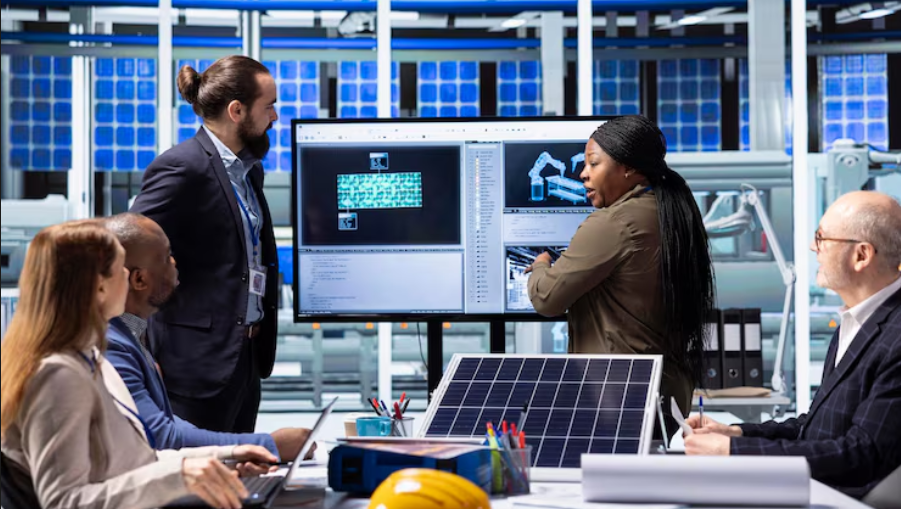
SWPC forecasters use a combination of satellites stationed at particular locations in space and ground-based instruments. One of the most significant is the Deep Space Climate Observatory, or DSCOVR, which provides real-time solar wind data and is located at the first Lagrange point between Earth and the Sun, about a million miles away. Solar imagery has been provided for decades by SOHO, a joint NASA and European Space Agency mission. It’s important to note that both missions have greatly outlived their initial engineering lifespans. Concerns about what would happen if they failed before their replacement was operational are becoming more prevalent within NOAA. The Director of NOAA’s Office of Projects, Planning and Analysis, Dr. Elsayed Talaat, has stated in public that the agency’s capacity to forecast and issue timely warnings would be severely hampered by any break in observational continuity.
The Space Weather Follow-On Lagrange-1, or SWFO-L1, is currently under development as a replacement. The crucial measurements of solar wind speed, density, and magnetic field will continue while it remains in the same orbital position. Forecasters at SWPC will use the data it generates to determine the anticipated timing and magnitude of geomagnetic disturbances. It functions as a sort of advance warning system, providing airlines, military units, grid operators, and satellite companies with the information they need to safeguard their systems prior to the storm.
This place has something worthwhile to sit with. There is an unseen reliance on the Sun acting sensibly every time you use GPS, every time a weather satellite feeds data into a forecast, and every time a financial transaction clears a satellite network. Usually, it does. But not every time. The Boulder forecasters are keeping an eye out for the anomalies, the flares and ejections that have actual consequences. It’s meticulous, unglamorous, and technically challenging work. Furthermore, it’s possible that the majority of those whose lives it safeguards are unaware of it.
The frequency of solar activity is increasing as Solar Cycle 25 deepens toward its anticipated peak. SWPC is making the necessary preparations. What a small office in Colorado sees before the rest of us is crucial to the infrastructure that safeguards billions of dollars in international systems.
