

The way the ocean moves has an almost mechanical quality; it is a slow, deliberate churn that occurs hundreds of meters below the surface rather than the chaos of waves or the drama of storms. Although most people refer to it by its more obvious name, the ocean conveyor belt, scientists call it thermohaline circulation. It has been operating for thousands of years, almost nonstop. Additionally, salt plays a bigger role than most people realize.
The simplicity of fundamental physics is elegant. Cold water freezes at the surface in the North Atlantic, close to Greenland and Norway. Seawater releases its salt into the surrounding liquid when it freezes. The residual water gets saltier and colder, which makes it denser. It sinks. The entire system is propelled by this sinking, which pulls warm surface water northward, pushes deep currents southward, and gradually cycles nutrients from the ocean floor back toward the light. The North Atlantic would look and feel very different without it.
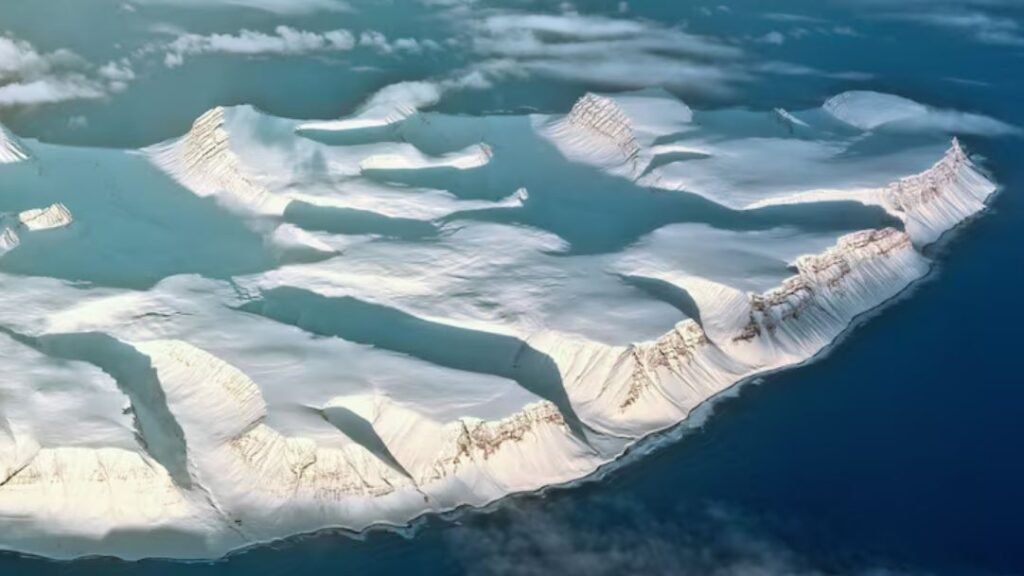
The freshwater is currently changing. Large frozen reserves that have maintained their shape for thousands of years, such as glaciers and ice sheets, are melting twice as quickly as they did twenty years ago. The world’s glaciers lost 46,000 Great Pyramids of Giza’s worth of ice between 2000 and 2023. There must be a place for that melt. The majority of it ends up in the ocean, and freshwater is lighter than the brine-heavy water produced during freezing. It floats. It doesn’t sink. This inflow of lighter, fresher meltwater is essentially diluting the very saltiness that drives the conveyor belt’s engine in the North Atlantic.
This is what some researchers are subtly calling a “great desalination” of the North Atlantic itself, not of drinking water. Furthermore, the issue is real. The specific current at the center of this system, the Atlantic Meridional Overturning Circulation, started to weaken approximately 400 years prior to a significant cold snap 13,000 years ago, according to a study published in Nature Communications. The climate changed gradually, almost imperceptibly, and then quickly. Over the course of what amounted to a geological eyeblink, Greenland’s average temperature dropped by about six degrees.
Sitting with that timeline is worthwhile. After four centuries of gradual deterioration, there was an abrupt lurch. Although scientists are cautious to point out that conditions today differ enough from the prehistoric record to make direct comparisons difficult, current evidence indicates that AMOC has been weakening for about 150 years already. However, as one of the authors of the study stated, the slowing itself ought to be a concern—not a distant one, but a current one.
The effects would not be dispersed equally if the circulation continued to deteriorate. Even as the rest of the world warms, temperatures in Europe, which greatly benefits from the heat carried northward by the Gulf Stream, could drop dramatically. Sea level rise may accelerate along the US East Coast. As the nutrient upwelling that supports marine food chains deteriorates, fisheries already under stress may experience additional disruption. It is not a single event, but rather a cascade.
Ocean circulation is frequently discussed in abstract terms, such as a system, a mechanism, or a model variable. However, the abstraction vanishes when you stand on the coast of Greenland or gaze at the lake-filled valley where a Swiss glacier once rested. The Swiss Alps’ Birch Glacier recently collapsed, burying the village of Blatten beneath rock and ice fragments. Glacial meltwater is still used on a daily basis by two billion people worldwide. Glaciers have always moved—they flow slowly due to gravity and their own weight—but whether they survived or vanished depended on the ratio of melting to freezing. That equilibrium is changing.
Although the ocean conveyor belt is a robust system, it has limitations. Cold temperatures, high salinity, and the proper density gradient are all necessary for it to function. It loses the very components it needs to continue turning if you flood it with too much freshwater over several decades in a covert and unannounced manner. It might not end in a single dramatic moment. It might just continue to slow until the effects on the weather, fish stocks, and European winter are evident.
As we watch this happen, it’s difficult not to feel that the ocean is sending signals that are just subtle and old enough that we haven’t responded to them as quickly as we ought to.
