

Watching the Arctic melt and witnessing the governments’ and energy companies’ quick response—calculation rather than alarm—is unsettling. A new type of discussion about who gets there first and how much is underneath has been taking place in boardrooms and foreign ministries as sea ice retreats at a rate that scientists describe as historically unprecedented.
The figures are truly astounding. According to estimates from the U.S. Geological Survey, the Arctic contains about 22% of the world’s undiscovered natural gas and oil reserves. That amounts to about 412 billion barrels of oil equivalent, which is more than twice Kuwait’s known reserves. It is mostly undiscovered beneath waters that were previously too frozen to access. That is rapidly changing. Since 1979, the amount of sea ice in September has decreased by over 25%, and this trend is continuing.
It’s not just the water that’s opening up. There is a geopolitical void. According to international maritime law, five countries—Russia, Canada, the United States, Norway, Denmark, and Greenland—have the right to exploit resources inside their exclusive economic zones. However, the legal framework governing who owns what in the deep Arctic is still being debated in international courts and diplomatic cables, the boundaries themselves are disputed, and the seabed is essentially unmapped. In 2007, Russia planted a flag on the North Pole’s ocean floor, which at the time was widely regarded as a publicity stunt. Now it seems less dramatic.
The most aggressive player is still Russia. Its state energy interests have been drilling in the Arctic for more than a century, and the region generates twenty percent of its GDP. The first offshore Arctic oil platform was the Prirazlomnaya platform in the Pechora Sea. Gazprom started production there in late 2013, the same year that thirty Greenpeace activists attempted to board it in protest and were imprisoned by Russian authorities. Currently, Moscow has more icebreakers than any other country in the world—forty. It’s not a symbolic fleet. It’s expansion-oriented infrastructure.
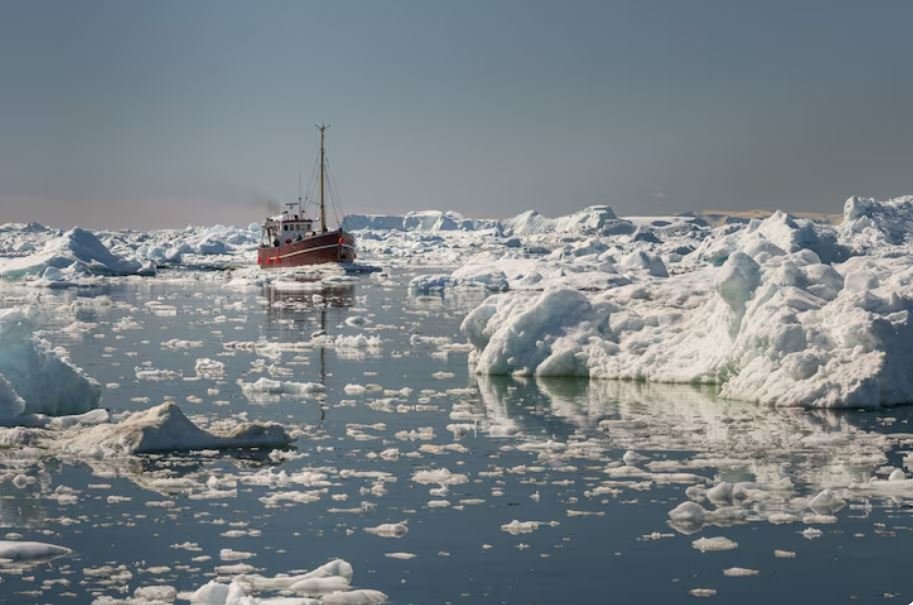
Though not solely for moral reasons, Western interests have been more cautious. After spending seven billion dollars on an Arctic drilling project off the coast of Alaska’s Chukchi Sea, Royal Dutch Shell abandoned it in 2015 due to a collapse in oil prices and a lack of economic viability rather than environmental concerns.
At the time, the break-even cost of producing Arctic oil was estimated to be close to $80 per barrel. The risk was not worth it at those margins. As the world’s energy needs change and easier reserves run out, that calculation may alter.
All of this has a cruel irony to it. Drilling for more Arctic ice is being justified by the same carbon consumption that has warmed the planet enough to melt it. In a region that is already warming at about twice the global average rate, the melting ice releases trapped methane, decreases the reflective surface that helps control global temperatures, and speeds up warming. Theoretically, that cycle would continue if what’s underneath was extracted. This is the exact argument that environmental organizations have been making for years. The planning is still ongoing.
The human element is frequently overlooked when discussing energy. The Arctic is home to about 400,000 indigenous people, many of whom rely on the immediate disruption of ecosystems. Fisheries are changing. Patterns of animal migration are evolving. Furthermore, the communities with the least influence over the course of resource extraction and climate change are the ones most vulnerable to their effects.
Whether the international community has the institutional capacity or the political will to handle what’s coming is still up for debate. Global trade flows could be altered by the Northern Sea Route along Russia’s coast, which could reduce shipping times from Europe to Asia by almost a third. The subsurface resources have the potential to change energy geopolitics for decades. All of that comes at a cost, and the cost will not be split equally. The race has already begun. The regulations have not yet caught up.
