

Samples that had been locked in the seafloor for 101.5 million years were unsealed by scientists in a Japanese laboratory using sediment cores taken from beneath the South Pacific and supplemented with nutrients. The International Ocean Discovery Program recovered the pale, fine-grained clay sediment from an area of the ocean so devoid of nutrients that very little reaches the seafloor to break down. Researchers then watched to see what transpired. Something began to grow in a few of weeks. Up to 99 percent of the microorganisms they had retrieved from the oldest layers—bacteria that had been resting in the dark at the ocean’s bottom with virtually no food since before the huge dinosaurs’ heyday—woke up, began to feed, and proliferated.
The recovery is made possible by the South Pacific Gyre. It is the least ecologically productive area of open ocean on Earth, frequently referred to as the “ocean desert,” where surface waters are so clear and nutrient-poor that very little develops and very little perishes and sinks to the bottom. This area has an incredibly sluggish rate of sediment accumulation—roughly one to two meters every million years. Because so little organic carbon reaches the floor, nothing uses up the oxygen that seeps down from the water above, making the sediment exceptionally oxygen-rich by deep-sea standards. Millions of years ago, the bacteria that ended up in these layers found themselves in an unusual situation: buried alive in temperatures that remained cold and stable for geological periods, with nearly no food and a minimal but not oxygen-free atmosphere.
The portion that has to be stopped is the discovery that the majority of those bacteria survived, since it is intuitively assumed that live organisms would perish in those circumstances. For a hundred million years, no. The University of Hawaii team and JAMSTEC researcher Yuki Morono led the study, which discovered that the microbes had survived through a type of aerobic dormancy—basically operating their metabolic processes at the very minimum necessary to prevent death, obtaining energy from trace amounts of organic material and whatever oxygen was available, without reproducing or doing much of anything for timescales that far outweigh the entire history of the mammal lineage.
The percentage is what makes the regeneration rate remarkable. It would be intriguing but not really shocking if any ancient dormant bacteria survived; it has long been known that some microbial cells can endure harsh environments for extended periods of time. However, the fact that up to 99 percent of the recovered cells responded to nutrients by proliferating and dividing shows that the great majority of those ancient populations retained the biological integrity to resume normal cellular function following what amounts to the longest known dormancy in any living organism. This is not merely marginal survival. They required to have nearly undamaged DNA. Their cell membranes have to continue to work. After a geological pause, their metabolism had to be able to adapt to new substrates.
This was likely made possible by the chemistry of the sediment. The cells appear to have been kept in a state where cellular damage accumulated slowly enough for repair processes to keep up over millions of years due to a combination of low organic carbon, sufficient oxygen, cold temperature, and physical stability. The South Pacific Gyre’s combination of features is unique, thus this formula isn’t found in many settings, but it shows that the boundary conditions for microbial survival are significantly broader than those found in earlier experimental studies.
Researchers who study extraterrestrial life have pointed out the astrobiological implications, which are worth considering without exaggerating. Subsurface habitats on Mars, icy moons like Europa and Enceladus, and other planetary bodies may provide conditions that are similar to the sediment these bacteria survived in in that they are cold, low-energy, resource-poor, and possibly stable over geological timescales. The University of Hawaii and JAMSTEC study does not prove the existence of extraterrestrial life, but it does prove that life on Earth can endure harsher and longer-lasting conditions than previously thought, which somewhat broadens the range of parameters that could support extraterrestrial life.
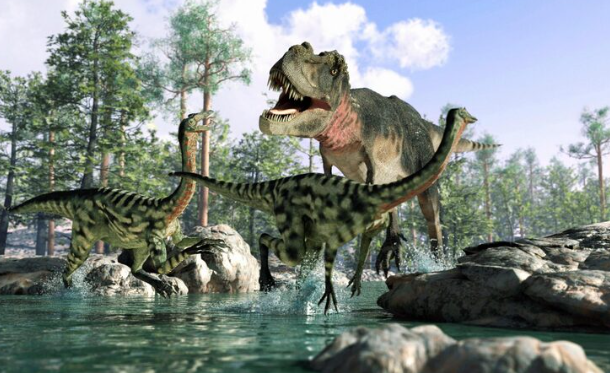
Although it is a handy news hook, the dinosaur analogy is more than that. Tyrannosaurus rex first arose some 70 million years ago, thirty million years after the oldest material in our study was building up on the ocean floor. These bacteria were found from strata that were created during the Cretaceous period, when the species had not yet evolved. The sleeping bacteria in those early Cretaceous sediments have outlived all the large animals that have lived and died throughout the years, waiting in the dark at the ocean’s bottom for someone to come with nutrients and a question about if they were still alive.
