

Waiting for results for eight years is a long time. That is effectively a whole grant cycle in the research sector, with nothing to show between the time you deploy your equipment and the time you find out if it was successful. This was known in advance by the California Academy of Sciences team that deployed thirteen monitoring structures to the seafloor off Guam. At depths of up to 100 meters, the devices—stacks of PVC plates intended to serve as tiny artificial reefs—were positioned and left there. No cameras are present. Nobody is checking in. Only time, the ocean, and whatever chose to settle in.
When the squad eventually recovered the units, they encountered far more than they could have reasonably anticipated. Thirteen structures yielded two thousand specimens. For the first time, 100 species were found in Guam seas. Additionally, there are at least twenty organisms that don’t seem to match anything that is currently documented in the scientific literature; these could be new species, such as glass shrimp, hairy crab variants, and worms with unidentified body plans. That’s a remarkable return for a single retrieval operation in waters that most people would consider to be very well-studied—the Indo-Pacific, which is close to one of the planet’s most biodiverse marine regions.
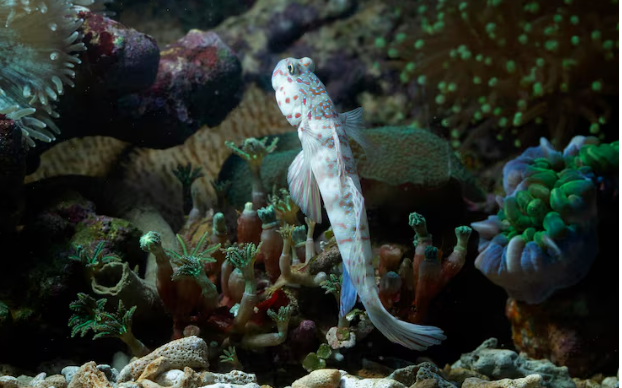
This depth range falls inside what marine biologists refer to as the mesophotic zone, or more commonly, the twilight zone. It extends down to around 150 to 200 meters and starts where recreational diving terminates. Snorkelers and scuba divers are familiar with the shallow reef environment above it, whereas the deep sea proper lies below.
Because human divers can only stay at these depths for 15 to 25 minutes before the pressure necessitates a lengthy, cautious ascent, the twilight zone occupies a midway place that has historically been challenging and costly to study. Although that window can be extended by technical diving gear and rebreather systems, systematic, long-term biological monitoring is not feasible. ARMS devices just remain there, gathering creatures over years in a manner that is impossible to duplicate thru diving.
For anything generating this level of scientific output, the PVC plate design is almost blatantly low-tech. The way the structures function is by providing surface area. Invertebrates, worms, crustaceans, and microbes are examples of marine animals that colonize any available substrate in the water, especially in settings with a lack of suitable hard surfaces. Organisms at different scales can coexist in the same structure because a stack of plates generates a complex three-dimensional environment with niches of varying sizes. It’s more of a thoughtfully designed piece of real estate that has been left in place long enough to attract renters than a piece of scientific equipment.
The result with the greatest immediate policy weight is the climate data included in the retrieval. Over the course of their eight-year deployment, the sensors within the ARMS units recorded temperature changes, and the data revealed that the twilight zone at these depths off Guam is being actively impacted by ocean warming. This is important because the mesophotic reef zone—a depth range where coral species may survive warming events that bleach their shallow-water counterparts—has occasionally been suggested, cautiously and with many caveats, as a potential refuge. Refuge framing is at least partially incorrect for this place, according to the Guam data. There is a warming indication. The twilight zone is not immune to events occurring above it.
