

Three massive turbines are spinning sixteen kilometers off the coast of Occitanie in a section of the Mediterranean that appears from the beach like any other deep blue stretch of open sea. They are not supported by foundations that are drilled into the ocean floor. They are positioned far enough out that the winds blow more forcefully and consistently than anything available closer to shore, and they float, tied to the bottom by mooring lines, rising and falling with the swells. The Éoliennes Flottantes du Golfe du Lion attained maximum capacity in July 2026. Thirty megawatts of clean electricity are provided to about 50,000 people by devices that exist in between a ship and an infrastructure project.
In a field where pilot experiments tend to remain pilot projects, France has finally put something truly operational into the water. The technology underlying this has been developed for years across numerous countries. The EFGL, created by Ocean Winds, an EDP Renewables and ENGIE joint venture, is not a demonstration. It’s a functional farm that generates power and feeds it into the grid from a spot that fixed-bottom turbines just can’t get to. Conventional offshore wind installation is not feasible due to the depth of the Mediterranean off Occitanie; it is not economically feasible to drive a pile that far into the seabed. That restriction is completely altered by floating foundations.
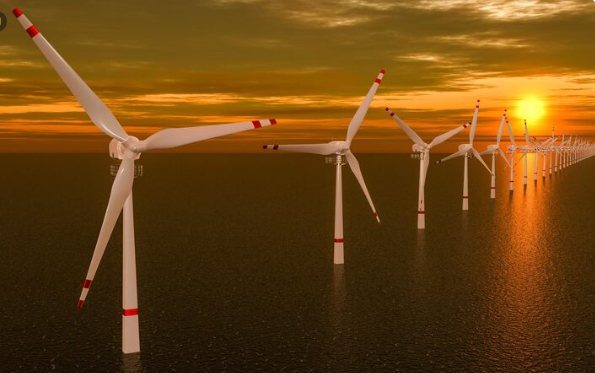
The physical description does not fully convey the elegance of the engineering principle. Each turbine is supported by a floating hull that is secured to the bottom below by anchor lines. The system, which is made to stay stable enough for the turbine above to continue spinning despite the kinds of swells the Mediterranean produces throughout its winter months, absorbs the motion of the sea rather than opposing it. This is especially useful because it shows how the turbines relate to the wind resource. Winds tend to blow more forcefully and steadily offshore, away from coastal interference and topographical impacts. at comparison to a similar machine placed on land or near shore, a turbine at that location collects more energy every hour of operation.
Beyond the energy generation figures, the part of EFGL that merits emphasis is the nature-inclusive design element. Before being deployed, the project attached 32 Ecocean Biohut artificial marine habitat structures to the floating foundations. These are specially made structures that give marine life—fish, invertebrates, and algae—shelter and surfaces to latch to, effectively turning the floaters’ submerged sections into functional artificial reef systems.
The assertion that it is the first nature-inclusive floating wind farm in the world is a sincere architectural choice taken early in the project’s development, not marketing gibberish. The industry is keeping an eye on whether that strategy becomes commonplace for floating wind or continues to be a unique aspect of this specific installation.
The project’s industrial significance goes far beyond the electricity it produces. With substantial French industry involvement in manufacturing, transport, installation, and maintenance, EFGL was constructed mostly through European supply chains. Compared to the structures used in shallow fixed-bottom offshore wind, floating wind components—such as anchor systems, hull fabrication, and cable management for a moving structure—are significantly heavier and more complex. It takes time and dedicated projects to develop the manufacturing capacity and port infrastructure to handle that complexity at scale. Both a finished reference project and the operational data required to guide the upcoming generation of larger commercial ventures are provided by EFGL.
The Mediterranean coast, the Atlantic approaches to Portugal and Scotland, and the deep-water regions off the coast of Norway are attracting the attention of investors and energy planners throughout Europe, who perceive a resource that floating wind at last makes available. The fixed-bottom locations in its shallower seas won’t be enough to meet France’s ambitious goals for offshore wind deployment over the next ten years. EFGL is the proof of concept that establishes floating offshore wind as a significant contributor to that capacity. It is not a far-off potential, but rather something that is currently producing actual kilowatt-hours for actual families.
