

When a remotely operated vehicle was roaming the bottom close to Darwin Island in the Galápagos in 2015, it stumbled across something that the scientists viewing the camera feed couldn’t quite classify. The creature was tiny, about the size of a golf ball, and it was perched on the sediment at a depth of 1,800 meters. That was an odd, but not exceptional, section. The hue was what caught people’s attention. It was a blue creature. Instead of the drab brownish-grey that deep-sea cephalopods typically wear as a sort of non-color at depths where sunlight doesn’t reach, they have a light blue dorsal surface that shades to a deep purple below. After logging it, the crew continued. Years passed before that sighting was confirmed by official scientific research.
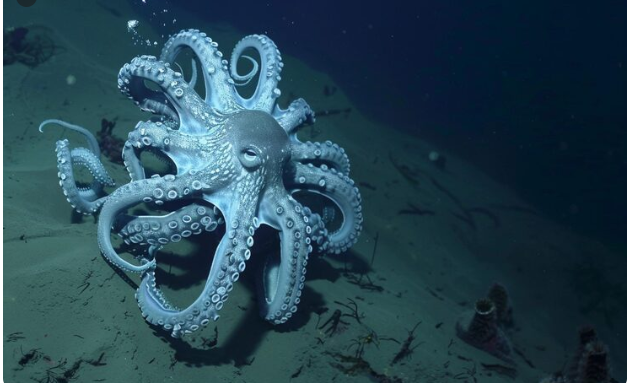
The species, which is a recent addition to the Microeledone genus—a collection of tiny octopuses found in the deep seas of the Pacific and Atlantic—is now known as Microeledone galapagensis. The formal description, which is backed by micro-CT imaging research at the Field Museum in Chicago, describes an animal that doesn’t exactly fit the pattern established by deep-sea octopus biology. Its arms are abnormally short. While most related species have two rows of suckers per arm, it only has one. Instead of having the tiny, uneven projections known as tubercles that give many octopuses their distinctive texture, its skin is smooth. Additionally, the fact that it is blue raises a query that the academics working on the description haven’t entirely answered.
In nature, blue is uncommon. Really rare, not uncommon-rare. The majority of blue hues found in animals are structural rather than pigment-based, which means that light interacts with the skin’s small physical structures to form the color rather than chemical pigments absorbing wavelengths. Because blue light is more effective at penetrating water at depth than other wavelengths, several midwater organisms have experienced evolutionary pressure to become blue.
However, Microeledone galapagensis is found on or close to the sediment, at a depth where blue penetration from the surface is practically insignificant and bioluminescence is the only light source. The researchers working on the description are open about the fact that it is not immediately clear what selective advantage a blue dorsal surface offers in such setting.
The other puzzle is the sucker situation. Octopuses use their arms and suckers as hunting tools to grab, hold, and manipulate prey. Shorter arms and fewer suckers typically indicate a different kind of prey, a different method of capture, or both. An octopus that lives on the surface would never come into contact with the microscopic invertebrates, worms, and bioluminescent species that inhabit deep-sea sediment settings. Microeledone galapagensis may have evolved to hunt something unique to the deep-sediment environment of the Galápagos, something that doesn’t require the sucker density required for a reef octopus to wrestle a crab. Even tho the evidence is yet indirect, some researchers believe it is worthwhile to investigate whether that hunting technique includes employing the characteristic colors as part of how it approaches or attracts prey in a bioluminescent habitat.
The Field Museum’s usage of micro-CT is noteworthy. There was just one specimen available for research, and dissecting it would have destroyed features before they could be accurately recorded. Without opening the animal, researchers can map internal anatomy using CT scanning at the micro level, creating three-dimensional models of organs, muscles, and nervous system features that can be studied and reexamined. Microeledone galapagensis is precisely the type of species where non-destructive imaging makes the difference between a complete scientific record and a damaged one. This technique has been revolutionizing taxonomic work on rare or delicate specimens.
