

The scenery starts to change about thirty miles west of Houston’s downtown. The billboards get thinner, the freeways get flatter, and what was once cattle land is now home to industrial parks called Empire West. It’s the type of location that rarely makes headlines. That’s going to change.
According to most accounts, Tesla has quietly started establishing a solar panel manufacturing facility in Brookshire, a small Texas city nestled along Interstate 10. The location is adjacent to the company’s Megapack Megafactory, which is currently being built. It seems intentional to combine the two on one campus. Placing the electricity-generating panels next to the batteries that store it makes sense because it creates a fully integrated energy system on a single plot of Texas land.
According to reports, Tesla is aiming for a difficult-to-absorb scale. The company aims to develop 100 gigawatts of annual solar manufacturing capacity in the United States by 2028. For comparison, that number would place Tesla among the world’s biggest producers of solar energy, competing with Chinese behemoths that have controlled the industry for more than ten years. The number might be aspirational. Given Musk’s track record with public targets, skepticism makes sense. However, the equipment orders are genuine and the capital is flowing.
Naturally, Tesla’s solar story has been a mess. Following the 2016 acquisition of SolarCity, a Buffalo factory deal worth almost $1 billion in New York subsidies was made. This facility was never going to be the biggest solar plant in the Western Hemisphere. Panasonic eventually took over production, but they left in 2020. Buffalo produced Supercharger parts and labeled Autopilot data for many years. Inquiries about solar ceased from investors. The business ceased to report it.
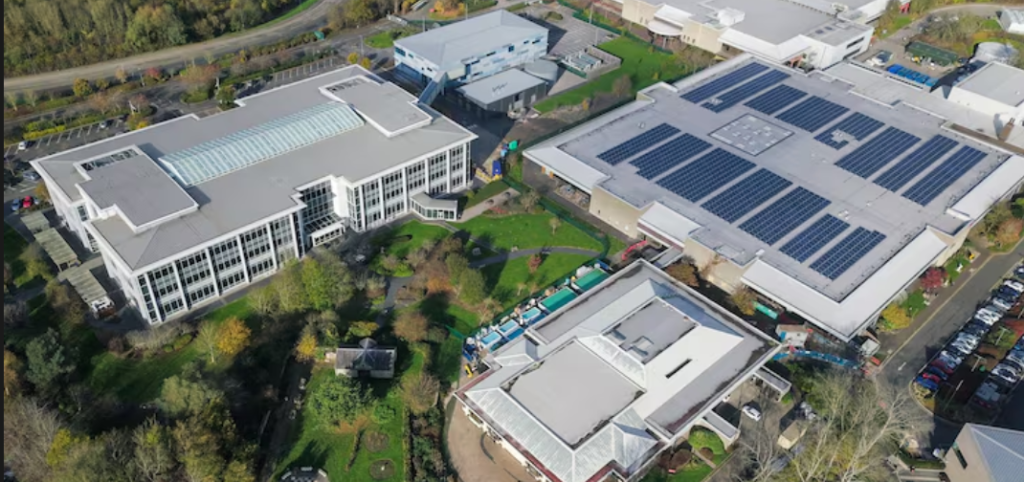
Thus, it feels odd in a subtle way to watch this Texas project take shape. It’s the second opportunity that Tesla wasn’t anticipated to accept. The TSP-420 panel, which was produced in Buffalo in small quantities, marked the beginning of the revival last year. Then, in Davos in January, Musk casually declared that SpaceX and Tesla would each construct 100 GW of solar power in the United States. The $2.9 billion order for Chinese manufacturing equipment, mostly from Suzhou Maxwell, was then reported by CNBC. The parts are coming in. The plants are being constructed.
The relatively simple process of panel assembly is not the only thing being installed in Brookshire. According to reports, Tesla is developing a fully vertically integrated business, combining the production of photovoltaic cells, ingot growth, wafer slicing, and completed panel assembly under a single operational umbrella. Precision-tooled machinery, cleanroom-grade settings, and a workforce that is largely untrained in Texas are all necessary for this. Even by Tesla’s standards, the initial builds will cost more than $250 million in capital expenditures.
The timing makes sense. Due to AI data centers, electric cars, industrial reshoring, and the gradual electrification of almost everything, the demand for electricity in the United States is rising more quickly than it has in a generation. The quickest and least expensive solution is increasingly thought to be solar power combined with storage. The reasoning behind Brookshire becomes more apparent when you consider the political pressure to produce domestically, which includes supply chain disruptions, tariff disputes, and the persistent shadow of Chinese dominance.
Even so, it’s worth stopping before the festivities. There is a distinct level of difficulty when scaling to 100 GW. Lead times for equipment can take years. The supply of polysilicon is limited. There is hardly any skilled labor available in the US for the production of cells. Tesla has previously failed to meet goals, sometimes spectacularly. Analysts believe that the company is truly committed this time, but execution and commitment are two different things.
The work is quietly going on outside the Brookshire site. Trucks arrive and depart. Steel rises. In a state better known for its oil, engineers are working somewhere inside to figure out how to grow silicon ingots. The symbolism in that is difficult to ignore.
