

A local villager in Chaiyaphum Province, northeastern Thailand, noticed something strange near the edge of a shared pond sometime in 2016 during the dry season. Every dry season in that region of the country causes the water level to drop, and what appeared to be unusually large, oddly shaped rocks protruded from the exposed earth. They weren’t rocks. They were the remains of the biggest dinosaur ever discovered in Southeast Asia. The animal had been peacefully resting there for between 100 and 120 million years.
The animal is now known as Nagatitan chaiyaphumensis. Although it’s a mouthful, the reasoning behind it is sophisticated. “Naga” is based on the mythological serpent of South and Southeast Asia, which has long been portrayed in Thai temples as having scales, coiling bodies, and a sort of divine control over water. Given that the naga is a creature of water and vastness and the fossils were extracted from a pond’s edge, the connection seems purposeful and appropriate. “Chaiyaphumensis” just means “from Chaiyaphum,” while “Titan” refers to sheer scale. The location gave it that name. It was framed by mythology. For a dinosaur that weighed about 27 tonnes, or nine adult Asian elephants crammed into one heaving, long-necked body, that’s a pretty good combination.
To give you an idea of the scale, the humerus, a single bone in the front leg, was almost six feet long. The study’s leader, Thitiwoot Sethapanichsakul, a Thai PhD candidate at University College London, was pictured standing next to it. He is not as tall as the bone. That picture does something that a data sheet cannot: it gives the animal a sense of realism that is rarely possible with just numbers. Sethapanichsakul has referred to himself as a “dinosaur kid,” and the fact that the creature he studied and officially named for years is from his native nation is truly touching. He described it as the realization of “a childhood promise.” At that point, it’s difficult not to feel something.
The site underwent excavations from 2016 to 2019, and further fieldwork was finished in 2024. After recovering the leg bones, spine, ribs, and pelvis and analyzing the remains using 3D scanning, researchers came to the conclusion that they were studying a completely unidentified species. According to the researchers, the Nagatitan was about twice as large as any other known Thai sauropod. It belonged to the family of long-necked, barrel-bodied plant eaters known as sauropods, which also includes the Diplodocus and Brontosaurus. Additionally, it was substantially heavier than Dippy the Diplodocus, the well-known composite cast that was housed in London’s Natural History Museum for many years.
The Nagatitan lived in a dry, warm environment with winding river systems that carried turtles, crocodiles, and freshwater fish. It coexisted in that world with early Triceratops relatives and smaller plant-eaters. Given that temperatures were high and carbon dioxide levels were rising in the late Early Cretaceous, it’s plausible that the creature’s enormous size was a reaction to the climate. There is serious scientific disagreement over how sauropods were able to flourish and grow so large in those circumstances. The most popular theory is based on the sheer amount of plant material they ate—bulk-browsing seed ferns and conifers with little chewing. It seems that the ancient Thai landscape supplied the enormous amounts of food that an animal of that size required.
The Nagatitan has been dubbed “the last titan” of Thailand by the researchers, and that moniker has special significance. The fossils were discovered in the nation’s youngest dinosaur-bearing rock formation. The area gradually changed into a shallow sea after this geological layer, engulfing the land and everything on it. There would be no more sauropods to stroll. The largest creature ever discovered in Southeast Asia was also, in essence, the last of its kind in the area; it was gradually wiped out by the silent, unstoppable rise of ancient water rather than by a catastrophe, making for an oddly poetic conclusion.
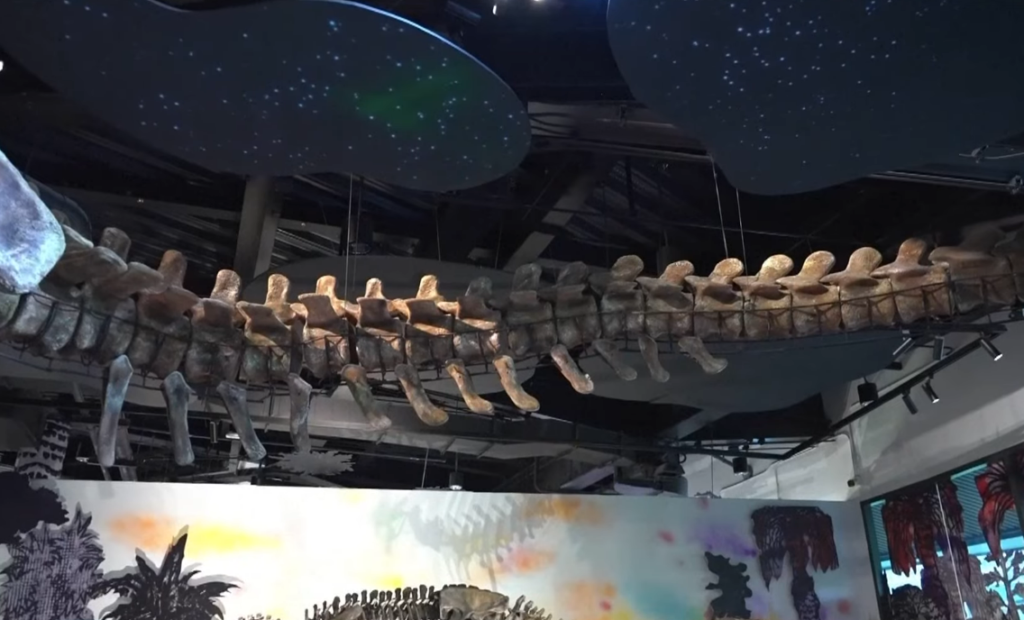
The Thainosaur Museum in Bangkok currently has a life-size replica. If nothing else, it’s worthwhile to stand next to something so massive and briefly try to visualize the ground trembling.⁖※
