

A volcano the size of a small city is located about 300 miles off the coast of Oregon, at a depth where the pressure is about 140 times what you’d feel standing at sea level and no sunlight has penetrated since the ocean formed. It erupts roughly every ten years, reshaping miles of seafloor and supporting a thriving ecosystem of creatures that, according to most conventional biological logic, shouldn’t exist. The most active volcano in the northeast Pacific is Axial Seamount.
In 1998, it erupted. In 2011, it erupted once more. When it erupted in 2015, the seafloor monitoring devices that scientists had set up to observe it were covered by lava flows. Every time, the network of cabled sensors on the ocean floor recorded the events in greater detail than any prior recorded eruption of this type. The seafloor off the Pacific coast of the United States is far more active than previously thought, according to the picture that has evolved from those studies.
The Regional Cabled Array, a network of ocean-bottom sensors run by the University of Washington’s interactive oceans program and financed by the National Science Foundation, is the monitoring system that makes Axial Seamount the most closely observed undersea volcano in the world. Instead of keeping data until a research ship returns to collect it, the array transmits data in real time by connecting seismometers, pressure gauges, temperature sensors, and hydrophones to a fiber-optic cable that runs to shore.
The seafloor physically swells upward as magma builds up beneath it, and the continuous data stream has shown that Axial Seamount’s magma chamber inflates between eruptions at a measurable rate that is faster than similar processes at land-based volcanoes like Mount St. Helens. By monitoring the inflation over time, researchers can predict when the pressure will rise to the point where the next eruption will occur. It is a predictable volcano in the strictest sense of the word.
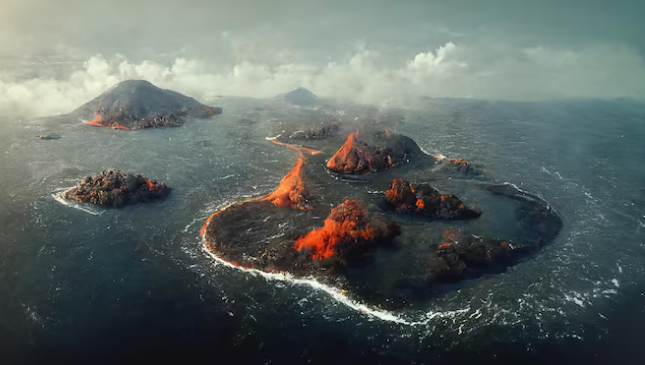
The term “volcano” is not frightening to residents of coastal Oregon or Washington because the eruptions themselves are not violent. At the bottom of Axial Seamount, the ocean exerts around 140 atmospheres of pressure, which is sufficient to stop the explosive fragmentation that is typical of surface eruptions. Pillow-shaped formations, which are the distinctive rounded shapes formed when hot magma meets cold seawater and the surface quenches more quickly than the interior, are formed as lava escapes from the vents and spreads across the seafloor.
Tsunamis are not produced by the eruptions. They don’t generate the kind of strong seismic signals linked to the risk of earthquakes. They are geologically striking but essentially invisible to those who live above them, which helps to explain why the amount of activity occurring on the Pacific bottom was long underestimated.
The scientific significance of the hydrothermal vent communities at Axial Seamount changes from geological to biological, touching on issues that go far beyond volcanology. In addition to shrimp, crabs, fish, and massive amounts of chemosynthetic bacteria, which form the foundation of a food web based solely on chemical energy from volcanic processes rather than sunlight, black smoker vents—named for the dark plume of superheated, mineral-rich water they emit—support dense communities of tube worms that can grow up to two meters in length.
These are not struggling, marginal ecosystems. Organized around a whole different energy source than nearly everything else on the world, they are among the most ecologically productive habitats on earth per unit area.
Because it is both a real scientific subject and one that is often exaggerated, the beginnings of life question looms over this research in ways that researchers carefully consider. The temperature gradients, mineral-rich water, and concentration of organic precursors at hydrothermal vents are some of the most plausible settings for the emergence of early life on Earth.
Additionally, they are similar to conditions that may exist on ocean worlds such as Europa and Enceladus, where liquid water is thought to exist beneath silicate rock covered by ice shells. There’s something about watching the lava flows from Axial Seamount spread across the Oregon Ridge seafloor and the vent communities that follow them rebuild within years of each eruption that reads less like a geological curiosity and more like an illustration of how obstinately life manages to infiltrate the areas that appear most hostile to it.
