

For a century, whale remains provided scientists with nearly all of the information they needed to understand the enormous squid. Contents of the stomach. Only a portion is left. The occasional beak. It was barely sufficient to determine the animal’s true identity, but it was sufficient to verify its existence. Then, on March 9th of this year, the squid was simply floating in the frame of a remotely operated vehicle called SuBastian as it drifted through chilly, dark water almost 2,000 feet below the South Atlantic Ocean.
The video was taken during an expedition by the Schmidt Ocean Institute close to the South Sandwich Islands, a region of the ocean so remote that the closest people at the time were supposedly on the International Space Station. According to Dr. Michelle Taylor of the University of Essex, who was in charge of the 35-day research mission, when the creature first appeared, the team wasn’t quite sure what they were looking at. Despite this, they filmed it because, as she put it, it was “beautiful and unusual.” It turned out that instinct was important.
People were almost immediately taken aback by the size. The enormous squid in the video was about 30 centimeters long, or slightly less than a foot. This was obviously a juvenile because adults of the species are thought to grow up to 23 feet in length and weigh up to 1,100 pounds, making them the heaviest known invertebrates on the planet. Basically, a baby. It appears more like something from a fever dream than a living animal; it is transparent, almost ghostly, and has pearly organs visible through its body.
Notably, the scientists on board were unable to identify the creature in real time. The animal was identified as a potential colossal squid by an online viewer of the live-streamed ROV footage. One of the most important zoological sightings of the century, initially noticed by someone watching a stream from home, is a little odd when you sit with it.
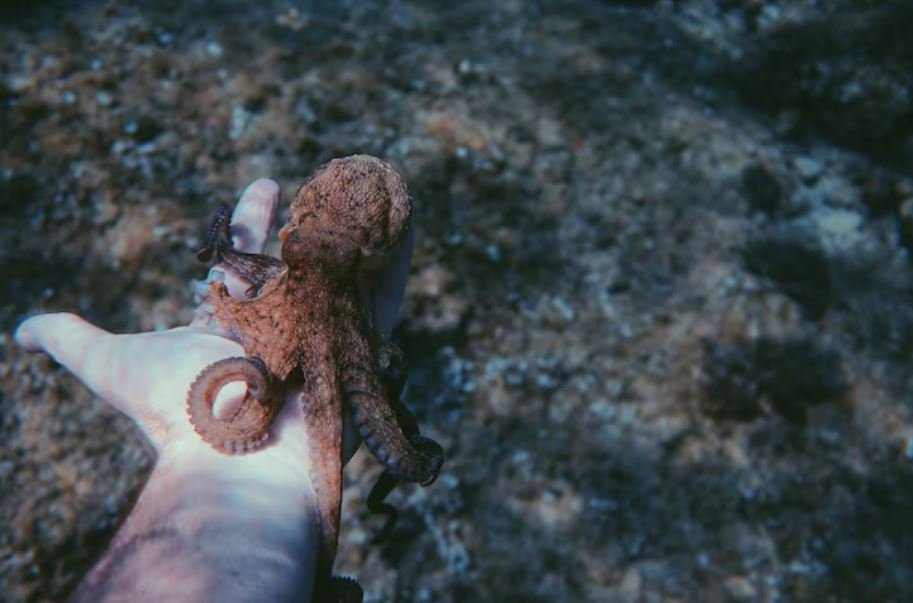
Squid biologist Dr. Kat Bolstad of Auckland University of Technology, who assisted in the video’s verification, has dedicated her professional life to researching this species primarily through the remains of predators. At one point, she used recovered remains to reconstruct an entire enormous squid. Her description of this moment as one of the most thrilling discoveries in the field’s history therefore carried some weight. Additionally, she revealed something subtly startling: the squid “has no idea that humans exist.” It’s understandable why so many people have found resonance in that line.
These animals have long shunned cameras for a practical reason. According to Bolstad, colossal squids have incredibly large and sensitive eyes, which most likely evolved to detect the faint bioluminescent flickers of prey in almost complete darkness. Research submarines are often bright and noisy, just the kind of disturbance that would cause a cautious squid to freeze or retreat into the dark. The squid wasn’t intentionally hiding from us. It’s more that we were loudly announcing ourselves in a place where silence is the norm without even realizing it.
The animal’s middle chapters are currently of greatest interest to scientists. Nearly nothing is known about the colossal squid’s early life, including its diet, growth rate, and behavior prior to adulthood. Although this video doesn’t provide answers to those queries, it does provide researchers with a starting point.
An actual representation of the creature halfway between hatching and the massive, hook-armed adult form that has been incorporated into deep-sea mythology for many years. Given how infrequently these expeditions record anything at all, it’s still unclear if more footage will be easily obtained, but the fact that the same team recorded a glacial glass squid on a different expedition only months prior raises the possibility that the southern ocean is revealing its mysteries a bit more easily than in the past.
The enormous squid was officially named in 1925 after its remains were discovered inside a sperm whale. It was captured on camera exactly a century later, living in its own water and going about its peaceful business up to almost 2,000 feet below the surface as a foot-long transparent squid. The timing seems almost too perfect to be a coincidence, even though it is. Symbolic schedules are rarely used in science. It only sometimes, and unexpectedly, produces something memorable.
