

The fact that one of the most important conflicts over the world’s food supply is taking place somewhere above the clouds rather than on the water is subtly amazing. Satellites fly overhead in silence. Radar imagery is churned by algorithms. And somewhere in the Pacific or off the coast of West Africa, a government analyst’s screen abruptly displays a fishing vessel operating in the dark with no broadcast signal, no transponder, and no intention of being located.
This is how the U.S. Coast Guard actually uses xView3. The Defense Innovation Unit and the nonprofit Global Fishing Watch worked together to develop the system, which uses machine learning models trained on synthetic aperture radar imagery to identify “dark vessels”—ships that purposefully turn off or tamper with their automatic identification systems to evade detection. It’s a very successful form of defiance. Until recently, that is.
Clouds and darkness are irrelevant to synthetic aperture radar. It penetrates both, charting the ocean’s surface with the kind of apathy that makes avoidance truly challenging. The goal of the xView3 challenge, a machine learning competition with a $150,000 prize, was to identify the best algorithm that could automatically process that imagery and flag suspicious vessels without the need for a human analyst to manually sort through thousands of miles of satellite data. Serious talent entered the 2021 competition, and the Department of Transportation and the Navy already used the results.
The Coast Guard’s deputy commandant for operations, Vice Admiral Scott Buschman, made it clear why all of this is important. He claimed that illegal, unreported, and unregulated fishing, or IUU fishing, weakens the international rules-based order and threatens national sovereignty. Although that may sound like diplomatic language, the scope of it is truly astounding. According to estimates from the UN Food and Agriculture Organization, about 20% of the world’s seafood harvest comes from IUU fishing. That percentage rises to 50% in some areas. It’s not a rounding error. That is the covert looting of half the ocean.
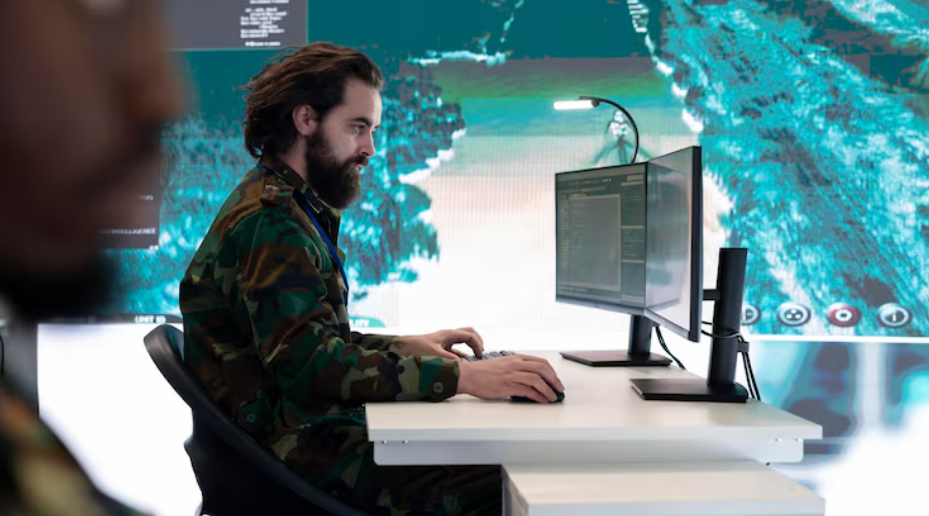
The effort’s peculiar geometry is difficult to ignore. The Coast Guard, NOAA, a Pentagon innovation office, a nonprofit, and a variety of foreign partners all rely on open-source algorithms that are freely shared and accessible to anybody with the necessary infrastructure. Global Fishing Watch’s chief innovation officer, Paul Woods, put it simply: the more people use these tools, the more quickly illicit actors lose their space to operate. There’s a democratizing logic there that seems out of the ordinary for a program that is close to defense, and it appears deliberate.
The U.S. military’s Africa-focused command, USAFRICOM, provided perhaps the clearest example of what the system has truly accomplished. According to officials there, xView3 offered information about dark vessel activity on the African continent that was previously unavailable in terms of both volume and accuracy. From a command with substantial intelligence resources, that is a significant admission. It implies that rather than merely enhancing current capabilities, the technology is actually closing a gap.
It’s worth stopping to look at the pipeline itself. The winning xView3 models pull real-time imagery from the European Space Agency’s Sentinel-1 constellation, process it, and then feed it into maritime awareness platforms such as SeaVision. An automated detection list can now be filtered by analysts who previously had to manually examine satellite imagery in order to find a single vessel of interest. Decision-making replaces spotting as the bottleneck.
It is genuinely unclear if this will result in ongoing enforcement action at sea. It’s one thing to detect. Another is interception over an open ocean. The political will to act on intelligence varies greatly among partner countries, and the Coast Guard is a small force in comparison to the geography it monitors. Observing this endeavor, however, gives the impression that the information advantage is changing. Once, the ocean seemed endless. It is becoming smaller.
