

A ship that refuses to be located has a subtly unsettling quality. It cuts its transponder somewhere beyond the horizon, sails under a flag it didn’t earn, and carries insurance documents that don’t stand up to scrutiny. When an oil spill occurs or a cable breaks, the world takes notice for a moment before forgetting once more. However, there is another aspect of this story that has gone mostly unnoticed: an increasing number of these unregulated vessels are transporting more than just crude oil. They are collecting information. mapping the bottom of the deep ocean. methodically, systematically, and entirely outside the purview of international supervision.
From about 600 ships in late 2022 to what Ukraine’s government now lists as more than 1,300 ships as of February 2026, the shadow fleet—loosely defined by the International Maritime Organization in late 2023 as ships involved in illegal operations to evade sanctions, environmental regulations, or insurance requirements—has grown dramatically. Just that growth ought to make people stop. However, the more serious issue is what some of these ships are doing when they’re not transporting oil, a topic that defense analysts and oceanographers discuss cautiously.
Multibeam sonar systems, acoustic sensors, and sub-bottom profilers—technologies initially intended for navigational safety that can, almost incidentally, gather incredibly detailed maps of the ocean bed below—are becoming more and more common on contemporary tankers and cargo ships. With its ownership structure hidden under three shell companies and its AIS transponder dark, a ship idling in the Baltic or drifting slowly through the Danish Straits can survey miles of strategically sensitive seabed without submitting a single report. The information it collects, such as the depth profiles close to naval installations, the location of possible cable corridors, and the form of underwater ridges, does not vanish. It travels somewhere.
It’s important to keep in mind the events of late 2024, when the tanker Eagle S was investigated by Finland due to alleged sabotage of underwater power cables that connected Finland and Estonia. The ship was confiscated. Protective operations were initiated by the Estonian Navy. Suddenly, a pattern that had been developing for months became more apparent: shadow fleet ships weren’t just putting coastlines at risk with spills. They were working in areas where the ocean floor has important secrets, close to vital infrastructure.
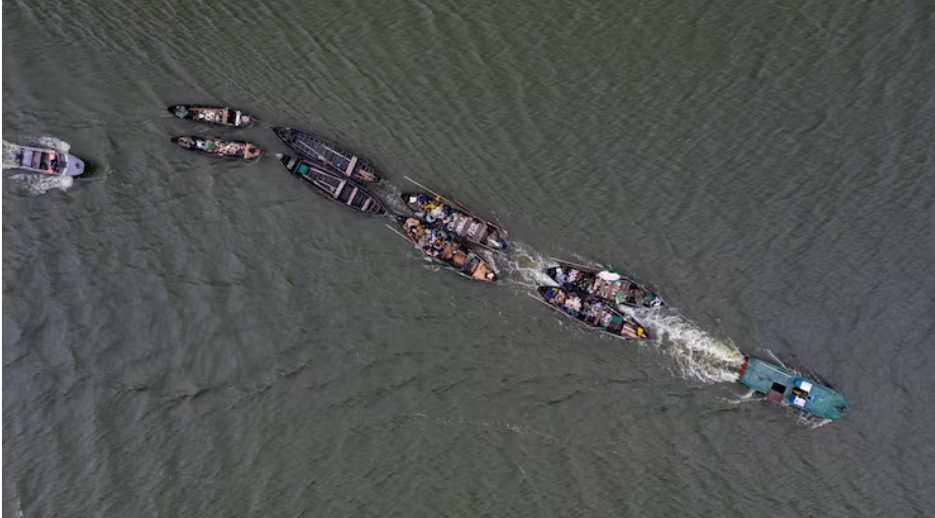
According to reports, two thirds of ships transporting Russian oil do not have adequate, verifiable insurance. They are elderly. They disintegrate. They ignite. In 2023, the ship registry of Gabon, one of the favored flag-of-convenience countries, more than doubled, and an estimated 98% of its tankers were deemed high risk with no known owner. Given the worst Black Sea oil spill of the century in December 2024, there’s a feeling that the environmental catastrophe angle—real and serious as it is—has actually provided helpful cover for more subdued activities taking place literally below the waterline.
Addressing this is almost elegantly challenging due to international law. Ships are still allowed to pass through territorial waters in an innocent manner under UNCLOS. Access to the Danish Straits for merchant ships is guaranteed by the Copenhagen Convention of 1857. These are outdated agreements that were created for a different era of shipping, and they coexist uneasily with the reality that a ship can simultaneously assert its innocence and carry out deep-water surveys of seabeds that coastal nations would strongly prefer to remain unexplored by foreign entities.
As this develops, it’s difficult to avoid the impression that the policy discourse has been lagging behind the operational reality by roughly three steps. In order to stabilize energy markets, the U.S. Treasury temporarily lifted restrictions on Russian oil stored in detained shadow fleet tankers in March 2026. This is an example of how sanctions are tightened and then subtly relaxed. In December 2024, twelve European countries decided to work together to disrupt the fleet. These are significant actions. However, the ships continue to operate in waters that belong to everyone and, increasingly, to whoever is most willing to map them first, while they move slowly and run sensors.
