

Observing a color vanish from the world’s oceans has a subtle, unsettling quality. Only satellite sensors and deep learning algorithms tracking decades’ worth of chlorophyll data across millions of square miles of open water can measure it in fractions rather than dramatically or all at once. The greenery of the oceans is diminishing. Furthermore, the ramifications of that one sentence go well beyond what would fit neatly into a news cycle.
Between 50 and 80 percent of the oxygen in the atmosphere is produced by microscopic, mostly invisible phytoplankton, which is in decline. A seminal study that monitored chlorophyll concentrations in low- to mid-latitude oceans from 2001 to 2023 and was published in October 2025 in Science Advances discovered a steady, statistically significant decline of about 0.35 micrograms per cubic meter annually. It sounds insignificant. It most likely is.
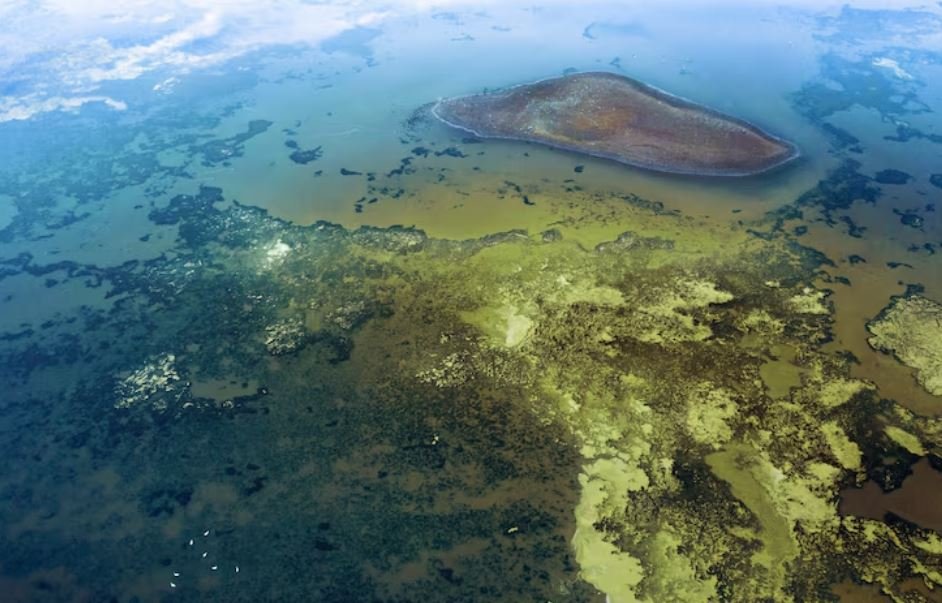
Although the consequences are complex, the mechanism is not. The upper layers of water warm more quickly than the depths below as ocean surface temperatures rise. This tightens what oceanographers refer to as stratification by increasing the temperature differential between the surface and deep ocean. Beneath a warmer thermal layer, the cold, nutrient-rich water that phytoplankton need to grow is trapped and cannot rise. Lacking fuel, the phytoplankton produce fewer blooms. They don’t multiply as much. They make the water less green. Carbon capture decreases. The production of oxygen decreases. Everything that is related to them, which is, in a way, everything, changes.
One of the study’s collaborators, Michael Mann, said it was the first study to confidently and robustly show a decline in ocean greenness. That wording is cautious, almost restrained. The rate at which these changes will intensify and the point at which the disruption to marine food chains becomes irreversible are still unknown. However, the direction is no longer uncertain, and that is important.
This is hard to explain because the stakes seem so insignificant. Phytoplankton is not observed in the same manner as polar ice or coral reefs. People are not moved by photographs. Millions of these organisms can be found in a single cubic centimeter of seawater, but you wouldn’t notice them. Only water. You wouldn’t see the base of a whole planetary oxygen system, which produces half of the air we breathe and more than all land forests put together, as the WWF pointed out last year. It’s difficult to ignore how casually that fact is overlooked when talking about the Amazon.
Compared to the open ocean averages, the coastal numbers are worse. The rate of chlorophyll loss near river estuaries is more than four times faster than the general trend. Coastal waters are experiencing a nearly two percent annual decline in high-bloom events. According to Tsinghua University researchers, the ocean’s ability to sequester carbon is decreasing by about 0.088 percent annually, or 32 million tons of carbon absorption every year. The study’s leader, Di Long, was direct about the implications for emissions targets: since the ocean’s capacity to absorb our emissions is not the stable baseline on which the Paris Agreement was based, we might face more pressure to reduce emissions than current climate models predict.
Even less comforting is the longer historical picture. Ocean acidification poses a distinct threat to diatoms, silica-shelled phytoplankton that contribute significantly to ocean biomass. Global diatom populations could decline by up to 10% by the end of the century, according to GEOMAR research published in 2022. Over 25% of diatoms may disappear if that trend continues until 2200. In terms of sequestering carbon and oxygen, scientists likened that loss to eradicating the entire Canadian boreal forest from the earth.
This type of slow emergency has an almost geological quality. Ancient coccolithophore skeletons, or phytoplankton that perished, sank, and stored carbon over millions of years, make up the white cliffs of Dover. The system has consistently functioned. For the most part, it still functions. However, the margins are getting smaller and change is happening faster than most species can keep up. Even though emissions have not significantly decreased, the ocean, which once absorbed one-third of human carbon emissions, is becoming less effective every year. There will need to be a solution to that gap that has not yet been found.
