

It takes a moment to realize that something is wrong with the water when you stand on a dock in Gloucester, Massachusetts on a calm June morning. Not dramatically incorrect, not a disastrous film. It’s just a little too calm, a little too warm, and a little too clear where it shouldn’t be. Local fishermen who have been working these waters for decades are also observing it, and some of them are picking their words carefully when discussing it, as if putting it simply might make it seem more real.
By most accounts, what is currently taking place off the U.S. East Coast is extraordinary. Across the Atlantic, a marine heat wave of unprecedented intensity has emerged, with ocean surface temperatures rising to levels that scientists are finding difficult to describe in everyday terms. Kim Wood, an atmospheric scientist at the University of Arizona, expressed on social media that she was “out of superlatives” in response to data that indicated temperatures in the eastern Pacific Ocean were rising more than usual during hurricane season. Echoes of that same pattern can be heard in the Atlantic situation, possibly more urgently.
NOAA has been keeping a careful eye on this evolving event, and their data is not very encouraging. The marine heat wave is not a transient increase brought on by a few exceptionally sunny weeks. It seems to be ingrained in deeper circulation patterns that are difficult to reset. According to the agency’s own extended projections, warming is expected to increase rather than decrease. At first, scientists thought the system would deteriorate as spring gave way to summer. It seems that hope was misguided. Reading the data gives the impression that the window for simple correction has already closed.
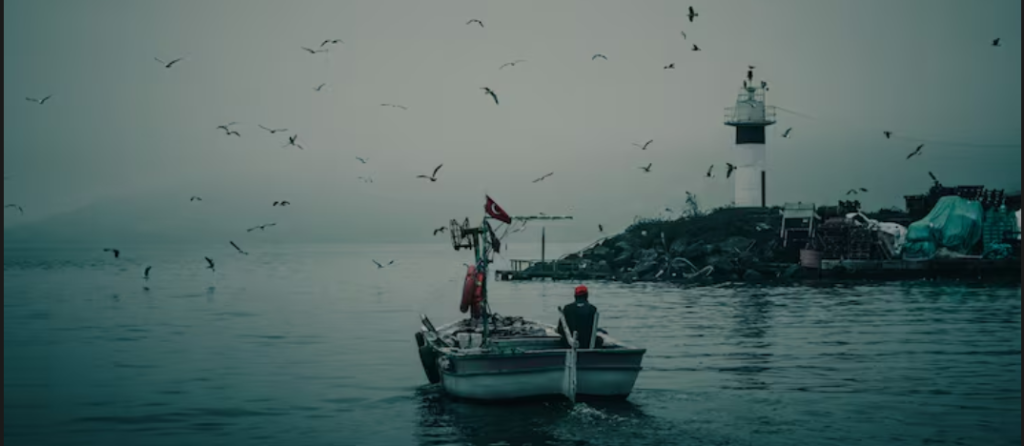
The fishing industry is keeping a cautious, restrained watch on all of this. Along the East Coast, commercial fishing operations already have to deal with more stringent regulations, growing fuel prices, and erratic stock movements. Now they also have to deal with the fact that the species they rely on are starting to migrate. Fish are compelled by warmer waters to follow cooler temperatures, which may entail traveling north or down to deeper areas that are normally inaccessible by commercial nets. Although the precise extent and speed of this displacement are still unknown, fishermen are already modifying their routes and lowering their expectations.
The way ocean temperature anomalies of this magnitude spread outward is what makes this marine heat wave more than just a story about the fishing industry. Heat is stored in abnormally warm ocean water, but it escapes the ocean and returns to the atmosphere, intensifying the type of land-based heat events that meteorologists have already predicted for mid-June. A strong ridge of high pressure is predicted to cause above-normal temperatures throughout the lower 48 states during the second week of June 2026, according to the Weather Prediction Center and the Climate Prediction Center. A feedback loop that is, to put it simply, difficult to break is created when warmer-than-average ocean surface temperatures feed into a warmer-than-average atmosphere.
The land heat wave, the marine heat wave, and the drought conditions affecting more than half of the lower 48 are all occurring at the same time, making it difficult to ignore. They are not wholly distinct narratives. They are fragments of the same one. For years, scientists have warned that as baseline conditions changed due to human-caused climate change, extreme ocean events would increase in frequency and severity. Observing the real-time arrival of that prediction, dock conversation by dock conversation, fishing boat by fishing boat, has its own weight.
The larger question is whether this summer is an exceptional season or a new normal that is arriving ahead of schedule. This is the question that the fishing industry, coastal communities, and climate researchers are all silently debating. There has previously been a warmer ocean off the East Coast. Not quite like this, though. Not quite so intense, not quite so early, and not quite so impervious to the natural adjustments that once brought temperatures back to a familiar level.
