

On a rainy afternoon in late June 2019, a research team lowered a bulbous three-seat submarine named Nadir into the Atlantic off the coast of Eleuthera in the Bahamas. It was starting to stop raining. The scientists watching from the deck probably didn’t care if it was a coincidence or a result of luck because they had spent a year preparing for this moment and the weather was free to do as they pleased.
The bluntnose sixgill shark, which most people are unfamiliar with, was their target. Instead of five gills, there are six. Unsettlingly, emerald eyes catch light. an eighteen-foot-long body. and a predilection for depths up to 4,500 feet below the surface, where there is no sunlight and oppressive pressure. Before pterodactyls and before the continents took on their present forms, these animals were swimming in ancient oceans. In a way, they predate the modern world.
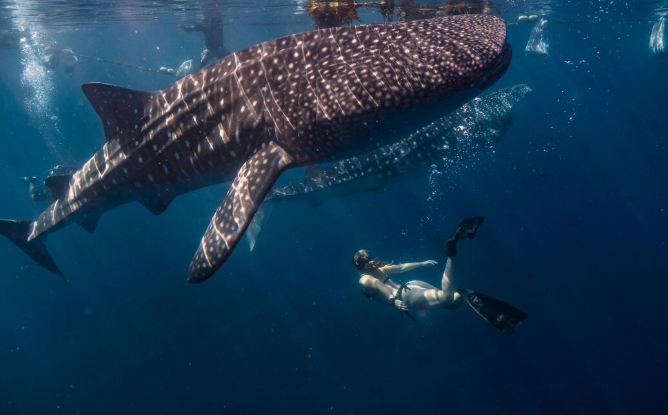
For years, Florida State University elasmobranch ecologist Dean Grubbs had been attempting to conduct a thorough investigation of bluntnose sixgills. He was able to tag one back in 2005, but the technique was difficult. Hook it, use fishing line to pull it to the surface, attach a satellite tracker close to the dorsal fin, and then let it go. Technically, it worked. In this manner, he tagged more than twenty sharks in five different parts of the world. However, he was bothered by something. The sharks made it to the surface, but for a few days afterward, their behavior was abnormal. They seemed to be affected by the experience of being pulled from the freezing depths to the bright surface and back. This implied that the information obtained right after tagging might not accurately represent the sharks’ way of life.
This insight gave rise to what initially appeared to be an impractical concept. What would happen if you tagged the shark down there, in its natural habitat, without ever bringing it up? What if the shark approached the submarine instead of the other way around?
When put simply, it sounds obvious. However, putting it into practice required finding solutions to issues that didn’t already exist. Nadir’s exterior was equipped with two spearguns, providing the team with precisely two opportunities each night to correctly tag an unrestrained deep-sea predator. In that configuration, there is virtually no margin for error. One poor angle, one tiny calculation error, and the chance is lost. Most research budgets are unable to cover the costs associated with the entire operation, including crew, equipment, and submarine time. The cost of using Woods Hole Oceanographic Institution’s submarine Alvin is approximately $45,000 per day. The cost of this kind of science is truly sobering.
The Moore Bahamas Foundation, Bloomberg Philanthropies, and OceanX, a marine exploration project financed by hedge fund billionaire Ray Dalio, all supported the mission. The extent to which private funding is essential to deep-sea research cannot be overlooked. These levels are rarely reached, either literally or figuratively, by government funding alone.
When the team finally came across a bluntnose sixgill in its natural habitat after the Nadir descended, tagging it represented more than just a technical accomplishment. It made it possible to comprehend an animal that was virtually unknown to humans until recently. When asked what scientists know about these sharks, Simon Thorrold of the Woods Hole Oceanographic Institution allegedly laughed and said it would be quicker to describe what they do know. which is almost nothing. The population cannot be estimated by researchers. They have no idea where the sharks breed. The duration of gestation is unknown to them. They are listed as near threatened by the International Union for Conservation of Nature, but that classification is based on incredibly scant information.
Eventually, the deep-sea tagging approach should show whether and to what extent the surface-tagging method was distorting behavioral data all along. It’s possible that the sharks continued to exhibit trauma-related behavior for days following conventional tagging, which would indicate that years of research contained a subtle error that was impossible to quantify. The idea is unsettling. That kind of interference is supposed to be taken into account by science, but this specific variable was ignored for a long time.
For hundreds of millions of years, the bluntnose sixgill has been circling in the dark, completely unaffected by human curiosity. The fact that it took a submarine, two spearguns, the support of a billionaire, and more than a year of planning to get a good look at them on their terms is almost humble. It seems reasonable to say that these sharks have already taught scientists something about the limitations of studying a world you can’t comfortably enter, regardless of what they ultimately teach researchers.
