

Akwa Ibom’s deep seaport has mostly existed on paper for more than 20 years, appearing in government statements, feasibility studies, and the occasional headline announcing a new partner. A deep-water terminal along the Gulf of Guinea that can accommodate the kind of megavessels that currently completely avoid Nigeria and instead pass through Lomé or Tema is a familiar dream. Politicians enjoy articulating this kind of vision, but funding it turns out to be much more difficult.
Governor Umo Eno took that vision to Paris this month, where he met with executives from Africa Global Logistics and went over a new Worley Parsons feasibility report. There’s a feeling that this meeting was more important than the typical round of seaport press releases. This isn’t because anything was signed, but rather because the topic of discussion has shifted, albeit slightly, from whether the port should exist to how exactly anyone gets paid to build it.
It’s important to keep in mind how old this is. The Infrastructure Concession Regulatory Commission began seeking qualified port operators in 2018, characterizing the project as a model public-private collaboration involving the Federal Government, the Nigerian Ports Authority, the state, and private investors. At one point, a consortium led by Bolloré was in a position to run the port for fifty years, recovering its investment over a fifty-year period. Like a number of previous agreements, that one quietly stalled. By 2023, the eight-and-a-half-billion-dollar plan was being publicly criticized for investor indifference and financial difficulties. Even the most enthusiastic boardroom can be sobered by numbers like that.
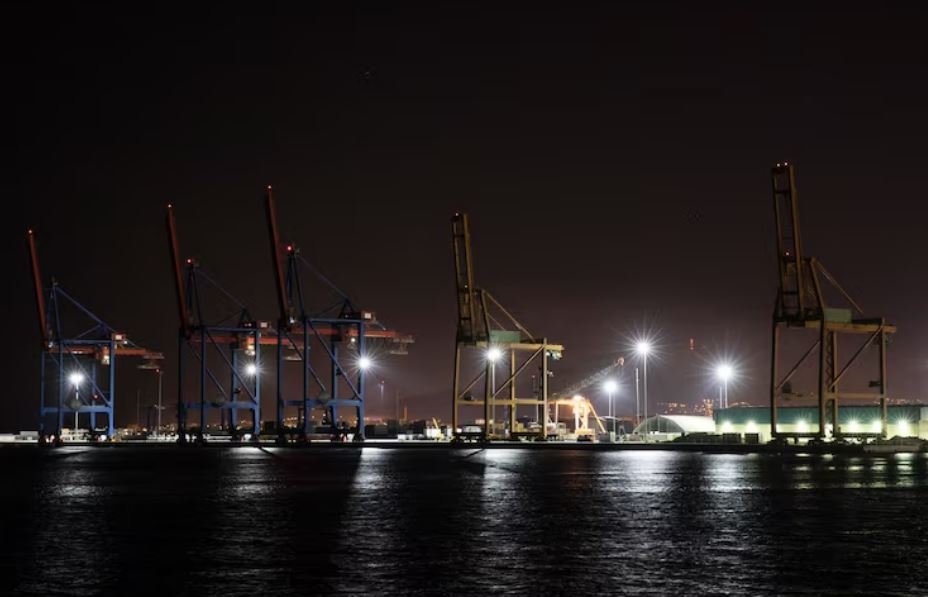
Take a moment to visualize the contrast. Lagos’s ports are always clogged, with trucks waiting days to load or unload, and exporters bearing the expenses that reduce the competitiveness of Nigerian products overseas. In contrast, the coastline of Akwa Ibom remains largely silent, with fishing boats, a few smaller jetties, and communities that have witnessed outsiders discussing billion-dollar plans for their water without much happening on the shore. In a sense, the whole story here is that gap between potential and current reality.
On paper, deep seaports seem genuinely appealing to investors. Global shipping is changing due to larger ships, and any port that can’t handle them runs the risk of becoming obsolete in ten years. The planners of Akwa Ibom are aware of this and have framed the project as a transshipment hub for ships carrying up to 13,000 containers, with smaller ships redistributing cargo to other ports in Nigeria. The thesis is sound. Like Rotterdam decades before, Singapore based its entire economy on the same kind of reasoning. However, the earth is not moved by these. Capital does, and thus far, capital has been noticeably hesitant.
The packaging appears to have changed. The current administration has made a conscious effort to connect the seaport to a larger infrastructure narrative, which includes an industrial city, a free trade zone, better roads, and a growing state airline. It’s unclear if that bundling actually reduces the seaport’s risk for investors or if it just makes the pitch deck look nicer. Bankers typically don’t care about adjacent ambition; what matters to them are estimates of cargo volume, dredging costs, and clarity regarding who will bear the loss if traffic doesn’t meet expectations.
Additionally, opposition voices in the state have relied on the federal question for years, implying that Abuja has quietly lost interest. That story is complicated, though not entirely resolved, by the Nigerian Ports Authority’s recent listing of Ibom Deep Seaport among projects approved for investment, along with Badagry, Olokola, Bakassi, and Bonny. Financing is not the same as being on an approved list. There are plenty of approved projects in Nigeria that are just collecting dust.
Strong technical arguments, sincere government interest, and yet, at the financing stage, a reluctance that is seldom explained in public statements are all recurring patterns in Nigerian infrastructure. The seaport at Akwa Ibom might eventually alter that trend. At the very least, Eno’s insistence on deadlines and benchmarks rather than ambiguous declarations of dedication implies an understanding that vision alone has reached its limit.
It is still unclear if Paris will attract an investor who is prepared to invest actual funds in dredging channels and pouring concrete. In Nigeria, infrastructure aspirations are typically patient. In the past, economic reality has been significantly less so.
