

There is a part of the ROV footage from the E/V Nautilus expedition in 2015 that still feels very personal for a scientific find. Someone on the ship says almost under their breath, “He’s tiny. It’s blue.” as the camera slowly moves across the ocean floor near Darwin Island, which is named after the man who also came to the Galapagos and couldn’t quite explain what he saw.
Something is said by that reaction. These are people who study the deep sea. They’ve seen weird things before. Still, this small animal, about the size of a golf ball, that was about 5,800 feet below the surface of the Pacific stopped them in their tracks.
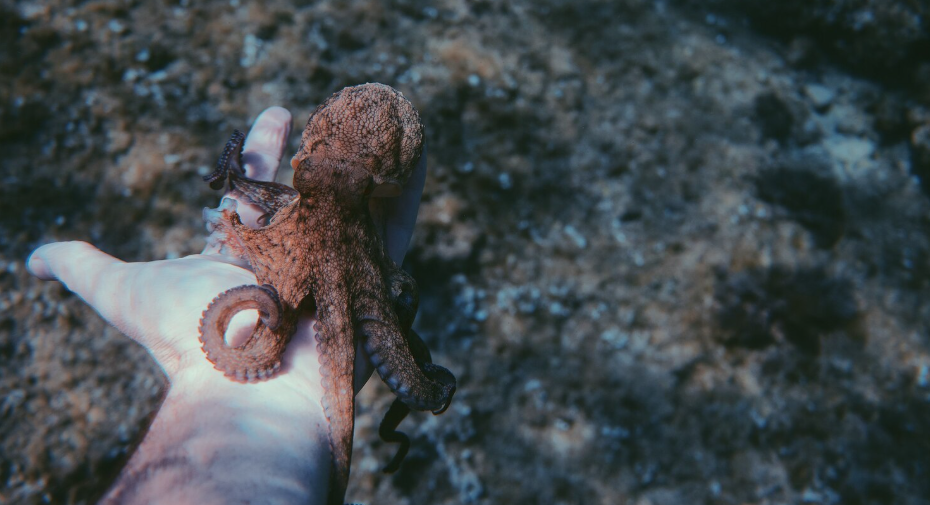
Since then, the animal has been officially named Microeledone galapagensis, which is a new species and was written up in the journal Zootaxa. It’s a small, smooth-skinned octopus with arms that are noticeably short. Its pale blue back and dark purple inner mantle made it stand out right away in the sand. Blue is really hard to find in nature. Not just in cephalopods that live in the deep sea. In nature, in general. People tend to pay attention when something down there is blue and doesn’t look like any known species.
It’s not just the discovery of a new species that makes this find interesting. People describe new species all the time, even if most people don’t hear about them. It’s the details. At first, the octopus was seen near an underwater mountain off of Darwin Island, which is at the very northern tip of the Galápagos archipelago. That place is important. In the temperate South Atlantic, Stumpy-armed octopuses from the Microeledone group have been seen off the coast of Uruguay. Finding a related species in the equatorial Pacific waters makes us wonder how these animals got there, how they changed, and how they might have become different in different oceans. The range of deep-sea cephalopods may be much bigger and more complicated than what our current maps show.
Janet Voight has been studying octopus evolution for forty years. She is the lead author of the study and the curator emerita of invertebrates at the Field Museum in Chicago. She has seen many things. Researchers at the Charles Darwin Foundation sent her a picture of the specimen, but they weren’t sure what it was. She knew right away that it wasn’t what they thought it was. “Right away, I knew it was something really special,” she said. “I’d never seen anything like it.” That’s not something someone with that much experience would say on the spur of the moment.
But there was an unusual limit on how the species could be identified. The team only had one specimen that had been kept alive. Usually, to describe a new species of octopus, you have to look at the beak, the teeth, and the insides of the animal. You can’t do any of these things without cutting the animal open. Voight didn’t want to do that. Instead, the specimen was scanned with a CT machine at the Field Museum’s imaging lab. This made thousands of X-ray slices that were then put together to make a full three-dimensional model. Without making a single cut, the inside of the body, the structures of the mouth, and other anatomical details could all be seen. Not too long ago, this kind of method wouldn’t have been possible. A small surprise was that it worked so well on a soft-bodied specimen without any contrast agents that could have hurt the tissue.
It’s not hard to see what this means in a bigger sense. The Galápagos Marine Reserve is one of the safest ocean areas in the world, but researchers admit that they still haven’t really looked into it in depth. It was sitting there in 2015, being filmed and collected, but it wasn’t officially named until years later. We don’t know what else is down there. It’s hard not to feel how much we still don’t know when you see this kind of discovery happen—slowly and carefully, with CT scans, shipped specimens across continents, and 40 years of expertise put toward a single golf ball-sized creature.
Voight said that the Earth’s land would not cover the Pacific Ocean even if it were all flattened and pushed together. Yes, that is a true statement. It’s just math.
