

Ocean color satellites have been providing scientists with the same fundamental information for around thirty years: the ocean’s level of greenery. Green stands for phytoplankton, which are microscopic organisms that resemble plants and produce oxygen, fix carbon, and constitute the foundation of the marine food chain through photosynthesis at the ocean’s surface. In general, more green indicates more phytoplankton. Less green equates to less. Sensors that detected ocean reflectance in a few distinct color bands and used those observations to estimate chlorophyll content, such as SeaWiFS (launched in 1997) and MODIS (launched in 1999), provided that signal. The information was quite helpful. Additionally, it was fundamentally a blunt instrument. It might indicate that the water contained phytoplankton. It was unable to identify which ones.
The Ocean Color Instrument, which detects light differently, is carried by NASA’s PACE satellite, which was launched on February 8, 2024. The OCI uses a technology known as hyperspectral imaging, which constantly records data spanning hundreds of wavelengths from the ultraviolet to the shortwave infrared, as opposed to sampling at a small number of discrete wavelengths.
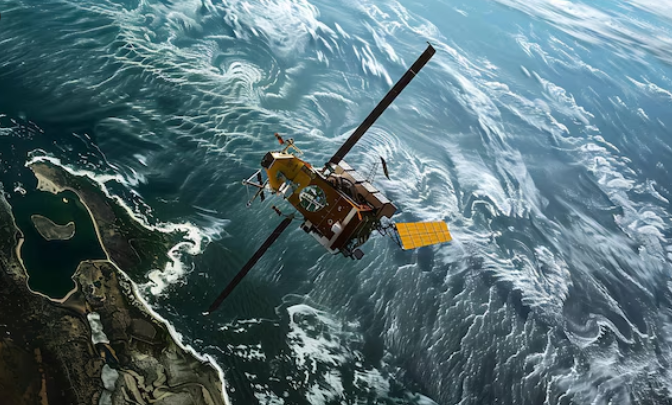
There is no incremental change in the information content between hundreds of continuous measurements and a few color bands. Light is absorbed and scattered in different spectral patterns by various phytoplankton species and populations. These patterns can be identified with sufficient wavelength resolution. The first year of data has produced results that ocean biologists have been waiting their entire lives to produce, and the OCI has sufficient resolution to distinguish between the two.
The ability to distinguish between different types of phytoplankton communities has been the specific subject of research. This is important because different phytoplankton in the water perform essentially different functions. One of the most common photosynthetic organisms on Earth, Synechococcus is a tiny cyanobacterium that behaves very differently from larger diatoms or dinoflagellates in terms of what it eats, how quickly it sinks when it dies, how much carbon it exports to the deep ocean, and how it reacts to changes in temperature, light, and nutrient availability. These organisms could not be distinguished by earlier satellites. The OCI is able to. Additionally, PACE’s maps of the distribution of phytoplankton communities throughout ocean basins are showing patterns in which particular communities predominate that were previously unobservable on a global scale.
One of the most immediately useful applications that fishery regulators and water quality managers have been concentrating on is the application of dangerous algal blooms. The management response to harmful algal blooms varies greatly depending on the organism causing the bloom. These blooms are not a singular phenomenon, but rather are created by various species under various conditions. Cyanobacteria that OCI can now differentiate from non-toxic species are responsible for some hazardous blooms. The ability to determine the cause of a bloom using satellite data instead of waiting for vessels to sample the water could shorten the time lag between bloom development and management response by several days. This is important for decisions regarding beach advisories, shellfish harvesting closures, and aquaculture operations.
Climate scientists are focusing most of their attention on the implications of species-level phytoplankton data for the carbon cycle. One of the main processes preventing carbon from entering the atmosphere on geological timeframes is the biological pump, which is the process by which carbon fixed at the surface sinks to depth in the form of dead cells, fecal pellets, and organic aggregates. However, depending on which phytoplankton populations predominate, the biological pump’s effectiveness varies greatly.
Compared to smaller, softer-bodied species that break down in the upper water column and return their carbon to the atmosphere, diatoms, which form silica shells, often sink more quickly and export more carbon to depth. Measuring those changes from space would be extremely helpful in understanding how the ocean’s role in the carbon cycle is changing if climate change is altering the balance between phytoplankton communities in ways that affect carbon export efficiency, which there are reasons to suspect it might.
