

Something begins to move south every spring when the snow melts across the cornfields of Illinois, Indiana, and Iowa. You can’t see it. Subterranean, it passes through drainage ditches and tributary streams before entering the Illinois, Ohio, and Missouri rivers, all of which feed into the Mississippi, which transports the entire pile to the Gulf of Mexico. Nitrogen and phosphorus, fertilizer nutrients that were applied to fields the previous season but weren’t completely absorbed by crops, the accumulated waste of millions of confined livestock, and regular chemical runoff from millions of suburban lawns, golf courses, and municipal drainage systems are what’s moving. There is enough of it to create an algal bloom the size of New Jersey by the time it reaches the Gulf.
The most well-documented example of a phenomenon that occurs at several locations along the U.S. coastline is that bloom and the dead zone it creates. Although it varies greatly according on spring rainfall and river flow volumes, the Gulf of Mexico hypoxic zone is the largest, averaging over 5,000 square miles at its yearly high. The concentrated chicken business in the area and the suburban expansion throughout Maryland, Virginia, and Pennsylvania provide nitrogen for the Chesapeake Bay, which has its own version. Seasonal hypoxia occurs along the Pacific Northwest coast due to both natural upwelling patterns and nitrogen loading from agricultural valleys. These are not isolated incidents. They are recurrent characteristics of a coastal system that has been taking in more phosphate and nitrogen than it can handle for many years.
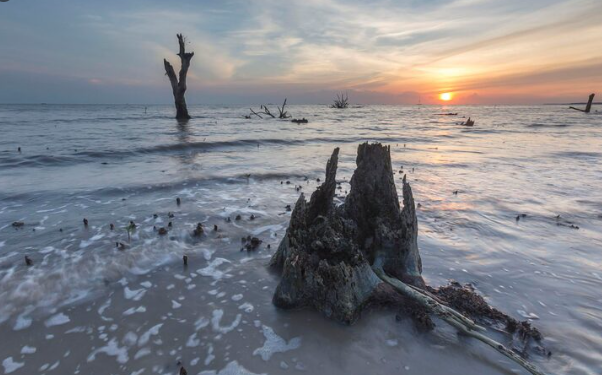
Once you understand the process that turns nutrient runoff into dead water, it is hard to ignore. Fertilizers for plants include phosphorus and nitrogen. The relevant plants in the ocean are phytoplankton, which are microscopic algae that grow quickly and densely in response to increased nutrients, much like lawn grass does in response to fertilizer. A bloom that can turn the surface of coastal water visibly green in a matter of days is caused by a nutrient pulse.
The creatures perish and sink when the bloom reaches its limit, which occurs when nutrients are depleted or light penetration is obstructed by the density of algae at the surface. Bacteria at the bottom break down organic matter, using dissolved oxygen in the process. The oxygen at the bottom of stratified water—warm, less dense water layered on top of cooler, denser water with little mixing between the two layers—is not restored quickly enough to make up for this. The dissolved oxygen falls below what the majority of marine species can withstand.
Fish are able to move. Before the longer-term picture of limited habitat and disrupted food webs catches up with capture rates, they can momentarily help fishermen working the margins of the dead zone by detecting the decreasing oxygen and swimming away from the hypoxic zone, concentrating in nearby waters. Crabs and shrimp are less mobile. The worms, clams, and tiny crustaceans that inhabit the seafloor sediment are known as benthic creatures, and they are mostly unable to flee. They die in place as the dead zone spreads, upsetting the food chain that eventually supports the commercial fisheries above them.
An already critical issue is made more challenging to resolve by the climate dimension. There is less dissolved oxygen in warmer water. Regardless of fertilizer loading, the baseline oxygen concentration of coastal waters has decreased as sea surface temperatures in the Gulf of Mexico and Chesapeake Bay have increased over the past few decades. This indicates that compared to thirty years earlier, the same amount of fertilizer runoff causes a more severe hypoxic episode. Because the water’s ability to buffer the impact has decreased, reducing fertilizer input to the level required to stabilize dead zone size now requires more reduction than would have been required earlier.
The majority of this nutrient loading originates from what environmental law refers to as non-point sources, which are runoff from millions of acres of suburban and agricultural land rather than a single pipe emptying into a river. This presents a regulatory difficulty. For the whole history of the Gulf hypoxia issue, it has been politically difficult to extend significant regulatory control to agricultural runoff because the Clean Water Act was primarily constructed around point sources. Although there have been some local improvements brought about by voluntary initiatives to lower fertilizer application rates and enhance manure management, the general trend at the watershed size has not been reversed.
