
Close Menu
Indeep ProjectIndeep Project
  • Home
  • Privacy Policy
  • Terms of Service
  • Disclaimer
  • About
  • Indeep
  • Marine Life
  • News
Indeep ProjectIndeep Project
SUBSCRIBE
  • Home
  • Privacy Policy
  • Terms of Service
  • Disclaimer
  • About
  • Indeep
  • Marine Life
  • News
Indeep ProjectIndeep Project
Home»News»How Oceanography Is Adapting to the Age of Rapid Coastal Erosion
News

How Oceanography Is Adapting to the Age of Rapid Coastal Erosion

Derrick LesterBy Derrick LesterMay 6, 2026No Comments4 Mins Read
Share
Facebook Twitter Reddit Telegram Pinterest Email

It’s difficult to get rid of the feeling that something permanent is subtly crumbling as you stand on the cliffs close to Scalby in Yorkshire on a chilly morning and watch the sea churn against the rock face below. For thousands of years, these cliffs have existed. However, Imperial College London researchers predict that they won’t look the same by 2100, and perhaps not even by 2030.

Sandy beaches shift and erode, as oceanographers have long known. By now, that’s practically common knowledge. The increasing amount of evidence that even hard rock coastlines—the ones we take for granted—are starting to react to rising sea levels in quantifiable, concerning ways is more recent and, to be honest, more unsettling. By analyzing rare isotopes in rock samples known as cosmogenic radionuclides, Dr. Dylan Rood and his colleagues were able to read the geological memory of those cliffs and determine how rapidly they have been retreating over thousands of years. They came to the startling conclusion that by the end of this century, erosion rates at these locations could triple or tenfold.


Topic Overview: Coastal Erosion & OceanographyValues
SubjectCoastal Erosion & Modern Oceanographic Response
Erosion Rate (Global Average)Approximately 1 metre of permanent land lost per year (1984–2015)
Rock Coastlines AffectedOver 50% of the world’s coastlines are rock-based
Projected UK Cliff Retreat by 210013–22 metres inland (Yorkshire); 10–14 metres (Devon)
Erosion Rate Increase3 to 10 times current rates possible by 2100
Caribbean Land Loss EstimateUp to 3,900 km² by 2050
Economic Impact (Caribbean)US$406 billion to US$624 billion in projected losses
Key Research InstitutionImperial College London — Department of Earth Science and Engineering
Lead ResearcherDr. Dylan Rood; Dr. Jennifer Shadrick
Primary Research MethodCosmogenic radionuclide (CRN) isotope analysis of rock samples
Reference & Further ReadingNOAA Coastal Resilience Toolkit
PublicationNature Communications (2022)
Adaptation Focus AreasGrey infrastructure, nature-based solutions, community participation

The science underlying this is more personal than it may seem. Cosmic rays slowly accumulate in exposed rock surfaces as they stream down from space. The accumulation of these isotopes increases with the length of time a rock face is exposed. Scientists are able to reverse-engineer the rate of retreat over prehistoric timescales by measuring concentrations in samples. It’s possible that no prior research has used real observational data spanning 3,000–5,000 years to validate rock coast erosion models in this manner. Given what’s at risk, that gap in the literature now seems almost unnatural.

The stakes are high. Alongside vital infrastructure, such as nuclear power plants, transportation routes, residences, and farms, hundreds of millions of people reside along coastlines worldwide. According to Rood, coastal erosion “is one of the greatest financial risks to society of any natural hazard.” When you consider the Caribbean, where island nations are predicted to lose up to 3,900 square kilometers of land by 2050 and potentially suffer economic losses of over $600 billion, that is not hyperbole. The figures seem meaningless until you consider particular towns, roads, and communities that are witnessing the annual erosion of their shoreline.
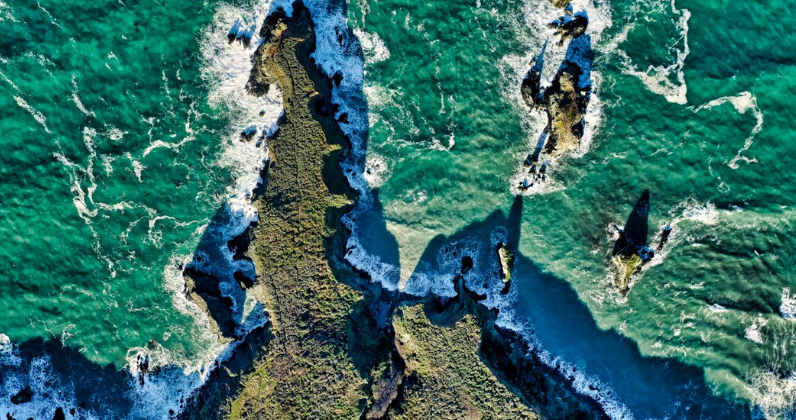
How Oceanography Is Adapting to the Age of Rapid Coastal Erosion

This crisis is especially acute for small island developing states. In these countries, coastal areas are more than just real estate; they support entire communities’ cultural geography, tourism, and fishing industries. The world’s coastal zones lost about one meter of permanent land annually, according to satellite data tracking shorelines from 1984 to 2015. That speed is probably quickening. Conventional solutions, such as concrete barriers, sea walls, and revetments, have occasionally made matters worse. Two seawalls constructed in Fiji to prevent flooding in villages ended up trapping inland drainage, resulting in previously unheard-of flooding issues. It’s the kind of unforeseen consequence that shows how inadequately some of these hard infrastructure solutions take the complexity of coastal systems into account.

Perhaps too slowly, oceanography is realizing that adaptation necessitates thinking in systems rather than structures. Dunes, mangroves, coral reefs, and coastal grasses are more than just picturesque features. They anchor sediment, buffer storm surges, and absorb wave energy in ways that a concrete wall just cannot match. Though they continue to encounter the well-known challenges of underfunding and political inertia, nature-based solutions are gaining popularity.

As this field develops, it seems like the science is outpacing the policy response. Forecasts are more accurate than before. The modeling is getting better. However, the window for taking preventative action is getting smaller as the cliffs near Bideford and Scalby are already moving—quietly, gradually, and relentlessly. For now, it’s genuinely unclear if that’s enough of a warning to change decisions made in the real world.

Oceanography Is Adapting
Share. Facebook Twitter Pinterest LinkedIn Telegram Reddit Email
Previous ArticleThe Startups Trying to Convince Us That Sustainable Deep-Sea Mining Isn’t an Oxymoron
Next Article The Pacific Decadal Oscillation Is Shifting – What It Means for Global Weather
Derrick Lester

    Derrick Lester is a professor and editor at indeep-project.org. His academic career has been molded by a single, enduring obsession: the sea and all life in it. Drawing from marine biology, oceanography, and the kind of hard-won field knowledge that only comes from spending significant time on and under the water, Derrick's writing has the depth of a scholar thanks to his years of research and teaching experience. His writing delves into the science of marine life with the inquisitiveness of someone who has never fully moved past the wonder of what exists beneath the surface. Derrick hopes to introduce readers to a world that encompasses over 70% of the planet and is, in many respects, still largely unexplored through his contributions to indeep-project.org.

    Related Posts

    The Pacific Decadal Oscillation Is Shifting – What It Means for Global Weather

    May 6, 2026

    The Race for Cobalt: Why Mining the Abyss Is More Lucrative Than Space Exploration

    April 28, 2026

    ISA Stakeholder Consultation Process: Why Twenty-Three Submissions Mattered More Than You Think

    April 28, 2026

    A 10,000-Foot Dive: The Undergrad Who Discovered a New Ecosystem From Her Dorm Room

    April 27, 2026
    Add A Comment
    Leave A Reply Cancel Reply

    You must be logged in to post a comment.

    Don't Miss

    The Pacific Decadal Oscillation Is Shifting – What It Means for Global Weather

    By Derrick LesterMay 6, 2026

    When a tool that the scientific community has relied on for decades stops functioning as…

    How Oceanography Is Adapting to the Age of Rapid Coastal Erosion

    May 6, 2026

    The Startups Trying to Convince Us That Sustainable Deep-Sea Mining Isn’t an Oxymoron

    May 6, 2026

    The Jellyfish Surge in the Bay of Bengal That Climate Scientists Are Linking to Deep Ocean Warming

    May 6, 2026

    Why We Need a Better Digital Twin of the Ocean to Prevent Future Tsunamis

    May 6, 2026

    The Shocking Finding From a Deep-Sea Expedition That Rewrote the Biology Textbooks Nobody Had Time to Update

    May 6, 2026

    Why Out of Sight, Out of Mind Is a Lethal Approach to Ocean Conservation

    May 6, 2026
    About Us
    About Us

    Indeep-project.org is dedicated to disseminating information that is supported by data, open about its sources, and truthful about the limits of human knowledge.
    Peer-reviewed studies, official scientific publications, and the knowledge of contributors with firsthand knowledge of ecology, environmental policy, and marine science are all sources of information used by our editorial team. Content that expresses opinion is clearly marked as such, whether it comes from our own contributors or from outside sources.
    Important Information Opinion pieces, commentary, and third-party viewpoints on subjects like science, technology, finance, politics, and public policy are among the content published on indeep-project.org. Only educational and informational purposes are served by this content. It does not constitute expert scientific, financial, legal, or medical advice; rather, it reflects the opinions of the original authors.
    We strongly advise readers to seek qualified professional advice appropriate to their particular circumstances before acting on political, financial, or scientific information published on this platform. Decisions based on third-party opinion content published here are not endorsed, recommended, or liable for by indeep-project.org.

    Our Picks

    The Jellyfish Surge in the Bay of Bengal That Climate Scientists Are Linking to Deep Ocean Warming

    May 6, 2026

    Why We Need a Better Digital Twin of the Ocean to Prevent Future Tsunamis

    May 6, 2026

    The Shocking Finding From a Deep-Sea Expedition That Rewrote the Biology Textbooks Nobody Had Time to Update

    May 6, 2026

    Why Out of Sight, Out of Mind Is a Lethal Approach to Ocean Conservation

    May 6, 2026

    The Golden Orb Mystery That Stumped Deep-Sea Researchers for Years Has Finally Been Solved

    May 5, 2026

    Scientists Are Discovering That Deep-Sea Ecosystems Are Far More Interconnected Than Any Model Predicted

    May 5, 2026
    • Home
    • Privacy Policy
    • Terms of Service
    • Disclaimer
    • About
    • Indeep
    • Marine Life
    • News
    © 2026 ThemeSphere. Designed by ThemeSphere.

    Type above and press Enter to search. Press Esc to cancel.