

Pulling a net out of the ocean and discovering that it is filled with translucent, pulsating masses of jellyfish rather than fish is incredibly unsettling. Since late January, trawler crews off the coast of Bangladesh have been managing dense blooms from deep-sea zones where fish were once abundant enough to justify burning the fuel.
There was not a single dramatic event that brought about the shift. As is often the case with climate consequences, it quietly crept in. Surface waters were warmer than normal between November and January due to little rainfall and no seasonal cooling from freshwater runoff. The salinity increased. Acidity increased. And somewhere in that mix of circumstances, jellyfish discovered an opening.
| Key Information | Details |
|---|---|
| Location | Bay of Bengal, South Asia |
| Affected Country | Bangladesh (primary), also India |
| Phenomenon | Mass jellyfish blooms displacing commercial fish stocks |
| Primary Cause | Climate change-driven ocean warming, prolonged dry spell |
| Ocean Depth Affected | Beyond 40 metres in deep-sea zones |
| Trigger Period | Late January–February 2025; intensified after minimal November–January rainfall |
| Key Species | Pelagia noctiluca, Noctiluca scintillans, Chrysaora caliparea |
| Economic Impact | Trawler operators unable to recover fuel costs; sharp catch decline |
| Scientific Alert | First documented co-occurrence of P. noctiluca and N. scintillans in the Bay |
| Industry Source | Rancon Sea Fishing (CEO: Tanvir Shahriar Rimon) |
| Research Reference | ScienceDirect — Siddique et al., 2025 |
| Broader Risk | Feedback loop: fewer fish → more jellyfish → even fewer fish |
The CEO of Rancon Sea Fishing, Tanvir Shahriar Rimon, put it simply: jellyfish prefer environments with higher temperatures and acidity. The fish simply depart once they have established their dominance in a given area. The trawlers that once followed those fish are left tracking emptiness as they migrate toward colder, more stable waters.
Many in the industry may have anticipated this in some form and hoped it would turn around. It hasn’t. The authorized deep-sea fishing zones in the Bay of Bengal are now much deeper than 40 meters due to the jellyfish surge, and the economic damage is already apparent. Owners of trawlers are finding it difficult to pay for fuel. Smaller operations are in serious trouble because they lack a buffer to absorb frequent low catches.
The science building beneath it is what elevates this moment beyond a bad fishing season. The simultaneous co-occurrence of Noctiluca scintillans, a bloom-forming dinoflagellate that upsets the typical zooplankton and phytoplankton food web, and Pelagia noctiluca, the mauve stinger, a toxic scyphozoan with an especially aggressive swarming instinct, was recorded by researchers as something unprecedented in the Bay of Bengal. It turns out that there is a somewhat disruptive partnership between the two species. By consuming zooplankton, the jellyfish lessens competition and makes it possible for N. scintillans to freely graze on phytoplankton. As a result, the food web layers that support everything else in the ocean collapse, a phenomenon known as trophic truncation.
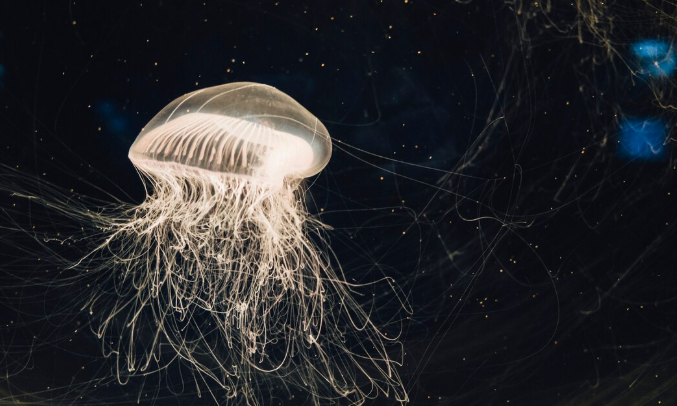
Anyone who is paying attention should be concerned about this feedback loop. Because there are fewer fish, there are fewer predators to control jellyfish populations. There will be more competition for ichthyoplankton and young fish if there are more jellyfish. Future populations will be smaller if there are fewer juvenile fish. With every season that passes with high temperatures, the cycle reinforces itself and the ocean tilts further out of balance.
When you observe this from a distance, you are struck by how out of proportion the crisis’s visibility is to its true scope. Bangladeshi coastal fishing communities are bearing the consequences of their actions.
Global emissions are the cause of deep-sea warming, which manifests itself in very local, very human terms, such as the weight of an empty net or the comparison of fuel prices to almost zero catches. As they flourish and proliferate, jellyfish are essentially marking the territory that warming has given them. The fish are aware of it. The fishermen are aware of it. Whether the response catches up before the harm becomes irreversible is the current question.
