

As she usually does on weekdays, Marianne Nelson left her Rawlins home at 5:15 a.m. It typically takes her ten minutes to get to the Wyoming State Penitentiary. By eleven, she was still in her car, with a quarter tank of gas remaining, three semitrucks obstructing her view, and snow falling so heavily that she was unable to see past the windshield. That’s the problem with a May blizzard in Wyoming. Unlike a January storm, it doesn’t make an announcement. People anticipate that winter will be over by now, which contributes to the danger of a storm like this.
By late Monday morning, the Wyoming Department of Transportation had blocked over 200 miles of Interstate 80 from Rock Springs east to Cheyenne in the southern half of the state. You can’t just take a detour around that stretch. There were no viable options for anyone traveling eastward toward Nebraska or westward toward Salt Lake. They had two options: they could wait or take a detour, which they would probably regret. The majority waited while sitting.
The series of minor setbacks that accumulated alongside the snow may have been the most remarkable aspect of this storm rather than the snow itself. A power transmission line in Carbon County collapsed at around two in the morning due to wind and wet snow. Wamsutter, Sinclair, and Rawlins were without power. This indicated that the fuel pumps that WYDOT employees depend on to replenish their plows were malfunctioning. As a result, on a morning when every hour counted, the plows that were meant to clear the interstate had to travel to Sinclair to fill up.
Jordan Young, WYDOT Deputy Public Affairs Officer, put it simply: the equipment designed to combat the snow became stranded due to the rapid snowfall and power outage. That sequence, which occurred in real time, has a circular cruelty to it. Crews had to deal with four-foot drifts by midday. Don Day, the meteorologist for the Cowboy State Daily who usually makes accurate predictions, reported 30 inches in the Snowy Range and about 10 inches along sections of the interstate.
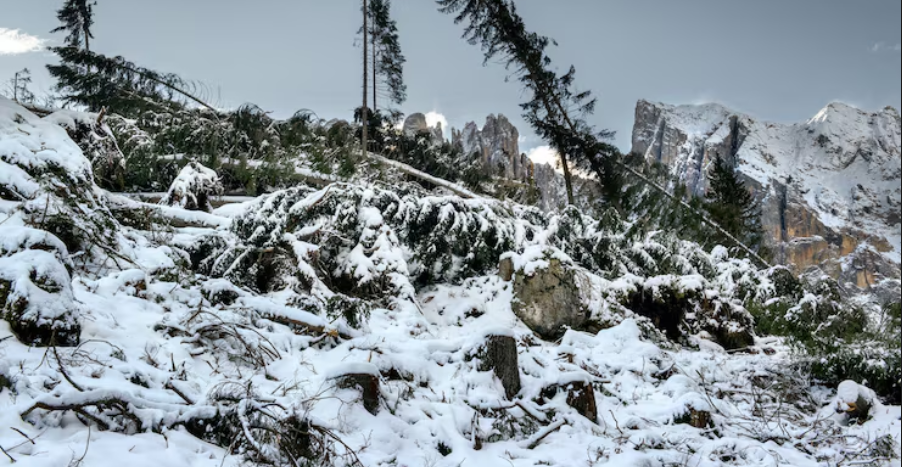
Due to whiteout conditions close to Arlington, the National Weather Service office in Cheyenne changed its Winter Storm Warning to a Blizzard Warning on Monday morning. The fact that it was the first warning of this kind to be issued in Wyoming in over two years speaks volumes about how uncommon the conditions that satisfy the requirements—sustained winds exceeding 35 mph and visibility of less than a quarter mile for at least three consecutive hours—are. The bulletin’s wording was uncommon: travel is only permitted in an emergency and you should stay in your car if you get stuck. They write it that way for a reason. While attempting to walk for assistance, people perish in their cars.
Of course, there were crashes. The Wyoming Highway Patrol was still gathering information, but a semitruck may have struck a WYDOT snowplow close to the Wagonhound Rest Area between Arlington and Elk Mountain. A patrol car was being loaded onto a flatbed, according to witnesses. Alex Bakken, the sheriff of Carbon County, wrote on Facebook about “prolonged power outages and limited transport capability” throughout his jurisdiction. This is the kind of cautious, subdued language a sheriff uses when things are actually pretty bad.
From the outside, it seems like Wyoming handled this as well as anyone could. Even seasoned drivers can be caught off guard by late-season storms, and residents of the Cooper Cove to Quealy Dome stretch of I-80 are aware that high-profile vehicles are frequently caught broadside by the wind. Locals are aware. Sometimes, out-of-state truck drivers have to learn the hard way.
The Rawlins-to-Laramie segment is expected to reopen between 6 and 8 a.m. on Tuesday, while the Rawlins-to-Rock Springs section is scheduled to open earlier, according to WYDOT. Whether the wind slows down enough for crews to stay ahead of the drifting will determine whether those timelines are maintained. The number of cars that spent the night on the shoulder and the number of people who had Marianne Nelson’s morning—a ten-minute commute that turned into a six-hour ordeal with no end in sight—are still unknown. The storm is now in its last hours. The cleanup is just getting started.
