

A space agency lowering itself into the ocean has a subtly ridiculous quality. For the past few years, NASA—the organization most people associate with rockets and red planets—has been developing robots that descend rather than ascend. Martian dust or lunar regolith are not the destination. Pressure can crush a steel sphere like a soda can in the hadal zone, the area of the ocean named after the Greek underworld.
You begin to see why this makes sense when you stand on the deck of a research ship such as the Nautilus. From above, the ocean does not appear strange. However, it acts like a different planet six kilometers below the surface. Dark, cold, and chemically peculiar. In the same way that astronomers discuss exoplanets, scientists working on NASA’s underwater analog program, SUBSEA, discuss hydrothermal vents with a combination of quiet hunger and patience.
The reasoning is not as complicated as it seems. We believe that beneath their icy shells, Enceladus and Europa conceal oceans. We believe that water on the Lō’ihi seamount off Hawaii or along Gorda Ridge near the Oregon coast may be doing the same chemistry when it comes into contact with warm rock. If life can survive close to a seafloor vent on Earth, it most likely can elsewhere. Most likely. In this field, that word is very useful.
The focal point of the current endeavor is Orpheus, a small autonomous vehicle developed at Pasadena’s Jet Propulsion Laboratory that shares visual navigation techniques with the Perseverance rover currently exploring Mars. It creates three-dimensional maps by identifying rocks, shells, and other tiny seafloor features. It is a gateway vehicle, according to Tim Shank, head of WHOI’s hadal program. “There is no place in the ocean you cannot go if it works,” he said. After a colleague’s former robot, Nereus, was lost to implosion in 2014, somewhere close to the Kermadec Trench, it is difficult to ignore how casually scientists say things like that. Errors in design are not forgiven by the ocean.
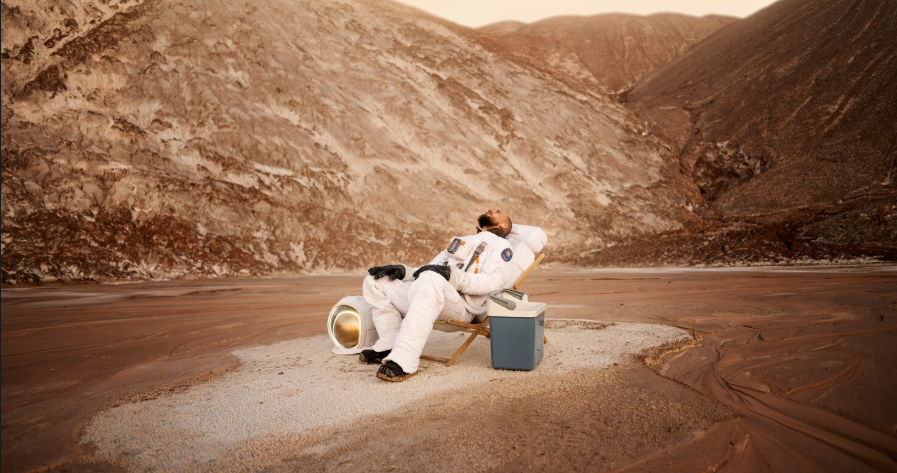
NASA exists for a second reason, which is more utilitarian than romantic. In the future, deep space missions might have astronauts in orbit around a moon while robots crawl across its surface below, responding to commands from scientists on Earth and the crew above. They refer to it as “low-latency teleoperations,” which is an awkward term for a lovely concept. Running a rover on the Moon while astronauts in orbit relay decisions is not all that different from operating a remotely operated vehicle from a ship while a science team in some windowless room in the Midwest weighs in on every sample. In this way, the sea becomes a stage for rehearsal.
As this develops, it seems as though NASA has quietly abandoned the previous divisions between space science and earth science. Leaving the planet was the foundation of the agency’s reputation. It now spends actual money to stay on it—just more deeply. Budget reality accounts for a portion of that. However, the majority of it appears to be sincere intellectual humility, an acknowledgment that the answers to some of the more important questions, such as whether we are alone, may be waiting in the area of our own world that we haven’t yet bothered to examine. It remains to be seen if the abyss truly provides those answers. However, Orpheus’s lights are already on, and the rehearsal has begun.
