

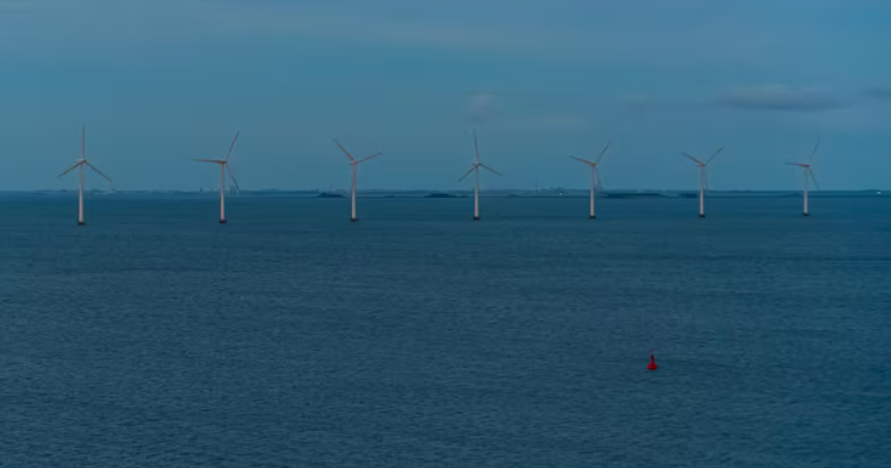
You wouldn’t notice them right away if you were standing at the edge of Port-La Nouvelle on a bright May morning, gazing south toward the Mediterranean. They are sixteen kilometers away, beyond the gentle haze of the horizon. However, somewhere out there, three enormous turbines are spinning on platforms that are not in contact with the seafloor; they are suspended, anchored, and producing electricity from winds that travel freely over one of Europe’s most difficult expanses of open water. The world’s first fully operational floating offshore wind farm in truly deep Mediterranean waters was just completed by France, quietly and without much fanfare, fulfilling a long-awaited dream of many in the energy industry.
The project, known as Éoliennes Flottantes du Golfe du Lion, or EFGL, began supplying electricity to the French national grid on May 4, 2026. The development was managed by Ocean Winds, an offshore wind company that emerged from a collaboration between EDP Renewables and ENGIE. The numbers behind it—30 megawatts, three turbines, and a 20-year operational lifespan—are modest by today’s standards, but the significance goes beyond what the capacity figures indicate. This wasn’t a prototype for a proof-of-concept that was fastened to a shallow shelf. The turbines are located in water that is about 100 meters deep, which is too deep for traditional fixed-bottom structures both technically and financially. For those who have spent the last ten years arguing that floating wind could truly function on a commercial scale, that distinction is crucial.
It’s difficult to ignore how purposefully local this entire operation seems. Roughly 60% of the direct suppliers recruited for EFGL were small and medium-sized businesses, and about 85% of them were French companies or businesses operating in France. Cranes, machinery, and workers coordinating across the dock made the port itself a hive of visible industrial activity during last summer’s assembly campaign at Port-La Nouvelle. This kind of scene rarely makes international headlines but is significant for a regional economy. In a seaside town that has seen energy discussions take place elsewhere for far too long, more than 20 full-time employees now support daily operations and maintenance, securing long-term employment.
It is anticipated that the project will produce about 110,000 MWh of clean energy annually, which would be sufficient to power about 50,000 households for twenty years. Even before the turbines turned on, some analysts thought those forecasts were optimistic. Conversations in both policy offices and boardrooms tend to change when early production results meet or surpass expectations. Industry observers are beginning to believe that floating wind has surpassed a threshold it was previously unable to claim, though it’s still too early to say for sure.
Additionally, EFGL is the first nature-inclusive floating wind farm in the world, a distinction that seems almost too poetic to be a technical detail. In order to improve underwater biodiversity rather than just tolerate it, artificial marine habitats, branded as Biohut® and created by a local SME named Ecocean, were placed at sea next to the turbines. It is still uncommon enough to cause concern that an energy installation could actively enhance the surrounding ecosystem instead of merely minimizing harm. Regulators’ and developers’ reactions over the coming years will likely determine whether it becomes commonplace or stays a niche innovation.
EFGL appears to be the first step in a much longer game rather than a stand-alone experiment due to France’s larger offshore wind ambitions. Given the topography of the French coastline, the nation’s goals of 18 gigawatts of offshore wind capacity by 2035 and 40 GW by 2050 necessitate a working deep-water floating sector. EFGL directly leads to EFLO, a 250 MW floating project that Ocean Winds and Banque des Territoires were already given in late 2024. There is a significant difference between 30 MW and 250 MW. However, when someone inquires as to whether floating wind can truly be delivered, there is something tangible and functional to cite for the first time. Despite its depth and unique environmental complexity, the Mediterranean did not prevent it. It will be challenging to refute that point at this point.
