

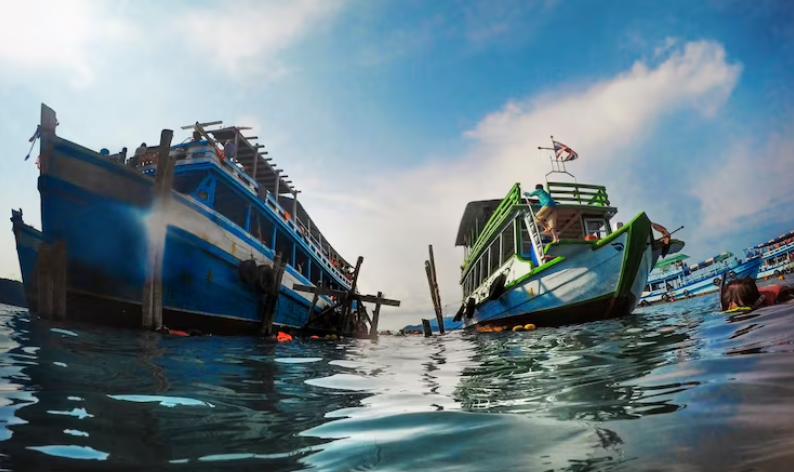
Stand at the old port in Mombasa on a clear morning and you can watch the dhows come in — wooden, hand-painted, some of them older than their captains. They return with modest catches, the kind that feed families and fill local markets but don’t register on global trade charts. A few kilometres offshore, in deeper, richer water, foreign-flagged vessels are doing something entirely different. They’re hauling tuna by the tonne, working an ocean that, technically, belongs to Kenya.
That image — the weathered dhow and the industrial trawler — captures the entire problem with Kenya’s fishing economy. The country controls one of the Indian Ocean’s most productive maritime zones, sits along the world’s second-ranked tuna migratory belt, and yet captures only a sliver of the wealth moving through its own waters. Spanish, French, South Korean, and Chinese fleets operate here under access agreements that generate, by most accounts, embarrassingly limited revenue for the Kenyan government. The fish get landed in Seychelles or Mauritius. The money flows elsewhere. Mombasa watches.
President Ruto’s 2025 announcement of KES 1.2 billion earmarked for deep-sea fishing vessels felt, to many in the industry, like someone had finally said what needed saying. The plan — acquiring between 15 and 20 industrial vessels to build Kenya’s own offshore capacity — is the most serious government commitment to maritime fisheries in recent memory. Whether it becomes a turning point or another underfunded ambition is the question everyone’s trying to answer.
The numbers behind the push are striking, even unsettling. Kenya’s blue economy currently contributes roughly KES 30 to 40 billion annually, against an estimated potential of KES 500 billion. The fishing sector employs over 60,000 people directly and sustains roughly 1.2 million more across processing, transport, and trade — yet it accounts for barely 0.5 percent of national GDP. Meanwhile, illegal and unregulated fishing drains an estimated KES 45 billion from the economy every year, with foreign trawlers accused of not just poaching fish but actively damaging reef systems that artisanal communities depend on. The math doesn’t add up in Kenya’s favour. Not even close.
It’s worth being honest about what’s driving fishers further out to sea in the first place. In Homa Bay County on Lake Victoria, fish production dropped from 80,150 metric tonnes in 2013 to just over 50,000 by 2022. Along the coast, near-shore catches have shrunk steadily, pushing small-scale fishers to spend more money on fuel, better gear, and longer trips just to maintain income that used to come easily. There’s a hard irony in that — the degradation of inshore waters is doing what no government policy has managed: pushing Kenyan fishers offshore. The question is whether they’ll be equipped to survive there, or simply find a bigger version of the same problem.
Marine scientists have been cautious about the deep-sea push for reasons that deserve attention. Deepwater fish species tend to grow slowly and reproduce late, making them far more vulnerable to rapid commercial exploitation than coastal species. Without strong catch limits, designated zones, and serious enforcement capacity, it’s possible that Kenya could transfer the overexploitation crisis from shallow water to deep water within a generation. That’s not a reason to abandon the ambition — it’s a reason to build the regulatory framework before the vessels are in the water, not after.
The Mombasa deep-sea fishing investment push, as it’s being framed by the government, isn’t just about fish. It’s about who controls the economic value of an ocean that belongs to Kenya. Aquaculture is growing — milkfish, tilapia, seaweed farming in Kwale and Kilifi counties — and climate finance from blue carbon ecosystems adds a newer dimension to coastal conservation. Regional coordination on surveillance is improving, with AU-IBAR and IGAD working on joint monitoring frameworks from Mombasa outward. The infrastructure still lags badly: Kenya lacks a modern fishing port capable of servicing industrial vessels, which is part of why foreign fleets use other countries’ facilities.
There’s a sense, walking through the fishing communities in Mombasa, that people here have been patient for a long time. Patient with promises, patient with foreign fleets, patient with statistics that describe enormous potential while daily life stays difficult. The KES 1.2 billion is real money, and the intention appears genuine. But the Indian Ocean doesn’t reward intention. It rewards capacity, enforcement, and investment that actually reaches the people on the water — not just the vessels above them.
