

Something remarkable is spinning off the coast of Yangjiang, about 70 kilometers out into the South China Sea. Most buildings you’ve ever stood next to are not as tall as this one. A circle larger than two football fields arranged end to end is swept by its blades. Additionally, it simply floats on water that is so deep that no one is bothering to try to bolt anything to the bottom.
On May 2, China Three Gorges Corporation finished installing the Three Gorges Pilot. The numbers associated with this machine are the kind that require some time to process. 16 megawatts of power. a 252-meter rotor diameter. blade tips that are higher than 270 meters above the water’s surface. According to the company, the turbine is anticipated to produce about 44.65 million kilowatt-hours per year, which is sufficient to meet the annual electricity needs of about 24,000 households.
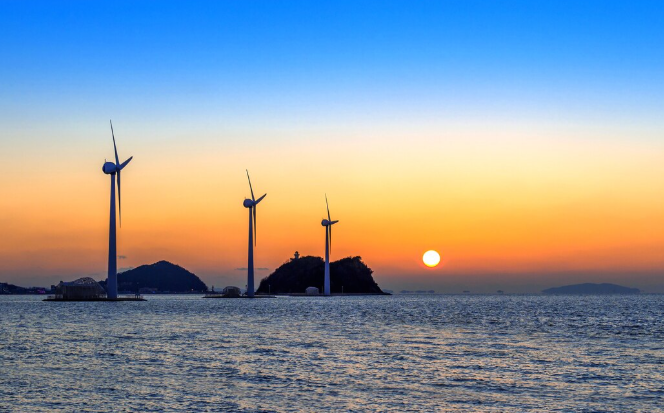
That final figure is difficult to ignore. Just one turbine. just one platform. Tens of thousands of houses.
Even by the accelerating standards of offshore wind, this device’s engineering is truly unique. Conventional offshore turbines are restricted to shallower coastal waters because they are fixed, driven into the seabed with massive steel foundations. High-strength polyester lines, heavy chains, and suction anchors are used to secure Three Gorges Pilot, which is situated atop a semi-submersible platform. The entire assembly is built to withstand winds of up to 264 km/h and waves larger than 20 meters, which is Category 5 hurricane territory. The structural ambition here is clear, but it remains to be seen if it performs exactly as promised under years of actual ocean conditions.
It’s not just the size that gives this moment its significance. It’s the place. The wind industry has always steered clear of deep water in the ocean. Yes, the winds are stronger and more reliable, but for a long time it seemed economically impossible to anchor anything permanently. The fact that a 16 megawatt machine can now function under those circumstances indicates that computation is changing, possibly more quickly than most people anticipated.
China has been making steady progress in this area. China Huaneng Group and Dongfang Electric installed a floating turbine last year, which at the time was regarded as a significant accomplishment. The Three Gorges Pilot expands capacity and scale by making structural and systemic improvements to that design. A trend is emerging here: every project that follows isn’t just marginally bigger; rather, it tests something that the one before it couldn’t.
It is hard to overlook the difference with other major economies. China is physically installing machines in deep water and learning from them in real time, while other nations are still debating permitting frameworks or witnessing projects stall due to grid connection costs. This operational experience tends to compound: the technology advances more quickly than any policy document can predict, costs gradually decline, and engineering lessons from one deployment inform the next.
This is part of a larger story about the true direction of offshore wind. Shipping lanes, the fishing industry, and communities with justifiable concerns about noise and sight lines are all fighting for control of the shallow coastal zones close to populated areas. A completely different map of feasible ocean territory is revealed by deep-water floating platforms. Even though the economics still need to be proven on a larger scale, the implications for energy planning over the next 20 years are significant.
As I watch this happen, I get the impression that deep-water wind energy has subtly crossed a threshold that most people were unaware of. In the conventional sense, Three Gorges Pilot is neither a concept nor a prototype. This 16-megawatt device is currently producing electricity in the open ocean. That is something to take seriously.
