

Some people check the radar first thing in the morning before checking their messages. Many of them ended up following the same account in Illinois.
The Paxton-based Illinois Storm Chasers, LLC. has discreetly created something that lacks a clean category. It’s not a government organization. It’s not a weather desk on television. However, it serves as one of the more dependable weather resources in the state thanks to its nearly 450,000 Facebook followers and real-time warning updates that are sent out faster than most people can refresh their news apps. It’s important to pay attention to that.
When storm season arrives, the Illinois flatlands can be surprisingly harsh. There are no natural obstacles to impede a supercell traveling northeast across open farmland, nor are there mountains to disrupt a system. Within an hour, a severe thunderstorm warning in southern Illinois can turn into a tornado watch in central Illinois. The locals are aware of this. Over time, they have also learned to seek out information prior to the sirens rather than after.
The Illinois Storm Chasers appear to have filled that void. The majority of casual weather consumers can actually read the real-time National Weather Service alerts that are broken down by county in their social feeds on Facebook, X, and YouTube. There is a controlled urgency to watching the feed on a day with active weather. Time-stamped warnings are released, followed by radar images and increased coverage. The lack of drama in the presentation is likely one of the reasons why people find it credible.
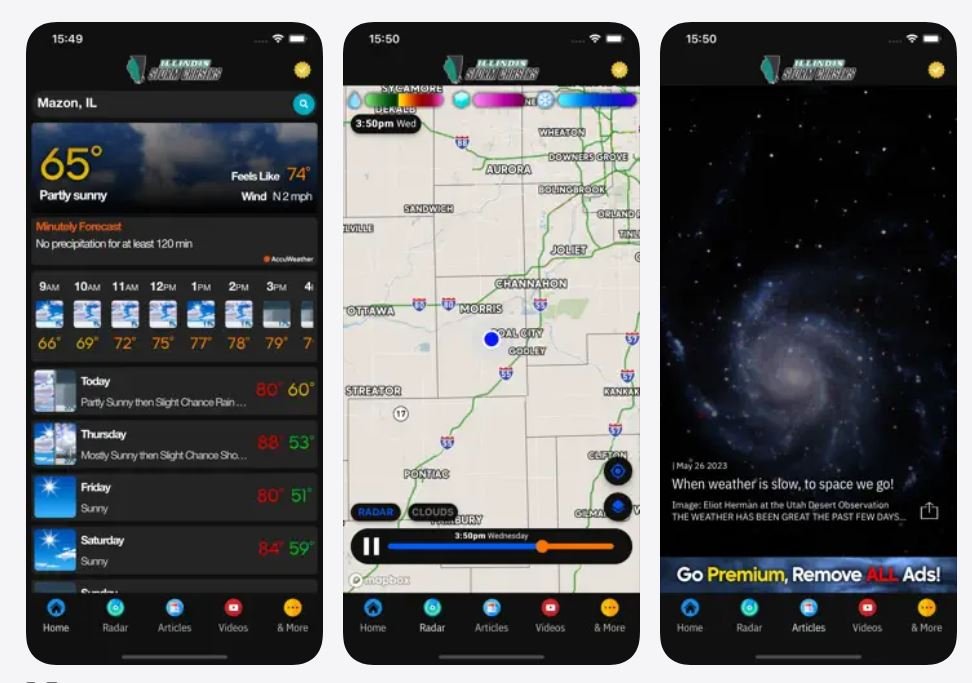
This is further expanded by the mobile app. There is a lot of functionality for something free on the App Store and Google Play, including live conditions from local weather stations, minute-by-minute precipitation forecasting, and NEXRAD radar with update speeds that are actually quick by consumer app standards. Push notifications are sent out when new alerts are issued, and the app pulls in forecast discussions and maps for everything from severe summer storms to winter weather events. For anyone who lives in a county that has experienced multiple tornado warnings, this is the kind of tool that makes sense.
Additionally, Illinois Storm Chasers engages in outreach, which isn’t always evident from the outside. In a state where comprehending severe weather is truly useful knowledge, they have scheduled weather education programs for school years, bringing storm science into classrooms. Compared to a hobbyist feed, this dimension gives the operation a distinct personality. It implies something more intentional—a team that considers the purpose of the information rather than just how to disseminate it.
It remains to be seen if volunteer weather networks such as this one will eventually be more formally integrated with emergency management systems. There’s a valid argument for it. It takes years to develop local knowledge, trust, and quick distribution, all of which are difficult to replicate from the top down. The goal of Illinois Storm Chasers was not to become a vital piece of infrastructure for the state’s weather-conscious citizens. However, from this vantage point, that is essentially how it appears.
