

There is a particular phrase that John Abraham, a professor of thermal sciences at the University of St. Thomas, used when describing what happened to the world’s oceans in 2024. He called it “bonkers.” Then he clarified, almost apologetically, that “bonkers” was the peer-reviewed scientific term. He was joking. But only just.
In 2024, the global ocean set a new heat record for the ninth consecutive year. Not the surface alone — the warming reached 2,000 meters below the waterline. The ocean heat content in the upper 2,000 meters rose by roughly 16 zettajoules compared to 2023. A zettajoule is a number so large it barely fits into a sentence comfortably. Abraham’s team put it another way: the heat absorbed by the oceans last year was the equivalent of twelve Hiroshima-sized atomic bombs detonating every single second, around the clock, for all 365 days.
That number is meant to be uncomfortable. It is. The ocean covers 70 percent of the planet’s surface and runs deep. Because of its sheer mass, it warms slowly — which is precisely why scientists trust it as one of the most reliable indicators of long-term climate change. The ocean doesn’t lie, doesn’t spike with seasonal noise the way the atmosphere can. When it tells you it’s getting hotter, year after year, without interruption, there is not much room left for ambiguity.
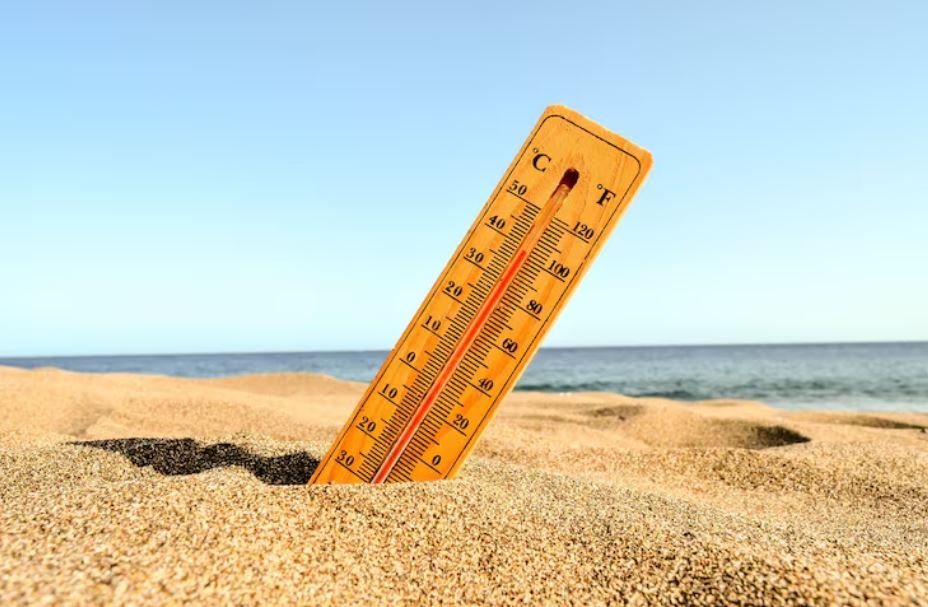
Every decade since 1984, when satellite-based ocean temperature records began in earnest, has been warmer than the one before. But what happened in 2023 and 2024 surprised even the researchers tracking it most closely. Global sea surface temperatures in those two years ran consistently about 0.2 degrees Celsius higher than during the comparable El Niño event of 2015-2016 — at all times, across all seasons. That gap is hard to explain away.
El Niño is part of the story, naturally. The warm-water cycle that begins in the western equatorial Pacific and eventually pushes eastward does raise global temperatures. The latest El Niño started in 2023 and drove heat through the first half of 2024. But sea surface temperatures were shattering records in regions far from El Niño’s influence — the tropical Atlantic, the Indian Ocean, the Mediterranean, the North Pacific, the Southern Ocean. The pattern was too widespread to pin on a single climate cycle.
One theory gaining traction involves aerosols. Certain airborne particles, particularly sulfur emissions from shipping and power plants, have historically acted as a mild brake on warming by reflecting sunlight back into space. In 2020, the shipping industry slashed sulfur emissions by nearly 80 percent. Chinese power plants have also cut back. The result, scientists suspect, is that a partial cooling effect has quietly faded — and the ocean is now absorbing more solar energy than before. It’s still unclear how much of the recent warming this accounts for, and researchers are careful not to overstate it.
What the ocean’s temperature does downstream is well understood. Warmer water evaporates faster, loading the atmosphere with more moisture. Storms intensify more rapidly. Hurricanes and typhoons that once might have stayed moderate can now reach catastrophic intensity in a matter of hours. In 2024, coral reefs experienced their most extensive bleaching event on record, with damage reported across multiple ocean basins simultaneously. Coastal communities from the Gulf of Mexico to the Philippines are increasingly living with the consequences of a heat reservoir that is, in scientific terms, completely unprecedented.
It’s worth sitting with that phrase for a moment. Unprecedented doesn’t mean slightly unusual. It means no measurement ever taken by human instruments, at any point in modern history, has recorded what we are now seeing. The ocean has not been this warm in living memory, or in the memory of anyone who built the tools we use to measure it.
The World Meteorological Organization confirmed that 2024 was also the warmest year on record for the planet overall — approximately 1.55 degrees Celsius above pre-industrial levels. That marks the first full calendar year to cross the 1.5-degree threshold that the Paris Agreement described as a level to avoid. Scientists are careful to note that one year above that marker doesn’t mean the long-term goal is finished. But it is not a comfortable data point. Nine consecutive records. That is not noise. That is a signal.
