

A Dumbo octopus floats by the camera of a remotely operated vehicle at about 3,000 meters below the Pacific Ocean’s surface, where the water pressure is around 300 times higher than it is at sea level and no sunlight has reached in geological timeframes. The video, which was taken by MBARI researchers off the coast of California, depicts an animal that swims quietly and efficiently. Its body is semi-translucent against the black water, and its two ear-like fins undulate in a rhythmic pattern. The skin appears to change under the lights of the submersible. Something shifts when it comes into contact with light. Then it doesn’t. Then it does it once again.
Marine researchers have been wondering for years what exactly is happening in that video. It’s not an easy question, and the truth is that there hasn’t been much firsthand observation of Dumbo octopuses by scientists. Because these animals live so deep and in such challenging environments, nearly all of the information we know about their biology comes from short ROV encounters, sporadic specimens that are unintentionally collected in research trawls, and a few well-researched video clips that are frequently revisited because fresh footage is so uncommon.
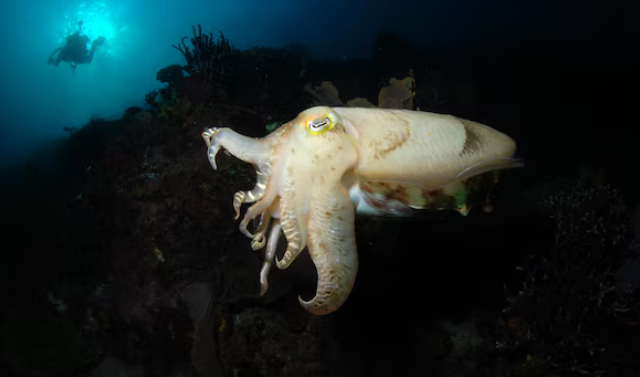
The subject of color shift closely relates to our understanding of cephalopod communication in general. Shallow-water octopuses communicate by extraordinarily complex changes in skin color and texture. These octopuses are the ones people see at aquariums and the ones researchers study by keeping them in tanks and watching them for weeks. They have chromatophores, which are specialized pigment-containing cells that contract and expand in response to muscle contractions. These quick pattern changes have been connected by researchers to hunting, threat presentation, and what appears to be social signaling. The common octopus, Octopus vulgaris, has the ability to instantly alter its complete visible body pattern. For an animal lacking a vertebrate-like brain, the visual sophistication is quite remarkable.
Chromatophores are not functioning in dumbo octopuses. That is a verified structural difference, not a research gap. Because the tissue is primarily transparent and gelatinous, it reflects and scatters the submersible’s beam under artificial light in ways that can appear as active color change on camera. Instead of intentional messaging, what researchers are seeing in the video is probably a passive optical impact of light on semi-transparent tissue. Unlike its kin in shallow water, the animal is not communicating. Maybe it’s just light refracting.
However, even though that response is most likely accurate, the question is not entirely resolved. Because the bigger mystery is how Dumbo octopuses manage to do any coordinated action in total darkness. In any case, chromatophore-based communication would not be able to overcome the difficulty of finding a mate at 4,000 meters in dark, acoustically challenging water. The sensory or signaling methods that Dumbo octopuses employ, whether chemical, tactile, fin movement, low-frequency vibration detection, or something that researchers haven’t yet identified, are virtually completely unknown. The most obvious possibility for a communicative display is the fins. Although there isn’t much evidence to support this theory, it’s plausible that fin movement conveys information beyond simple locomotion.
The degree to which access, rather than biological intricacy, determines the current state of Dumbo octopus research is quite fascinating. These creatures might just be more difficult to study than other deep-sea cephalopods. All of the film that is now available is from a small handful of ROV deployments that just so happened to come across one, and the majority of those encounters occur just minutes before the animal moves out of range or the submersible is required elsewhere. Single specimens or single video clips are used to represent the species known from the deepest records. It is a legitimate scientific inquiry to find out what and how Dumbo octopuses communicate. The fact that it requires a lot more hours of footage than what is currently available is the real limitation.
