

More people have set foot on the moon than have descended to the ocean floor. That fact has been stated so often that it is on the verge of becoming background noise, but if you take a moment to consider what is actually happening in subsea robotics at the moment, it becomes truly bizarre. No human eye has ever seen entire cave systems beneath the ocean’s surface. not only partially investigated. Not roughly mapped. Just unidentified.
This is beginning to change, and the machines that are making the changes sometimes resemble fish remarkably.
The engineering technique known as “biomimicry,” which involves taking design principles from nature, has subtly transitioned from scholarly interest to practical use in underwater robotics. The most advanced autonomous underwater vehicles currently under development are about five feet long, weigh about a hundred pounds, and move through the water like that of marine animals, with flexible body dynamics, undulating motion, and an innate sensitivity to their surroundings.
Perhaps this is the most candid admission robotics has ever made: that, after several hundred million years of iteration, evolution got some things right that engineers are only now catching up to.
There are more reasons to use biomimicry in subsea navigation than just aesthetics. Conditions in underwater cave systems penalize traditional propeller-driven vehicles. Environments like narrow passageways, erratic currents, and brittle sediment floors that cloud the water the moment anything disturbs them seem almost made to break conventional equipment. Using lateral body movement instead of thrusters, a fish-like robot can navigate through confined spaces without kicking up silt or creating the kind of turbulence that blinds its own sensors. It has a practical elegance that is difficult to dispute.
For more than ten years, Kraken Robotics, a Canadian company named after the legendary marine creature Jules Verne once made famous, has led the charge in the larger autonomous subsea movement. Their towed synthetic aperture sonar system, KATFISH, has shown the kind of imaging resolution that makes older sonar technology seem archaic: three centimeters by three centimeters, covering two hundred meters on each side, and streamed in real time to onshore operators.
The company conducted a live demonstration of launching and recovering KATFISH from an unmanned surface vessel, completely without human handling at sea, off the coast of Istanbul in early 2026. Attendees included naval observers from several nations. Anyone watching could see the implications for both scientific research and defense.
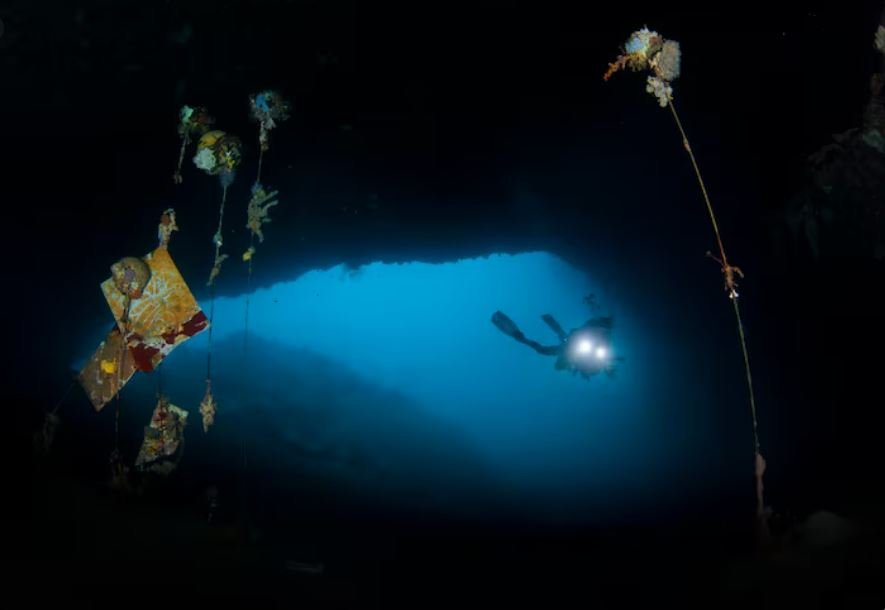
The cave navigation problem is particularly intriguing because it forces engineers to face the limitations of GPS. Water does not allow signals to pass through. When a robot enters a submerged cave system, it is navigating blindly in the traditional sense, using onboard sensors, acoustic positioning, simultaneous localization and mapping algorithms, and, in certain designs, the same type of flow-sensing that fish use through their lateral lines. In order to map geometry and water chemistry in environments that have essentially been sealed since the last ice age, AI-guided systems have already ventured into cave passageways that human divers could not safely enter.
How soon this technology will transition from infrastructure and defense applications to pure scientific investigation is still unknown. Mine detection, pipeline inspection, offshore energy surveys, and other military and commercial contracts are typically followed by the investment, and cave mapping work frequently takes place on the periphery of those larger initiatives.
However, the information being gathered is truly amazing. Certain cars have chemical sensors that can detect thermal gradients, mineral compositions, and biological signatures that suggest completely uncharted ecosystems lurking in the shadows.
Seeing this field grow gives me the impression that the ocean is being discovered twice. The researchers of that generation once ventured out in ships and dropped equipment over the side. And now, once more, by machines that think in algorithms and swim like animals, sneaking into areas that weren’t intended for anything that wasn’t born there.
